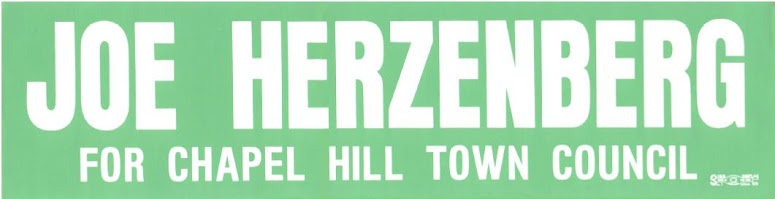
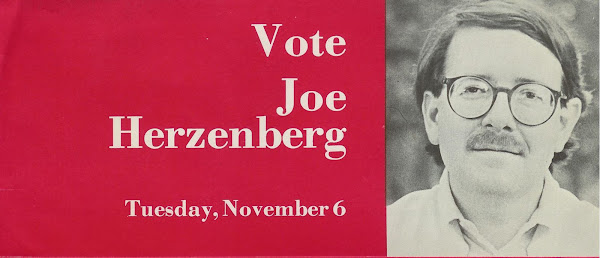
Campaign flyer from Joe’s first Chapel Hill Town Council race, 1979

About Joe

My photo
Chapel Hill, N.C., United States
Joe Herzenberg was born June 25, 1941, to Morris & Marjorie Herzenberg. His father owned the town pharmacy in Franklin, N.J., where Joe grew up. After he graduated from Yale University in 1964, Joe went to Mississippi to register voters for Freedom Summer. He joined the faculty of historically black Tougaloo College, where he was appointed chair of the history department. Joe arrived in Chapel Hill in 1969 to enroll as a graduate student in history at the University of North Carolina, and, along with his partner Lightning Brown, soon immersed himself in local, state, and national politics. Although Joe’s first campaign for the Chapel Hill Town Council in 1979 was unsuccessful, he was appointed to the Council to fill a vacant seat and served until 1981. In 1987, he was elected to the Council, becoming the former Confederacy's first openly gay elected official. Joe died surrounded by friends on October 28, 2007. He was 66 years old.

Tuesday, August 20, 1991

Note from Joe - Welcome back (and welcome to East Franklin precinct)


When I moved off campus into the Pink House on North Street in the summer of '91, just around the corner from Cobb Terrace, I became Joe's neighbor and a new resident of East Franklin precinct.


Joe served as precinct chair of East Franklin for 35 years, from 1972 until his death. Always excited to have another Democrat on the rolls, he took the liberty of filling out a change-of-address form to welcome me aboard.

Every year on Election Day, rain or shine, you could count on seeing Joe outside the East Franklin polling place at the Lutheran Church on East Rosemary Street. Standing just outside the line beyond which no campaigning was allowed, Joe would greet and talk with the voters who showed up, nearly all of whom knew him. It goes without saying that if anyone needed advice about which candidates were especially good that year, Joe was more than happy to help out.


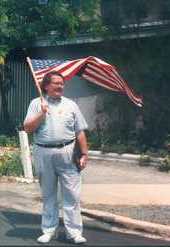
Joe on North Street in Chapel Hill, 1991

Friday, June 28, 1991

One act of violence using a gun is too many

Guns, shootings increase on Chapel Hill streets

The News & Observer, June 28, 1991

CHAPEL HILL -- Guns are appearing more frequently in Chapel Hill, and gun-related crime is skyrocketing, police say.

"We've been concerned about it all along but when the public hears about it they raise an eyebrow," Capt. Ralph V. Pendergraph said. "It's sort of a national trend." Police point to recent shootings in the downtown area and to an increase in fatal shootings during the past two years. They also say the number
armed robberies has risen sharply in Chapel Hill and Carrboro in the last year.

...

Early last year, the escalation in violence prompted Town Council member Joseph A. Herzenberg to call for a restriction on gun sales. But a report issued by town Attorney Ralph D. Karpinos concluded the town did not have the authority to pass such an ordinance.

Mr. Herzenberg said Thursday he would like to see the issue of gun control rekindled in light of the recent incidents.

"Every time there's an act of violence involving a gun I think of it," he said. "One act of violence using a gun is too many. Frankly, I don't think it's an issue Chapel Hill is divided on."

He said it was important to do what is necessary to preserve downtown Chapel Hill as a safe place.

"There's no doubt in my mind that Chapel Hill is the only town in North Carolina that has a Main Street as dynamic as we do," he said. "We really have a jewel and we need to polish it."

Wednesday, June 5, 1991

Mayor's race apt to be crowded

The News & Observer, June 5, 1991

By RACHEL BUCHANAN, Staff writer

CHAPEL HILL -- The decision by Mayor Jonathan B. Howes not to seek re-election has opened political floodgates in Chapel Hill, creating speculation and encouraging a pack of would-be candidates.

Traditionally, campaign posters don't start popping up on Chapel Hill lawns until the leaves change color. But Mr. Howes' announcement last month has prompted an early opening in the political season.

...

Two board members likely to consider a bid for the job are Nancy Preston, mayor pro-tem, and Joseph A. Herzenberg, the only openly gay elected official in the state. Ms. Preston was unavailable for comment. Mr. Herzenberg said he had not decided whether to run.

"I've had discussions with my campaign-planning staff and we haven't made any decision yet," he said. "We may not announce it to the world before September. Long campaigns are a bad idea."

Saturday, May 25, 1991

UNC-CH students want to cut gay group's funds

The News & Observer, May 25, 1991

By RACHEL BUCHANAN

CHAPEL HILL -- Some students at the University of North Carolina at Chapel Hill want the school to stop funding the campus gay and lesbian group because they say its members commit "crimes against nature."

The UNC-CH summer Student Congress has voted to recommend funding for the Carolina Gay and Lesbian Association be withdrawn next year. Congress speaker Timothy K. Moore said he sponsored the proposal because the CGLA violates state statutes outlawing sodomy and other forms of "unnatural sexual intercourse."

"The CGLA advocates the activities of homosexuals," said Mr. Moore, a senior from Kings Mountain. "By virtue of homosexuality being an illegal activity, the code of the Student Congress prohibits us from allocating funds to a group that promotes illegal activity."

The organization is the primary support group for gays and lesbians on the UNC-CH campus. Among other things, it publishes a newsletter and sponsors workshops and seminars. It has about 150 members.

Elizabeth A. Stiles, a recent UNC-CH graduate who was co-chairman of the CGLA in 1988-89, said she was not surprised to hear about the move by the Student Congress.

"They've been saying homosexuality is illegal forever," said Ms. Stiles, who now works at the Orange County Women's Center. "There are certain acts that are illegal, but they are illegal for heterosexuals also. It's just too bad they had to go out of their way to make this kind of statement."

The recommendation by the summer Congress passed on a vote of 8-5, but is largely symbolic. The final decision on whether or not to fund the group rests with the full Student Congress, which makes budget allocations in the spring.

Nevertheless, Joseph A. Herzenberg, a Chapel Hill Town Council member and a gay-rights activist, said the move was significant.

"The fight has begun to move from tolerance to acceptance," said Mr. Herzenberg, the only openly gay elected official in the state. "That's why I think it will be a perennial battle."

Last year, the student government awarded the CGLA about $2,000. The money came from a $21 student-activity fee that all undergraduates paid as part of their tuition. That meant that, on average, each of the school's 23,000 students paid about a nickel to support the group.

...

Matthew F. Heyd, student body president...said the CGLA had a legitimate claim to student-activity funds because it offered students a necessary service.

"There are times when the student government should spend money on groups that are not supported by the majority of students on campus," said Mr. Heyd, a senior from Charlotte. "Part of the role of student government is to create a community where everyone feels comfortable."

Thursday, May 16, 1991

Chapel Hill Considers Public Smoking Limits

TOUGH LAW EXPECTED TO WIN APPROVAL

Charlotte Observer (Associated Press), May 16, 1991

Chapel Hill has joined the growing number of N.C. towns considering smoking restrictions.

...

At issue is a draft ordinance that would ban smoking in most public areas in Chapel Hill. It would include shopping malls, public rest rooms, common office areas - even lines in banks.

Restaurants would be required to reserve 25 percent of their seats for nonsmoking patrons. And bars would be required to post a window sign explaining their smoking policy.

The measure is expected to win approval of the nine-member Town Council.

"One of the basic concerns of municipal government is the public health and safety," council member Joe Herzenberg said. "And if this isn't the public health and safety, I don't know what is."

Thursday, May 2, 1991

Town is cautious of plan - Residents review UNC land report

The News & Observer, May 2, 1991

By RACHEL BUCHANAN, Staff writer

CHAPEL HILL -- Remembering the conflicts that resulted when the University of North Carolina at Chapel Hill released its land use plan in 1987, residents are wary of trusting their biggest neighbor.

But last month, when the university released its revised plan, the response was guarded. "This is a considerable improvement over the 1987 plan," said Joseph A. Herzenberg, Town Council member.

Still, residents who have long seen the university's growth as a direct threat to their homes and happiness remain wary of the university's long-term plans.

To hear the stories -- already lore among the citizenry -- the release of the university's long-term development plan raised the ire of Chapel Hill's politically active populace like no other event.

Residents, in short, wouldn't accept what the university planned for development in and around their neighborhoods. Their protests forced the university back to the drawing board for more than four years.

...

Town residents say they are pleased by the changes, but not everyone is satisfied.

"There is some distrust," Mr. Herzenberg said. "Over the past 25 years, there have been a number of incidents where there has not just been suspicion the university might do something, there is evidence. The university has disregarded local ordinances and the feeling of people living in neighborhoods surrounding the university."

Residents are upset with parts of the new plan that includes more than six new parking decks, development of a thoroughfare that would draw traffic to the edges of campus -- which would destroy some of the married student housing -- and development of more than 3.5 million square feet of building space on campus in the next 20 years.

"The university is a state institution that does not have to abide by town ordinances," said Estelle Mabry, president of the Neighborhood Alliance, a townwide residents association. "So there is a lot of the concern about where parking decks are going to be. Why are they considering building them on the edge of those neighborhoods, bringing in all those cars? We want to talk about alternative transportation."

Saturday, February 23, 1991

Gunshot kills bookshop owner: Chapel Hill police hunt for clues, motive

The News & Observer, February 23, 1991

CHAPEL HILL -- The owner of an alternative bookshop in Chapel Hill died Friday after being shot the night before in the small wooden house where he specialized in left-wing literature.

Robert Howard "Bob" Sheldon, 40, owner of Internationalist Books at 408 W. Rosemary St., died at UNC Hospitals from a single gunshot wound to the head.

Police said they had few leads and no motive in the shooting.

"We believe he was shot with a small-caliber handgun," said Lt. Barry Thompson. "We don't have any motive. We don't have any suspects. We don't have any idea what happened."

Almost immediately, speculation about the slaying engulfed the town.

Some of Mr. Sheldon's friends looked for a connection between the killing and his left-wing politics, particularly his opposition to the Persian Gulf war.

...

Meanwhile, Mr. Sheldon's friends grieved. They remembered him as a man of conscience and conviction whose ear-to-ear smile disappeared only in the midst of passionate political debate.

The shop, which Friday was cordoned off by a circle of yellow police tape, was a hotbed for alternative politics. Its shelves are stocked with books on the politics of Central America, Africa, the Middle East. There are sections devoted to gay and lesbian rights, and others to religion and anti-militarism.

"Bob was a very important person in the leftist community in Chapel Hill," said Joseph A. Herzenberg, a Town Council member. "His store was much more than a place of business. It was a place for political conversation in a way that no other place in town has been for years."

When Mr. Sheldon first came to Chapel Hill in the 1970s, he was known as a rigid communist. He attended the University of North Carolina at Chapel Hill and was said to debate teachers frequently during political science classes. He worked as a nurse at the school infirmary.

He was a conscientious objector during the Vietnam War.

"Bob had a long history of political activism, and he was very radical when he came to town," Mr. Herzenberg said. "But he had mellowed considerably over the years. He registered to vote, and I think voted for Harvey Gantt."

...

Tuesday, January 29, 1991

Chapel Hill rejects war sanctuary plan

The News & Observer, Jan. 29, 1991

By RACHEL BUCHANAN

CHAPEL HILL -- Facing a deeply divided, standing-room-only crowd that mirrored the nation's anguish over the Persian Gulf war, the Chapel Hill Town Council on Monday rejected a move to declare the town a haven for military deserters and conscientious objectors.

The council voted down the sanctuary proposal, 6-2, with most members saying it was too radical. But the issues weren't simple and the debate was heated in a university town that became famous for its Vietnam War protests in the 1960s and 1970s. "This asks us to endorse particular behavior that is certainly illegal, is something we could not carry out, and is not supported by a majority of our citizens," said council member Arthur S. Werner, who voted against the plan.

At issue was a petition presented by the Orange County Greens, the local chapter of a worldwide, liberal political action group.

Under the plan, the town would have welcomed military deserters, conscientious objectors, war protesters and people who withheld part of their taxes to protest the war.

The proposal also would have allowed town employees -- including police officers -- to refuse to prosecute or arrest protesters or deserters. But the petition would not have been legally enforceable.

Council members Joyce Brown and Joseph A. Herzenberg voted for the sanctuary petition. But the majority of the council agreed with opponents and took the unusual step of refusing to accept a citizens' petition.

"I don't think {the sanctuary petition} deserves to see the light of day," said council member Alan E. Rimer. "I don't want us to do anything with it."

The split vote was indicative of the divisiveness that has racked the town since the sanctuary plan was proposed last week.

Council members said they had received numerous phone calls about the "safe haven" proposal. Town hall had received more than 50 calls in the previous three days. And security was tight at Monday's meeting, with Police Chief Arnold Gold and at least two undercover officers present.

The crowd was fraught with emotion. Supporters urged the council to meet Chapel Hill's image as a courageously liberal college community.

Many people at the meeting carried signs that typified the intellectual, rebellious streak the town has become famous for. Among them: "Individuals Should Not Abrogate Their Thinking and Moral Judgment to the President," and "Follow Martin Luther King's Dream, Not George Bush's Nightmare."

The Rev. W.W. Olney, who last week declared his church a sanctuary for war resisters, made an impassioned plea.

"Every day I get calls from across the state and out of state from young men and women saying, 'I do not want to kill and I do not want to be killed,'" said Mr. Olney, pastor of the Community Church. "How can we turn our backs on our children who can not bring themselves to kill?"

But others urged the council to reject the proposal, calling it unconstitutional, unenforceable and damaging to the town's reputation. Some waved flags while the council debated the petition.

"Chapel Hill would become the object of maximum derision and vilification in North Carolina and the country, and rightfully so, if this is passed," said Phillip J. Sullivan, a retired businessman and former Navy officer.

"Enticing members of the U.S. Armed Services to go AWOL is illegal, big-time. Most of us in Chapel Hill would consider that an act of treason."

Tuesday, January 22, 1991

Town is asked to be haven for deserters

The News & Observer, Jan. 22, 1991

By RACHEL BUCHANAN, Staff writer

CHAPEL HILL -- This university town with a tradition of anti-war protests should become a sanctuary for military deserters and conscientious objectors, say members of the Orange County Greens, a political and environmental group.

The proposal has the support of one town council member and is likely to be presented to the full council tonight.

"Basically we want the town to declare itself a safe haven for individuals who are acting from their moral conscience in matters regarding the war," said Daniel A. Coleman, a spokesman for the group, which has about 200 members in Orange County.

"There is a strong sentiment of opposition to the war in this community, you can see that on Franklin Street every day."

The resolution -- which also will be presented to the Carrboro Board of Aldermen -- would allow city employees to enforce federal and state desertion laws according to their individual convictions.

"Local governments are reluctant to take stands on national policies," said Mr. Coleman. "But this is a case where we are able to bring the national concern back home where they can take local action."

The resolution describes Chapel Hill as having "a long tradition of citizens taking courageous stands to attain great social and political goals" and as a place that "has for many years been in the forefront of the call for social justice and peace."

Chapel Hill council member Joyce Brown, a member of the Greens, said she supported the resolution and thought the town needed to take a stand against the war.

"I think this is an excellent way for local government to acknowledge the grave concern of our citizens about the war," said Ms. Brown. "This would certainly be a strong stand."

But other council members said the resolution might be too strong.

"I am personally against the war," said council member Joseph A. Herzenberg. "And I do believe in taking steps to work toward peace and putting pressure on the government to change its policy. But I'm not sure I want to go this far. I know that sounds cowardly, but I like to think about things."

The Rev. Roosevelt Wilkerson, a major in the Air Force Reserve and a council member, said he would not support the resolution.

"Personally, I don't think this is the proper time for us to be engaged in this type of dialogue," said Mr. Wilkerson. "I feel we need to be supportive of the young men and women engaged in this conflict not by choice but by the resolve of our nation to bring about peace worldwide.

"There may be dialogue about whether or not we are doing the right thing but that holds no place when you have young men and women on the firing line risking their lives."

Members of the Greens said they planed to present the council with the resolution at tonight's public hearing, which begins at 7:30 in town hall. It is unclear whether the council will allow the group to make its petition because the town council usually accepts petitions during its regular council meetings, not at public hearings.

But Mr. Coleman said he would urge the council to consider his plan.

"If they try to sit on it, to me that conveys a sense of a lack of moral fiber on such a critical issue," said Mr. Coleman.

"This is not like most of the things that come before them. This is something that is so much a part of everyone's thoughts and feelings that it behooves them to take this up."

Saturday, July 28, 1990

AIDS House Planned Again

Greensboro News and Record, July 28, 1990

An Orange County group is moving closer to establishing a home for AIDS patients, and organizers say they hope to get a better reception than the last time they proposed the idea.

"This house could go in any neighborhood," said Joseph Herzenberg, a member of the town council and of the Orange County AIDS task force. "It's my hope that neighbors anywhere would treat people living in this home as neighbors."

...

Saturday, June 30, 1990

Joe on morning of 1990 NC Pride Parade


Joe outside Crook's Corner in Chapel Hill, June 30, 1990. Photo courtesy of Mark Donahue.

On this morning, Joe was preparing to march in the 5th annual NC Gay Pride parade, Marching into the Gay 90's, held that year in Carrboro.


Photo courtesy of NC Pride.

Joe was one of the key organizers behind the first NC march, in 1986, which had its roots in Our Day Out, a 1981 Durham rally held in response to the Little River gay bashings. And as North Carolina's first openly gay elected official, he was an honored guest at NC Pride parades from the late 80's on.

Monday, December 18, 1989

Politician Refuses To Be Invisible: Openly Gay Chapel Hill Council Member Is Unique In N.C.

Charlotte Observer, Page A1, Dec. 18, 1989

By JOHN DRESCHER

CHAPEL HILL - Joe Herzenberg is a homosexual. That, in itself, is not unusual.

But Herzenberg is an openly gay, elected politician in North Carolina. And that makes him very unusual.

In fact, he's the only elected official in the state who publicly acknowledges his or her homosexuality.

"Gay people are still, in most parts of society, hidden and invisible," said Herzenberg, 48, a member of the Chapel Hill Town Council. "It's not right. I think people should know gay people are everywhere."

Last month Herzenberg attended the fifth annual National Conference of Lesbian and Gay Officials in Madison, Wis.

He was the sole elected official to attend from North Carolina - "and from South Carolina, Georgia, Alabama, Mississippi," he said, laughing. He believes he may be the only openly homosexual elected official from the Southeast.

The group's best-known member is U.S. Rep. Barney Frank, D-Mass.

Herzenberg's homosexuality has seemed to make little difference in this college town of 40,000. He said it never was an issue during the campaign and rarely is an issue now.

A Franklin, N.J., native, he has personally acknowledged his homosexuality for all of his adult life. "I sort of figured it out in junior high school," he said, fidgeting a bit in a low-slung chair in the mayor's office.

He never openly addressed his sexual orientation when he was appointed in 1979 to fill a vacancy on the town council. He served part of one term. He was defeated for reelection in 1981, still without publicly acknowledging his homosexuality.

Then, in 1984, he ran as a gay delegate to the Democratic National Convention and was elected. And when he announced he was running for town council in 1987, he said he was gay.

He won, finishing third in a nonpartisan race for four seats.

"I think my openness about being gay was considered a good point," he said. "The whole idea of carrying a huge secret around is a tremendous burden."

A Yale graduate who taught history in the 1960s at Tougaloo College, a historically black school in Tougaloo, Miss., Herzenberg is a liberal in the Chapel Hill mold. He is financially independent - he declined to discuss the source of his income - and is writing a biography on the late UNC-Chapel Hill President Frank Porter Graham.

Herzenberg said he believed that North Carolina has "a decent sprinkling of gay and lesbian elected officials, but for various reasons they elect to remain in the closet."

He acknowledged that it's probably easier for a gay politician to get elected in Chapel Hill, but he says he thinks openly gay candidates could be elected in more conservative towns. "I don`t think it's the formidable obstacle that people think it is," he said.

During his stint on town council, Herzenberg hasn`t pushed a gay rights agenda; the town already had an ordinance that protects homosexual town employees from discrimination.

His interests have been more generic.

His chief accomplishments: An ordinance that will require candidates for office in Chapel Hill to report all campaign contributions of more than $100 and a requirement for officeholders to disclose their property holdings.

"His sexual preference makes absolutely no difference in working on the issues," said council member Julie Andresen. "Whether or not he`s gay is really irrelevant to me."

Gerry Cohen, a former council member and political ally, said: "Even though I consider myself a good friend of his and still do, I had no idea he was gay until he announced it publicly."

Herzenberg, who lives alone, hasn't escaped the venom of a few citizens angry with his presence on the town council.

One person has written him three times anonymously criticizing his sexual orientation.

But his chief tormentor over the years has been Bob Windsor of Chatham County, who once published a homespun weekly newspaper on politics called The Landmark.

Windsor's stories called Herzenberg a variety of names and said that the state Democratic Party was kowtowing to homosexuals like Herzenberg.

"I just don't approve of their lifestyle," Windsor said in an interview.

Herzenberg shrugs off such comments and says they're rare.

"There really has been remarkably little negative feedback," he said. "I'm very pleased in the niche I'm in. My intent is mainly to be a good member of the Chapel Hill Town Council."
Friday, December 23, 1988

To live in Robeson County, NC is like to live in Mississippi 20 years ago

GROUP ASKS NEW YORK GOVERNOR TO REJECT EXTRADITION OF JACOBS

Fayetteville Observer, Dec. 23, 1988

CARRBORO (UPI) - About 15 religious and community leaders Thursday pleaded for New York Gov. Mario Cuomo to reject extraditing Indian activist Timothy Jacobs to North Carolina to face kidnap charges. The contingent also asked Cuomo to request the New York attorney general to investigate circumstances in Robeson County that led Jacobs and Eddie Hatcher to take 17 people hostage at The Robesonian newspaper office on Feb. 1.

...

"I don't think people today have any idea that to live in Robeson County, NC, is like to live in Mississippi 20 years ago," said Joe Herzenberg, a Chapel Hill Town Council member. Herzenberg says he wrote Cuomo a personal letter on Jacobs' behalf. A hearing is scheduled in mid-January in New York...

Thursday, June 30, 1988

Sixth Annual Stonewall Community Supper flyer, 1988


Sixth Annual Stonewall Community Supper flyer, 1988. Courtesy of Mark Donahue.

Tuesday, December 1, 1987

Herzenberg Wins Seat - by Sean Rowe

Lambda, Carolina Gay & Lesbian Association Newsletter, page 8, December, 1987


By SEAN ROWE

On November 3, 1987, 3,575 Chapel Hill voters elected this state’s first openly gay politician. Joe Herzenberg, a 46-year old historian and former catfish rancher, who lost three previous bids for a seat on the town council, finally won…


Read original version as PDF in Lamdba archives

(Editor's note - The author of this article, Sean Rowe, is a novelist and former reporter for the Miami Herald. Sean was a close friend of Joe's and traveled with him to several continents during the 80's and 90's.

Orange County Commissioner and former mayor of Carrboro Mike Nelson convinced Joe to make one last run for the Town Council in 1987 and orchestrated a brilliant race as his campaign manager. In 1995, Mike would himself become the first openly gay mayor in N.C.

Interviewed by Joseph Mosnier in 1995, Joe recalled how "they had planned to turn any anti-gay attacks to their advantage in the race, believing that local voters would rally to support him if he was attacked for this reason." (Mosnier's words) This proved unneccesary, because Joe said from his '85 campaign on, he encountered very few incidents where his sexual preference was an issue in Chapel Hill.

Mike Nelson reflected on the significance of Joe's '87 victory in an October, 2007 post on his blog titled Twenty Years Later, written shortly before Joe's death.)

Tuesday, November 3, 1987

Friday, October 16, 1987

Campaign fundraiser reception invitation, Herzenberg for Town Council, 1987


Campaign fundraiser reception invitation from 1987, Herzenberg for Town Council. Courtesy of Mark Donahue.