




The News & Observer, April 21, 1995
CHAPEL HILL -- For 20 years, the town of Chapel Hill has had a policy that prohibits discrimination against its gay employees.
Now town leaders are considering going further, extending some benefits to gay employees and allowing gay residents to register their unions officially. If enacted, the policies would be among the most liberal in the state. On Monday night, the Chapel Hill Town Council will consider a series of policies that would affect its employees. Among them:
- Allowing paid sick leave to care for partners.
-Redefining the word "family" in the development ordinance to include registered domestic partners.
-Prohibiting supervisory relationships between employees who are domestic partners.
-Requiring domestic partners of elected leaders to disclose their real estate holdings.
Chapel Hill Council member Mark Chilton, who proposed the changes last year, said it's a matter of fairness.
"I think that essentially this is recognition on the part of our town government that families are a lot different and more complex in the 1990s than they were in the 1950s," he said. "It is perhaps even overdue."
...
On Thursday, gay leaders applauded Chapel Hill's initiative.
Former Town Council member Joe Herzenberg, who was the town's first openly gay elected official, recalled the story of a town employee who had been fired from a previous job in another state because he was gay. When the man moved to Chapel Hill, he was protected by the town's anti-discrimination clause.
"Some people kind of growl at things that are symbolic, but I think symbolic things are very important," he said. "This isn't just symbolic. Some people will benefit from this, will feel better and have better lives."
Friday, April 21, 1995

Sunday, March 26, 1995
Franklin St. 'Pure' post a sign of times gone by
Chapel Hill Herald, March 26, 1995
Q: There's a tall, metal signpost standing between the Kinko's Copies and Walker's Funeral Home properties on West Franklin Street that has intrigued me since I moved to the Triangle seven years ago.
The rusting, circular sign has the word "Pure" written in large black letters on a white background., with smaller letters spelling out "The Pure Oil Company, U.S.A." around the sign's outer edge.
Did a gas station or oil company used to stand on this site? Does Pure Oil Co. still exist? Why is the sign still standing if Pure isn't?
A: Q&A contacted (unofficial) Town Historian Joe Herzenberg for some information on this mystery. As expected, he knew the history of Pure Oil.
According to Herzenberg, the whole building which now houses a restaurant, a convenience store and Kinko's used to be the Pure Oil Company gas station and garage.
About 15 or 20 years ago when Pizza Hut moved in, they were persuaded to incorporate themselves into the original structure instead of tearing it down.
"I guess that was in the mid-'70s," Herzenberg said. "I remember going to a meeting to protest."
As for the sign, apparently it's been kept as a memento of times past. Pizza Hut is gone without a trace but the Pure Oil sign remains.
Sunday, February 12, 1995
Where would we be without Hinton James?
Chapel Hill Herald, Feb. 12, 1995 - Letter to the Editor
In the old days, during the argument, mainly with the University of Georgia, over which state university came first, Frank Graham put it this way: the University of North Carolina was "the first state university to open its doors," and those are the very words on the state highway historical marker on East Franklin Street at the foot of McCorkle Place.
And it was on Feb. 12, 1795, that Hinton James, after his trek up from Wilmington, arrived in Chapel Hill, became the first student here, and thus initiated the active life of the University. After two hundred years of comings and goings, it is appropriate to acknowledge this anniversary and to express our gratitude to the two centuries of students who have provided the main reason for our town (and now for Carrboro too).
Joe Herzenberg
Chapel Hill
Tuesday, January 31, 1995
Gun control drive resumes
The News & Observer, Jan. 31, 1995
CHAPEL HILL -- Even though Chapel Hill has the toughest gun law in the state, some town residents say it's not enough.
In the wake of last week's shooting rampage that left two dead and three wounded, gun control was again on the Chapel Hill Town Council's agenda Monday. A petition with about 1,000 signatures was submitted calling for an outright ban on all guns in Chapel Hill.
...
Others suggested the council start with something a little more modest, such as passing an ordinance that would prohibit someone from carrying a large gun in the town limits.
"It seems to me a lot of people in Chapel Hill think if someone walked around the neighborhood with a large gun, that is threatening," said Joe Herzenberg, a former Town Council member and Cobb Terrace resident who made the first 911 call to police when the shooting started last week.
"It did occur to me that what that guy was doing was not illegal until he started shooting. I think that's wrong and I think most people in Chapel Hill think that's wrong."
Saturday, January 28, 1995
911 tapes tell what witnesses saw
Chapel Hill Herald, Jan. 28, 1995
The following is a transcript of the first two 911 calls -- of about 20 -- from residents reporting the shooting spree on Henderson Street Thursday.
The first call, from Joe Herzenberg, former Town Council member, came in at 1:48 p.m. Herzenberg, calm and articulate, was calling from his home at 6 Cobb Terrace.
...
Operator: Orange County 911. This is J.P.
Joe Herzenberg: There is someone with what looks like a rifle.
O: Where at?
JH: On Henderson Street, at the intersection of Henderson and North. In downtown Chapel Hill.
O: Henderson and North?
JH: Henderson and North, yes.
O: OK.
JH: He's been firing. He's fired about seven times. I can't see him well enough to describe him.
O: Can you tell if it's a white guy or a black guy?
JH: He's white.
O: And that just happened?
JH: Just now.
O: Hold on just a moment.
JH: I'm going to go look, I'll come right back. (pause) I can't see him.
O: OK. Can you tell me if it's a white male or a black male?
JH: White male.
O: White male. Can you tell me any other description of him?
JH: He had, it looked like a blue, dark blue coat on with a hood.
O: OK. Which direction was he walking?
JH: He was walking south, toward town, toward Franklin Street.
O: Can you tell me about how old he was?
JH: No. I would guess he's under 30 but I'm not sure.
O: OK. Can you tell me any more about him? Just carrying the rifle? Shooting the rifle?
JH: He's still shooting it. I mean, it looked like a rifle. It might have been an air gun or something. I'm not very knowledgeable about those kinds of things.
O: OK. What is your name, sir?
JH: My name is Joe Herzenberg. (spells it)
O: And your telephone number?
JH: (gives it)
O: OK, we've got officers in the area now. Thank you.
...
Friday, January 27, 1995
Street of death - Gunman kills 2, wounds 2 others
Chapel Hill Herald, Jan. 27, 1995
By SUSAN BROILI and RAY GRONBERG
CHAPEL HILL -- Two people are dead and three wounded after a man opened fire on passers-by, vehicles and police at Thursday afternoon on Henderson Street.
The shootings appeared to be random, according to police officials.
...
The gunman allegedly began at Cobb Terrace, an extension of Henderson Street, and walked towards Franklin Street carrying a WWII-type, M-1 30-06 high-powered, semi-automatic rifle.
"I just happened to look out my window. There was nobody else on the street," said Cobb Terrace resident Joe Herzenberg, one of the first to call 911.
"He was carrying this rifle, and I was thinking, 'Is it illegal to carry a rifle on the street?' " Herzenberg said.
"And while I was thinking, he turned to the house next door and started firing on it. ... He was actually killing somebody."
The gunman shot and killed two people -- first Ralph Walker, who was standing on the front porch of a rooming house at 2 Cobb Terrace, and then, a man on a bicycle, who died in front of Phi Mu Sorority on Henderson Street, police officials and eyewitnesses said.
Gunman kills 2 at UNC
Two are killed and two injured as a gunman sprays bullets over two blocks near the UNC-Chapel Hill campus
Greensboro News & Record, Jan. 27, 1995, Page A1
Joe Herzenberg looked out from his second-floor window and was astonished to see a man walking along Henderson Street casually clutching a semi-automatic rifle.
"I really wondered whether he was violating the law," Herzenberg says.
That question became academic seconds later.
"He started firing at the house next door," says 53-year-old Herzenberg, a former Chapel Hill town council member. And the man kept on firing for the next 10 minutes, aiming at people and autos ...
Monday, January 23, 1995
Neighbors, community gather for AIDS home's open house
Chapel Hill Herald, Jan. 23, 1995
By SUSAN BROILI
CARRBORO -- Throngs of people literally created a warm reception on a cold Sunday afternoon for the AIDS Service Agency of Orange County's open house.
Cars lined both sides of North Greensboro Street for several blocks as neighbors, agency members and supporters came to see what had taken three years to realize: a home for people who have AIDS.
"There was such a need. I never really lost hope that it would be built some day," Agency President Joe Herzenberg said.
In about two weeks, the first residents are expected to move into the one-story brick house at 1700 N. Greensboro St., according to Herzenberg.
...
"They've done a wonderful job. They've managed to make what could have been a clinical environment very homey," Mike Nelson said. He helped during the fall fundraiser at Crooks Corner which raised $25,000, according to Nelson.
For many of the residents, it will mean a roof over their heads rather than sleeping on the streets and in cars.
"If you're too sick to work and you don't have the support of family, it's awfully hard to pay rent and buy food," Nelson said.
"We probably need 10 homes," he added.
Neighbors tour group home for people with AIDS
The News & Observer, Jan. 23, 1995
CARRBORO -- A new group home for people with AIDS welcomed friends, politicians, supporters and neighbors, some of whom once opposed its construction, during an open house Sunday afternoon. Well-wishers as well as the curious toured the six-bedroom house at North Greensboro Street and Robert Hunt Drive. The house is intended to provide a less expensive alternative to a hospital forpeople with AIDS who desire a homelike place to live while receiving treatment.
...
The road to opening the house has been filled with roadblocks, said Joe Herzenberg, a member of the board of directors. "This has been a long and very frustrating experience, but we're happy," he said.
After being turned down repeatedly for grants and facing opposition from the neighbors, the board was excited when construction actually began, Herzenberg said. "When they were building it, I came out here almost every day to see every brick added," he said.
Thursday, November 10, 1994
Republicans gear up to take over: Chapel Hill ponders loss of Lee, Price
The News & Observer, page A1, Nov. 10, 1994
CHAPEL HILL -- Most people just didn't want to believe it. In one incredible day, Chapel Hill lost two of its longtime influential and popular politicians -- state Sen. Howard Lee and U.S. Rep. David Price.
Come the first of the year, Moore County residents Teena Little and Fred Hobbs will speak for Orange County in the state Senate while Raleigh Republican Fred Heineman will represent the county in Congress. On Wednesday, residents were trying to sort out what the changes would mean to them, while leaders at the University of North Carolina at Chapel Hill worried about the defeat of two of its staunch Democratic supporters.
...
Townspeople are also skeptical about whether the new leaders will be responsive to Chapel Hill interests, although its state representatives, Anne Barnes and Joe Hackney, will return to office.
"The relationship at best will be considerably more distant," said former Town Council member Joe Herzenberg. "Across the board, whether it's education, or social service programs, various civil rights issues -- almost everything we hold in high esteem -- the people who represent us in the next two years will be considerably less sympathetic than David and Howard have been."
...
To some extent, some Chapel Hill residents may feel some responsibility for the losses. In most Orange County precincts, voters picked Price 2-to-1. Lee and Hobbs both ran well in Orange, with Lee the top vote getter.
But Little and Heineman rode heavy Republican support outside Orange County to claim victory. Some said if turnout in Orange had been higher, perhaps Price and Lee could have squeaked out victories.
"We may have not been working hard enough for our candidates," Herzenberg said. "We may have been sitting back and taking it too easy."
Sunday, October 16, 1994
Post-Bag: Faulkner
Washington Post, Oct. 16, 1994
READINGS
By Michael Dirda
LAST month a desperate Dorothy Stokeley cried out for help, plaintively requesting advice on how to appreciate the work of William Faulkner, especially Absalom, Absalom! Loyal Faulknerians have ridden, or rather written, to the rescue. Several, including William C. Slattery (Washington) and Joseph Herzenberg (Chapel Hill, N.C.), recommend Edmond Volpe's A Reader's Guide to William Faulkner.
Monday, October 10, 1994
Lecturer to argue against gay rights
The News & Observer, Oct. 10, 1994, Page B6
CHAPEL HILL -- Just last weekend, the Gay and Lesbian Alliance sponsored a conference at Chapel Hill High to promote greater sensitivity of the hardships and pressures faced by gay students.
Tonight, it's equal time for the conservatives. Bill Horn, who travels the country's Christian speaker circuit, will lecture on "The Gay Agenda in America and the Public Schools" at 7 p.m. at Phillips Middle School on Estes Drive. He wants to push gays back into the closet.
The Christian Coalition of Orange County invited Horn, a sportscaster who is more famous for his anti-gay videos than his baseball coverage.
...
"I think in this political climate in Chapel Hill, Carrboro and even the whole county, that sort of opposition is likely to backfire," said Joe Herzenberg, the first openly gay elected official in the state. "It offends people so much I don't think it's effective."
Horn's organization, The Report, produced "The Gay Agenda" last year.
The video consists of interviews with former homosexuals, medical experts and clips from gay pride parades showing men strutting half-naked down city streets or dressed up as women, gesturing obscenely.
The video drew national attention when conservative activists used it to build opposition to gay rights ballot measures and to President Clinton's proposal to drop the ban on gays in the military. Since then, Horn and his small production company, have produced several other anti-gay videos, including one
on the public schools.
"When you talk about homosexuals, you don't just get the attorneys and school teachers," he said. "You get the transvestites, the people from ACT-Up, the QUEERs, SLUTs. Unfortunately, the other ones are not in leadership positions. If you have such good decent people, why aren't they stopping the people going in those parades?"
...
Friday, September 23, 1994

Thursday, May 5, 1994
Despite victory, Lee feels betrayed by voters
The News & Observer, May 5, 1994
By TODD NELSON & SUSAN KAUFFMAN, STAFF WRITERS
CHAPEL HILL -- Fresh from a down-to-the-wire primary victory, a bitter and angry Howard Lee focused Wednesday on the votes he didn't get.
Recapturing the Democratic nomination hardly seemed to satisfy the incumbent District 16 state senator. Instead, Lee made a point of skewering some longtime liberal supporters who publicly deserted him for allegedly becoming too conservative.
"The people who know me know that I expect people to express their thoughts," Lee said. "I'm disappointed in all those people who did express them in that they did it openly, never allowing me the opportunity to talk with them one-on-one to explain whatever differences they felt they had. I felt that was disrespectful. I would have done that for them."
Lee, 59, a former Chapel Hill mayor and state senator since 1990, finished first in Tuesday's three-way Democratic primary. He and the second-place finisher, Southern Pines civil engineer Fred Hobbs, will meet Southern Pines Republican Teena Little in the November election for two District 16 Senate seats.
Although he dismissed the criticism as coming from a small group, Lee bristled at the liberal backlash.
"It's hard to believe people would want to dump in such a callous fashion someone who's lived the American dream," Lee said Tuesday night. He wondered why the critics hadn't aired their complaints to him.
"I don't feel I've ever had a chance to defend myself with these people," he said. "I'm very accessible. I have an answering machine, I'm listed in the phone book, I play tennis. If people seriously wanted to see if we'd drifted, there were many ways to work through it."
...
Lee said some of his critics focused on single issues such as workers' comp, gay rights or gun control.
"Each one has his or her own particular issue; if I was not right on that, I was not right on anything," Lee said.
Joe Herzenberg, a gay former Chapel Hill Town Council member who supported Margaret Pollard, said he thought Lee had dismissed his concerns, which he said went beyond gay rights. "When he called me, I rattled off 12 issues. I didn't even mention gay rights. He has heard from us."
Lawyer Adam Stein, who took Lee to task over workers' comp, said Lee didn't respond to his letters; he found other candidates more accessible.
...
Despite his anger, Lee said he is willing to overlook the split as he campaigns for another term.
Thursday, April 21, 1994
Howard Lee hears new sound: voters grumbling
The News & Observer, April 21, 1994
By TODD NELSON, STAFF WRITER
CHAPEL HILL -- Win or lose, state Sen. Howard Lee has carried Orange County every time he has run for office in a long, ground-breaking political career.
This year, however, he is hearing some rumblings of discontent from his home county as he campaigns for renomination in a three-way Democratic primary in the 16th Senate District.
"I don't think it adds up to any serious trouble," Lee said Wednesday. "I've never lost this county in any election I've run. I have a lot of friends in Orange County, and I have a lot of friends in Chapel Hill -- a lot of people who are not going to judge me on one issue."
While Lee continues to enjoy broad support, some longtime supporters nonetheless are finding themselves in a new, perhaps unexpected position -- splitting with him on issues ranging from a state lottery to gun control.
Feeling taken for granted and having grown increasingly disenchanted with Lee's record, the one-time supporters are now backing others in the May 3 primary.
"With the case of someone like Howard, people remember him as a liberal icon here, the first black mayor of a town in the South in the late 1960s," said Joe Herzenberg, a former member of the Chapel Hill Town Council. "I wouldn't be surprised if most people still do vote for him, but I think there's an increasing erosion in his support."
Herzenberg said he thought he might have been isolated in his misgivings until he started hearing more dissatisfaction in recent months.
"When I started realizing I wasn't alone was when I started hearing people say, 'I have to confess that Howard does not represent me any more,'" said Herzenberg, who is supporting Margaret Pollard in the Senate race.
Lee, 59, was appointed to the Senate in 1990 from the 16th District, which covers all of Orange, Chatham and Moore counties and parts of Lee and Randolph counties. Lee narrowly won re-election two years ago along with Sen. Russell Walker of Asheboro, who will retire at the end of this term.
Also running in the Democratic primary are Pollard, a former Wake County health educator from Moncure, and Fred Hobbs, a civil engineer from Southern Pines.
The two top Democratic voter-getters will face Republican Teena Little of Southern Pines in the November general election.
...
"I represent the majority of the people in the best fashion I can," Lee said. "Many people realize that it would be a disservice to vote out one of the strongest members of the Senate over some very narrow views held by some people."
Breaking points:
For some former Lee backers, disagreements on issues such as gun control, a local equal rights provision and a state lottery have been the breaking points.
Beverly Kawalec, who campaigned for Lee when he was first running for mayor in the 1960s, said she is working for Hobbs this year. A strong advocate of gun control, Kawalec said Hobbs understands her point of view on the issue better than Lee.
"It seems to me such an important issue that it has been a major factor in my decision," Kawalec said. "I'm not voting against Howard, I'm voting for Fred Hobbs. I believe he is right on the issues. He can represent me well."
Lee said the misunderstanding over his position arose when he introduced a strict gun control measure that included a provision legalizing the carrying of concealed weapons under limited circumstances.
...
Most baffling of all, Lee said, is the criticism he took for his handling of a bill to allow the town of Chapel Hill to add an equal rights statement to its charter -- a statement that included a gay rights provision.
Lee said he and the other members of the local legislative delegation agreed to remove the statement to save other local bills that otherwise would have died in committee.
"It's unfortunate that some people will make a decision based on a narrow span of issues," he said.
Thursday, January 20, 1994
Gays believe film overdue
The News & Observer, Jan. 20, 1994
It has taken far longer than many in the Triangle's gay community had hoped, but they say they're glad they can now see a realistic version of themselves in their neighborhood movie theater.
For that, they thank "Philadelphia," the movie starring Tom Hanks as a gay lawyer fired for having AIDS, and Denzel Washington as the attorney who takes the case against Hanks' bosses. The film, says Lucy Harris of the Durham-based Lesbian and Gay Health Project, is wonderful.
"Everyone needs to see this movie," says Harris. "It shows real life -- real, live gay folks living with AIDS and with everything that means, not with a lot of glamour or trying to be gross, but in a way that celebrates our reality."
...
Chapel Hill's Mark Donahue rates the film high for its realistic portrayal of how AIDS can ravage not only a person's body, but his mind as well. "A lot of these scenes show people as they really are, and how they change over time," he says.
Former Chapel Hill Town Council member and gay political activist Joe Herzenberg is happy with the movie for the way it portrays gay characters. Instead of relying on stereotypes that reinforce negative images of gays, "Philadelphia" allows Tom Hanks' gay lawyer to be an ordinary homosexual facing extraordinary circumstances.
"It was clearly a Hollywood movie in the grand tradition of the underdog triumphing over evil," Herzenberg says. "It's excellent company to be in."
While Herzenberg says he can't find much fault with the movie, he says he can understand why others might. "It's often said about gay public officials that they're not 'gay enough' to suit their gay constituents, and too gay to suit their straight constituents," he says. "I could see how people would say that of this movie."
Donahue agrees, saying the studio definitely played it safe with the advertising: the posters and the early trailers downplay the movie's gay angle. "From what you saw before going to the movie, all you knew is that it was a courtroom drama," he says. "The ads don't mention AIDS, they don't mention homosexuality. They were banking on the star power of Tom Hanks and Denzel Washington, which I guess is shrewd on their part."
Tuesday, November 30, 1993
Lowenstein biography raises a flap
The News & Observer, Nov. 30, 1993
By SUSAN KAUFFMAN, STAFF WRITER
CHAPEL HILL -- Allard Lowenstein has been dead 13 years -- murdered by a former protege at 51 -- but that hasn't stopped people from talking about the man who earned a national reputation as a liberal hero.
A controversial new book based on the intensely personal letters and diaries of Lowenstein is reviving interest in the political activist who got his start in Chapel Hill.
In some cases, "Never Stop Running: Allard Lowenstein and the Struggle to Save American Liberalism," by Dr. William Chafe, is generating silence.
Some of Lowenstein's closest local friends, including those who feature prominently in the book, say they don't want to discuss it. Others say the tormented man the book describes is not the Lowenstein they knew.
One reason for the uneasiness greeting the book is that Chafe probes aspects of Lowenstein's character that some colleagues find troubling. He contends Lowenstein was unhappy with his looks, terribly uneasy about being Jewish -- and attracted to men.
...
Lowenstein, a New Yorker, served only one term in Congress but earned a national reputation for organizing students for liberal causes. He created a liberal legacy that influenced major political figures, starting with Eleanor Roosevelt in the '40s and continuing today.
"Five United States senators can directly trace their political roots to Lowenstein," Chafe said. "The Clinton administration is full of his children -- his political children."
Townspeople in Chapel Hill vividly recall Lowenstein's presence on the UNC campus, beginning in 1945. His charisma, frenetic energy and championing of the underdog quickly made him a major figure on campus and a favorite of the president of the university, Frank Porter Graham.
...
Lowenstein tried to integrate the campus and, despite his ambivalence about his heritage, challenged anti-Semitism at UNC. By the 1950s, he was fighting apartheid in South Africa. In the 1960s, he mobilized young people to fight segregation and join the "Mississippi Freedom Train." He orchestrated the "Dump Johnson" campaign on college campuses to protest the Vietnam War.
Chafe's book reinforces much of the local image of Lowenstein, but contends that an unhappy personal life fueled Lowenstein's commitment to political causes.
Lowenstein proposed to more than one woman before he married a wealthy Protestant and fathered three children. But Chafe asserts that Lowenstein was, among other things, bisexual, in an era when same-sex relationships were even less accepted than they are today.
"The connection between the personal and the political is compelling," said Chafe, the chairman of the history department at Duke University. "Lowenstein's political activism is a way of identifying with causes that are so pure that by virtue of identification with them all doubts are erased about his own character or stature."
Chafe drew heavily on interviews, as well as Lowenstein's extensive diaries and personal letters now cataloged in the Southern Historical Collection in UNC-CH's Wilson Library.
One friend quoted in his book recalls in a letter: "In a crowd he laughs and clowns as if he never had a care or a heartache, but alone, or with some one person, he reveals a strange and sad strain of melancholy." In other letters, both men and women expressed their fondness for Lowenstein.
"He attracted intense feelings of hatred and adoration," Chafe said.
Lowenstein was murdered in 1980 by Dennis Sweeney, a former disciple from Stanford University whose delusions and involvement with drugs are explored in the book.
Joe Herzenberg, a former Chapel Hill Town Council member who is gay, praised the book and Chafe.
"I think he handles the sex part with great sensitivity and does Al Lowenstein justice," said Herzenberg, who met Lowenstein in the 1970s when the activist spoke on campus and attracted great crowds.
"I really regret that when I mentioned his name to two students now, they really had no idea who he was."
...
Although Lowenstein graduated from UNC in 1949, he maintained close ties to Chapel Hill all his life, and even returned briefly to do graduate work.
It was one of the places -- along with Yale, where he graduated from law school, and Stanford, where he served briefly as an administrator -- from which he recruited students for his various political activities.
Lowenstein named his first son after Graham, the noted Southern liberal who became Lowenstein's mentor. Lowenstein's daughter, Katherine, graduated from UNC-CH in May.
"I always thought of him as a family man," said Dr. John Lambert Jr., an emeritus social studies professor who taught with Lowenstein during Lowenstein's brief tenure as a lecturer at N.C. State University.
"I will simply say in the years we knew him I never knew the problems he had with his Jewishness or incipient homosexuality," said Lambert, who plans to read the book. "He never seemed obsessed by anything except trying to do justice to any number of causes."
Friday, November 5, 1993
Not gone, and not forgotten
The News & Observer, page B1, Nov. 5, 1993
By JANE STANCILL
CHAPEL HILL -- In the 1991 Town Council race, Joe Herzenberg came in first with 4,803 votes. On Tuesday, he finished last with 202 votes.
But Herzenberg isn't complaining. His name wasn't even on the ballot this time. The former council member even got four votes for mayor.
"I'm delighted. I'm honored," Herzenberg said Thursday. He then chuckled and said: "I didn't want to be mayor."
Herzenberg stepped down from the council in September to avoid a recall election by voters peeved about his failure to pay state taxes. An eight-year council veteran, he remained a popular figure in town despite his tax troubles. Many speculated that his chances were good for winning a write-in campaign.
A few days after his resignation, however, Herzenberg surprised everyone by declaring that he would not wage a write-in campaign.
The former council member said Thursday that he was impressed with the number of votes he got.
"That's a lot of write-in votes for a campaign like this," he said. "I didn't discourage or encourage people."
During election week, signs of Herzenberg's support were popping up all over town -- literally.
At Pepper's Pizza, one of Herzenberg's favorite Franklin Street hangouts, a flier on the wall gave detailed instructions on how to cast a write-in vote for him.
When he left his home early Tuesday, there were four candidates' signs in his yard. When he returned that night, a fifth sign had appeared -- one for him. He still hasn't figured out who planted it. But he's grateful.
Will it convince him to run again sometime in the future?
"It certainly is inspiring," he said.

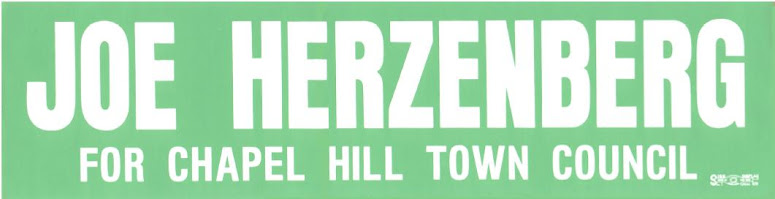
Vote Joe Herzenberg yard sign, 1991. Thanks to Mark Donahue and his talented co-workers at Replacements, Ltd. for restoring this yard sign to its original glory!
Friday, October 29, 1993
Vigil held to support gay texts - Multicultural lessons in high schools backed
The News & Observer, Oct. 29, 1993
By GREG EASTERLY
CHAPEL HILL -- About 100 people joined a candlelight vigil in front of the Franklin Street post office Thursday night to support the inclusion of homosexuality as part of a multicultural education plan for the Chapel Hill-Carrboro schools.
The group consisted of gay and lesbian activists, as well as parents and students, who came out to show that not everyone in Chapel Hill opposes the school system's controversial multicultural program, which includes references to sexual orientation.
...
The vigil, called "A Night of Healing," was arranged as a show of support for the school board's decision in May to add homosexuality to the school system's multicultural plan. Since that decision, parents opposed to the new plan have dominated several school board meetings. The debate has raged even hotter since last week's discovery of sexually explicit material in some selections of a reading list from Chapel Hill High School teacher David Bruton's class.
Support for the multicultural plan had been fragmented until the recent formation of groups called Many Voices, One Community and the Orange Lesbian and Gay Alliance. Both groups have criticized Putting Children First, a group that formed in August to combat the gay and lesbian aspects of the multicultural plan.
"There's a lot of misinformation being put out there," said Doug Ferguson of the gay-lesbian alliance. "If people knew who we were, then they would know that we are not the monsters that we are being made out to be."
Hugh Singeline, a board member of Outright, a gay and lesbian youth support group, said he has no problem with parents getting involved in school curricula. "But if forced ignorance is to be the goal, then there is a problem," he said.
Bruton attended the meeting Thursday night and did not address the crowd. But he said afterward, "This is much bigger than just Chapel Hill, and it's going to keep getting bigger until people learn to get along with each other and give up their closely held prejudices."
Carrboro Board of Alderman candidate Mike Nelson and former Chapel Hill Town Council member Joe Herzenberg, both of whom are openly gay, also attended.
Wednesday, October 20, 1993
Gays, lesbians unite politically in Orange
The News & Observer, Oct. 20, 1993
By JANE STANCILL
CHAPEL HILL -- Saying anti-homosexual sentiment is running high in Orange County, a group of gays and lesbians has formed a political action group that will endorse local candidates in the November elections.
The Orange Lesbian and Gay Association, or OLGA, will meet Monday and review questionnaires it sent out to candidates in three local races: the Chapel Hill Town Council, the Carrboro Board of Aldermen and the Chapel Hill-Carrboro school board.
Doug Ferguson, a founding member and co-chairman, said the group formed quickly in response to the fractious issue of multicultural education, which exploded this week with the suspension of a reading program at Chapel Hill High School that included the works of gay and lesbian writers.
He said parents who have spoken out against the inclusion of sexual orientation in the curriculum have painted gays and lesbians in a stereotypical -- and unfavorable -- light.
"We're not about indoctrinating children, not about pedophilia, not about promiscuity," he said. "A lot of issues are being misrepresented." Ferguson said he hopes the formation of OLGA can defuse the tense situation and present the other side of the argument.
The group will try to counteract arguments of another new group, Putting Children First, whose members say including sexual orientation in the classroom condones behavior they view as immoral.
Parents in Putting Children First, which also endorses candidates, became outraged last week over sexually explicit material on a reading list in one Chapel Hill High School class.
Robert Alexander, president of Putting Children First, said he isn't worried about the gay group.
"If this group is out to get people to vote and to inform them, I think that's wonderful," he said. "Maybe one day this group will want to sit down with us and write a true tolerance policy to make sure no one's rights will be infringed."
OLGA's Ferguson said gays and lesbians may have suffered during the recent emotionally charged debate over material offered in teacher David Bruton's English class. "It was a very unfortunate turn of events," he said. "I read the literature myself and felt it might have been inappropriate for high school age students. But they need to give the same level of scrutiny to other teachers. They zoomed in on David Bruton."
Joe Herzenberg, a former Chapel Hill Town Council member who is openly gay, applauded the group's birth. He said he has agreed to help the group assess candidates' answers on questionnaires.
Subscribe to:
Posts (Atom)