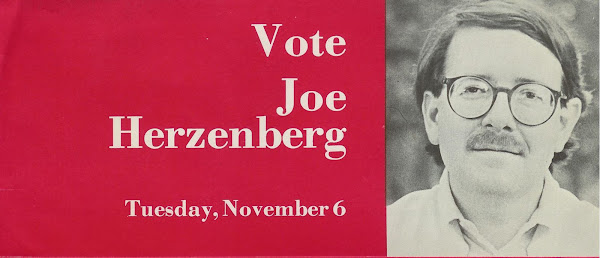
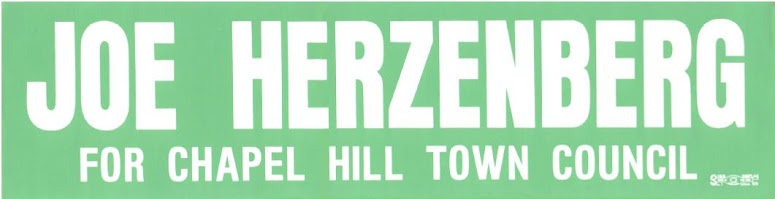
Campaign flyer from Joe’s first Chapel Hill Town Council race, 1979

About Joe

My Photo
Friends of Joe
Chapel Hill, N.C., United States
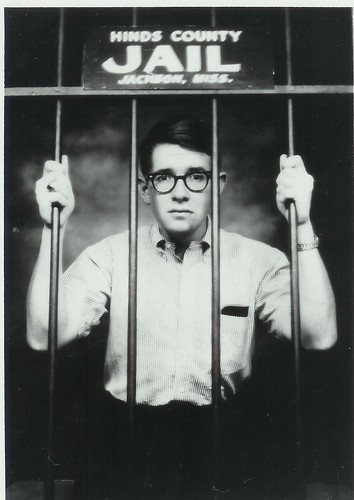
Joe Herzenberg was born June 25, 1941, to Morris & Marjorie Herzenberg. His father owned the town pharmacy in Franklin, N.J., where Joe grew up. After he graduated from Yale University in 1964, Joe went to Mississippi to register voters for Freedom Summer. He joined the faculty of historically black Tougaloo College, where he was appointed chair of the history department. Joe arrived in Chapel Hill in 1969 to enroll as a graduate student in history at the University of North Carolina, and, along with his partner Lightning Brown, soon immersed himself in local, state, and national politics. Although Joe’s first campaign for the Chapel Hill Town Council in 1979 was unsuccessful, he was appointed to the Council to fill a vacant seat and served until 1981. In 1987, he was elected to the Council, becoming the former Confederacy's first openly gay elected official. Joe died surrounded by friends on October 28, 2007. He was 66 years old.
View my complete profile

Wednesday, November 4, 2009

Mayor-Elect Mark Kleinschmidt Wins in Chapel Hill

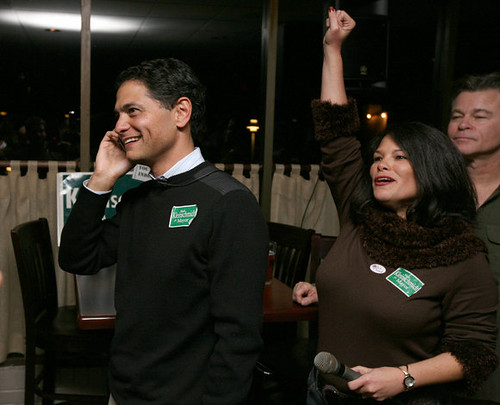
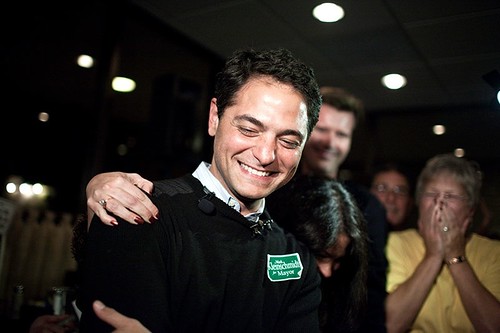
Last night, two-term Chapel Hill Town Council member Mark Kleinschmidt was elected mayor of Chapel Hill in a hard-fought victory over fellow Town Council member Matt Czajkowski. One of Joe Herzenberg's political protégés, Kleinschmidt fulfilled part of Herzenberg's unfinished legacy by becoming the first openly gay (and at age 39, the youngest ever) mayor of Chapel Hill.


Kleinschmidt ran on an unabashedly progressive platform, supporting civil liberties, a responsible approach to development, and environmental protection.

And unlike his opponent, who vastly outspent him by at least a 4-1 margin, Kleinschmidt supported and participated in the town's pioneering campaign finance reform program, Voter-Owned Elections. Czajkowski vocally opposed the program, claiming, "there is no special interest influence in Chapel Hill."

Amazingly, Czajkowski was so ignorant of local politics and history that in the week before the election, he ran a full-page endorsement ad listing former segregationist mayor Sandy McClamroch at the very top of his list of supporters. In early 1964, McClamroch led a 4-2 majority of the then-Board of Aldermen in Chapel Hill in voting against a public accommodations law that would have integrated Chapel Hill. The town's refusal to integrate became a moot issue when Congress passed the Civil Rights Act in July, 1964.

During the campaign, Kleinschimdt also had to contend with gay-baiting tactics used by another marginal mayoral candidate, Kevin Wolff. First, Wolff paid for a push poll that called himself the only "moral" candidate in the race. Then, he distributed flyers labeling Kleinschmidt a "gay-rights activist" who doesn't have children or own a home in Chapel Hill. In fact, Kleinschmidt owned a home in Chapel Hill from 2003-08 and is currently house-hunting for a new one, as fully detailed by the News & Observer once Wolff's scurrilous campaigning came to light.

Despite these obstacles, Kleinschmidt ran a professional yet grassroots campaign built on small donations, broad community support, and lots of volunteer effort. He focused relentlessly on the nuts and bolts of local issues, and his "reputation for getting things done" while standing up for progressive principles. It was the classic Herzenberg campaign model, and Joe would have been overjoyed to be there at the R&R Grill (formerly Papagayo's) last night watching Kleinschmidt declared the winner by the TV cameras while an overflow crowd of his supporters cheered.


Indy Weekly, 11-4-09 ("Relieved and jubilant, Kleinschmidt basks in win")

Supporters erupted. His mother burst into tears. His sister shouted. Mark Kleinschmidt just smiled contently, arms crossed but giving the kind of ear-to-ear grin you could feel across the room, satisfaction and disbelief merging together on his face. The campaign had just received word that rival Matt Czajkowski had made his concession speech at the Franklin Hotel...

N&O, 11-4-09 ("Kleinschmidt wins Chapel Hill mayoral race")

CHAPEL HILL -- The liberal establishment held off a band of businessmen trying to change the town's course. Two-term councilman Mark Kleinschmidt, a death-penalty defense lawyer and gay rights activist, narrowly defeated colleague Matt Czajkowski to take the reins as mayor. Kleinschmidt had just 48.6 percent of the vote in the four-person mayoral race...

Q-Notes, 11-4-09 ("Openly gay Kleinschmidt is next Chapel Hill mayor")

A member of the Chapel Hill Town Council since 2001, Kleinschmidt will become the third openly gay man to hold mayoral office in the state...

Wednesday, September 23, 2009

Worthy of the honor

Chapel Hill News, Editorial, September 23, 2009

Roses to Chapel Hill's ongoing efforts to commemorate those local activists who led the way on the momentous issues of civil rights and justice.

A historic marker was unveiled in the front of the Franklin Street post office Sunday. The event, sponsored by the town and the local chapter of the NAACP, honored nine remarkable local people: Charlotte Adams, Hank Anderson, James Brittain, Joe Herzenberg, Mildred Ringwalt, Hubert Robinson, Joe Straley, Lucy Straley and Gloria Williams.

The marker is at a spot that has been named Peace and Justice Plaza. Those nine are worthy of the honor, and we're confident that each of them would have agreed that there have been many more who played key roles in the struggle.

It's always worth remembering those who put themselves on the line to help society live up to its ideals.

Sunday, September 20, 2009

Dedication of Tribute Marker


(Click for larger image)

Town to unveil tribute marker today

Chapel Hill News, September 20, 2009

CHAPEL HILL - The historic unveiling of a tribute marker will take place from 3 to 4 p.m. today at Peace and Justice Plaza in front of the Post Office-Courthouse, 179 E. Franklin St.

The public event will be the second in a series sponsored by the town and Chapel Hill-Carrboro NAACP to honor nine local peace and justice leaders: Charlotte Adams, Hank Anderson, James Brittian, Joe Herzenberg, Mildred Ringwalt, Hubert Robinson, Joe Straley, Lucy Straley and Gloria Williams.

The quote on the marker comes from Martin Luther King, Jr.: "True peace is not merely the absence of some negative force, it is the presence of justice."

The town has recently increased efforts to commemorate its civil rights history.

Friday, August 28, 2009

Celebrate Our Peace and Justice Legacy


(Click for larger image)

Sunday, August 16, 2009

Town, NAACP to remember historic march

Chapel Hill News, August 16, 2009

On Friday, Aug. 28, the anniversary of the 1963 March on Washington, the Town of Chapel Hill and the Chapel Hill-Carrboro NAACP will hold the first of two programs to honor nine local peace and justice leaders.

An outdoor rally will be held from 5 to 6 p.m. at the Peace and Justice Plaza outside the Post Office/Courthouse at 179 E. Franklin St. The leaders being honored are Charlotte Adams, Hank Anderson, James Brittian, Joe Herzenberg, Mildred Ringwalt, Hubert Robinson, Joe Straley, Lucy Straley and Gloria Williams.

Three weeks later, the public unveiling of a tribute marker at Peace and Justice Plaza will be held from 3 to 4 p.m. Sunday, Sept. 20. The Town Council has established a process to honor additional peace and justice leaders in the future.

Thursday, July 23, 2009

Missing Joe

Carrboro Citizen, July 23, 2009

There are a lot of reasons people miss former Chapel Hill Town Council member and greenways champion Joe Herzenberg around election time.

For poll organizers and precinct captains, a big reason is that he could always be counted on to lend a hand. For journalists, he was a kind of institutional memory of local elections.

Joe could have quickly answered one of the big trivia questions floating around about the four-way race for Chapel Hill mayor. So we’ll put this one to our readers: When was the last time four people ran for mayor of Chapel Hill?

Saturday, June 27, 2009

Inside the halls of power: Gays and lesbians have served the Carolinas well

Q-Notes, June 27, 2009

By MATT COMER

In the 1980s, the chances for any openly gay man or lesbian woman wining an election to public office were pretty much slim-to-none. That didn’t stop scores of gay and lesbian North Carolinians from throwing their hat into the ring and giving it a shot.

...

Bob and Lightning

On August 25, 1981, openly gay N.C. State University graduate student Bob Hoy filed to run for the Raleigh City Council where just a generation before, arch-conservative Jesse Helms held office. Hoy was ultimately unsuccessful. Even The Front Page, North Carolina’s most comprehensive gay and lesbian newspaper at the time, said Hoy wasn’t a “serious contender.”

The Front Page’s writers changed their tune when Lightning A. Brown came onto the scene, extolling his abilities and platform. Just weeks after Hoy filed to run in Raleigh, Brown filed to run for the Chapel Hill Town Council.

Come election day, neither Hoy nor Brown won. Hoy picked up only three percent of the vote in his primary. Brown picked up more than 1,400 votes in his primary, but ultimately failed to capture the 2,100 votes required to continue on to the general election.

Hoy’s and Brown’s candidacies are likely the first openly gay candidacies for public office in the Carolinas.

‘The Mayor of Franklin St.’

Brown’s partner, Joseph Herzenberg, would go down in history. At the same time Brown was fighting for his chance to become Chapel Hill’s first openly gay town councilman, Herzenberg — not yet out — lost his chance to continue serving on the council.

Herzenberg had run for the council before. In 1979, he was narrowly defeated. He was later appointed to the council when University of North Carolina-Chapel Hill student Gerry Cohen resigned. Trying to keep that seat in 1981, Herzenberg barely missed the mark, losing his seat in the same primary election that saw his partner’s defeat.

That didn’t stop Joe. In 1987, he ran again and won, becoming the state’s first openly gay elected official. Serving until 1993, Herzenberg was instrumental in political organizing statewide and was a co-founder of the Equality North Carolina Political Action Committee.

He died of complications from diabetes at the age of 66 on Oct. 28, 2007.

Friday, March 20, 2009

Joe was always a true friend of the IFC

IFC News, Spring 2009

Thanks, Joe

Throughout his life, Joe Herzenberg enriched Chapel Hill. And so it's no surprise that even after his death in 2007, Joe continues to help the community, thanks to bequests he made in his will, including a $250,000 gift to IFC.

A historian and political activist, Joe became the first openly gay elected official in North Carolina with his 1987 election to the Chapel Hill Town Council. A fierce advocate for social, environmental and economic justice, Joe's generous bequest will help the disenfranchised served by IFC by supporting emergency shelter and long-term housing opportunities for men, women and children.

In addition, IFC purchased a truck, for its new FoodFirst program, which is used to transport food between all of IFC's facilities.


The FoodFirst truck used to transport food between IFC locations is just one of the legacies of a generous bequest by the late Joe Herzenberg.

"Joe was always a true friend of the IFC," says Chris Moran, IFC Executive Director. "He was a regular donor and advisor to IFC over the years. And he was someone who was extremely public in his views about supporting human services."

Community members are invited to support The Joe Herzenberg Fund; funds raised will support IFC's residential services operation.

For more information, contact IFC Development Director Kim Shaw at 919-929-6380 ext. 29 or developmentdirector@ifcmailbox.org.

Tuesday, December 16, 2008

Bill of Rights reading honors 'mayor of Franklin Street'

Chapel Hill Herald, Dec. 16, 2008

By LISA A. YOUNG

CHAPEL HILL -- With the traffic and activity of downtown Chapel Hill buzzing around them, a group of elected officials and local residents paused Monday to reflect on freedom and a man who championed it as they gathered for an annual reading of the Bill of Rights.

This year's event at Peace and Justice Plaza in front of the old Franklin Street post office -- organized by the Orange County Bill of Rights Defense Committee -- also served as a tribute to the late Joe Herzenberg, a former Chapel Hill councilman and the so-called "mayor of Franklin Street."

Herzenberg, who died last fall at the age of 66, was one of the first openly gay elected officials in the South and is particularly remembered for his passion for civil rights.

"We're doing this in honor of Joe," said State Sen. Ellie Kinnaird, who gave a few remarks before the reading. She then looked heavenward and added, "We know you're doing the right thing up there, too."

Bill of Rights Day 2008 marks the 217th anniversary of the day the necessary number of states ratified the Bill of Rights, the first 10 amendments to the U.S. Constitution. Kinnaird said the event has been held in downtown Chapel Hill for at least the last 20 years.

Chapel Hill Mayor Pro Tem Jim Ward, Orange County Commissioner Barry Jacobs and Carrboro Mayor Mark Chilton each read a proclamation declaring Dec. 15 "Bill of Rights Day" in their respective jurisdictions. They noted that North Carolina withheld its ratification of the Constitution until a Bill of Rights could be added.

All three jurisdictions have passed resolutions reaffirming the human and civil rights of residents. Additionally, Jacobs and Chilton said, the county and the Town of Carrboro have established policies against the use of local law enforcement to enforce civil immigration law and policy.

Reading with gusto

Ten individuals then read, some with great gusto, the original 10 constitutional amendments.

Daniel Pollitt, a retired UNC law professor who has been attending the Bill of Rights reading for most of its history, said he recalls a time when some had to read more than one amendment because there weren't enough people. This year's crowd of 15-20 people was much bigger than in years past, he said.

"It's good to keep people reminded that we have a Bill of Rights and they ought to abide by it," Pollitt added.

Tuesday, December 2, 2008

Bill of Rights Day 2008 press release

Orange Politics, Dec. 2, 2008

From Peggy Misch:

COMMEMORATION OF CIVIL AND HUMAN RIGHTS!

12 Noon, Monday, December 15, 2008

Bill of Rights Day

Peace and Justice Plaza, East Franklin and Henderson Streets, Chapel Hill

Proclamations read by two mayors and county commissioner; 10 amendments read by participants; words spoken by NC Senator Ellie Kinnaird remembering Joe Herzenberg for his dedication to civil rights

Orange County Bill of Rights Defense Committee
Information: 942-2535

Monday, November 10, 2008

Chapel Hill may name trail for Herzenberg

N&O, Orange Chat, Nov. 10, 2008

by MARK SCHULTZ

The Greenways Commission and the Parks and Recreation Commission voted unanimously to jointly recommend at tonight's Town Council meeting that the town make the following naming and dedication change:

* Dedicate the future phase 3 section of the Bolin Creek Trail in honor of Joe Herzenberg. The commissions note Herzenberg was a strong proponent of open space and greenways and left at least $250,000 upon his death to be used for the Bolin Creek Trail. (The commissions also note that it would be easier to plan a memorial to Herzenberg if any such dedication were made prior to construction.)

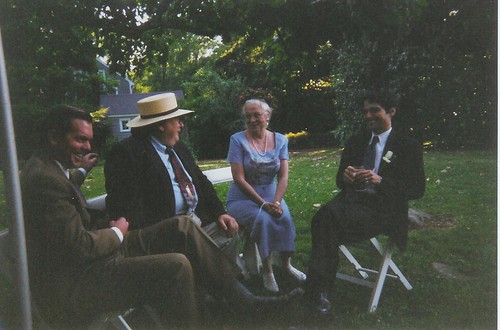
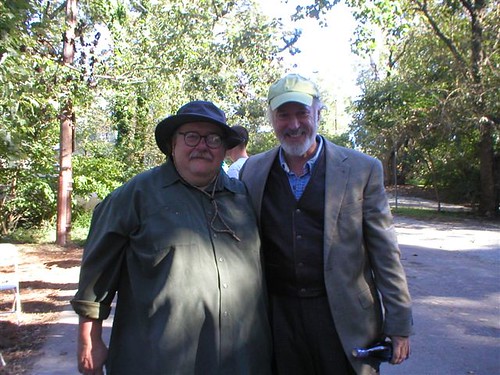
Joe and Allan Gurganus at Joe's Stonewall party, 2004.

Tuesday, October 28, 2008

Helms and Herzenberg: When The Old South Met New

Huffington Post, Oct. 28, 2008

by ERIK OSE

Despite sharing the same initials and middle name "Alexander," Jesse Helms and Joe Herzenberg were very different. Helms was a bigoted, heterosexual, Southern Baptist, extreme right wing Republican who used divisive politics to keep himself in power for five U.S. Senate terms. Herzenberg was a tolerant, gay, Jewish, staunchly liberal Democrat who spent his life standing up for progressive ideals.


Jesse Helms and Joe Herzenberg

Yet they were both historic politicians who bookended the Old and New South. Helms, who died last summer at age 86, was the last unapologeticly racist politician of the segregation era. Herzenberg, who passed away one year ago today at age 66, was elected to the Chapel Hill Town Council two decades ago as the first openly gay elected official in the former Confederacy. And in 1984, their paths memorably crossed during the epic Helms-Hunt U.S. Senate race.

That year, Helms used shameful hate mongering against Herzenberg, his partner Lightning Brown, and the rest of North Carolina's gay and lesbian community to eke out his narrow re-election against sitting Gov. Jim Hunt. Helms had been getting decreasing mileage out of race-baiting, drawing heavy criticism for his filibuster against the Martin Luther King Jr. federal holiday a year earlier. So he found a new bogeyman - the homosexual menace.

Headlines screaming "Jim Hunt Is Sissy, Prissy, Girlish and Effeminate," and asking, "Is Jim Hunt homosexual?...Is he AC and DC?" appeared throughout 1984 in a free newspaper called The Landmark, a virulently anti-gay publication printed in Chatham County, N.C. The paper's homophobic publisher, Bob Windsor of Chapel Hill, was a cog in the Helms machine.

The stories ran alongside paid ads for Helms' re-election campaign, and hundreds of thousands of copies of the paper were distributed around the state, particularly in rural areas. Its press run increased dramatically in the weeks leading up to Election Day. The Landmark was funded by shadowy national Helms backers, part of the religious right that played a key behind-the-scenes organizing role in Helms' campaign.

That June, the N.C. Republican Party held a press conference to accuse Jim Hunt of a "gay connection" because gay donors had bought 100 of 700 tickets to a Hunt fundraiser in New York, and Sen. Paul Tsongas of Massachusetts, leading Senate sponsor of a gay rights bill, had held a fundraising dinner for Hunt in Boston. The next day, Helms supporters paid to have a Landmark story reprinted as a large ad in the Raleigh News & Observer, accusing Hunt of "accepting a $79,000 contribution from Gay Activists."

Posing as reporters for the black and gay press, right-wing operatives made and taped phone calls to gay Hunt supporters around the country. Articles based on distorted excerpts from the phone calls were then published in issues of The Landmark.

Herzenberg and Brown were the smear campaign's N.C. poster children, targeted because they had helped co-found the Lesbian and Gay Democrats of North Carolina two years earlier, and were both vocally campaigning for Hunt. According to Lightning, one caller "asked about my fund raising for Hunt. The details ended up in The Landmark right away - it was frightening."

Besides running made-up stories that slandered Herzenberg and Brown relentlessly, including accusations that they had started a Chapel Hill NAMBLA (North American Man-Boy Love Association) chapter and were secretly "porno kings," The Landmark also published their home addresses and did everything possible to incite violence against the two of them. No wonder, as gay activist Mab Segrest recounted in an article on the Senate race, that "Brown and Herzenberg were subjected to more than a dozen separate incidents of intimidation, vandalism and harassment...for their work within the Democratic Party."

In a 1984 interview with the Independent Weekly when Herzenberg and Brown were awarded two of the Indy's first-ever Citizen Awards, Brown told of how "two people even threatened to kill me on Rosemary Street." Herzenberg called the attacks "very disruptive and at times painful." Asked if he had been scared, he admitted, with a subtlety that testified to his courage, "At moments."


In September, The Landmark published an interview with Helms in which he called homosexuality "a perversion and a crime." He described the gay movement as a "threat to the morals of our young people" and to "the ability of our population to reproduce itself...jeopardizing the very survival of the nation."

Helms was eventually forced to publicly distance himself from The Landmark after the paper published its most sensational charges accusing Jim Hunt of having a lover who was a "pretty young boy."" But he was well aware of how the paper was being widely distributed on his behalf. Helms betrayed himself on this point during a televised debate.

Although both were known in Triangle political circles, and in the state's gay community, the only actual media coverage of their status as gay activists was through The Landmark's smear campaign. But in one of their four debates, Helms twice gay-baited Hunt by thundering, "You're supported by people like Joe Herzenberg and Lightning Brown!" Herzenberg considered the moment he was publicly outed to have been when Helms announced his name on statewide television.

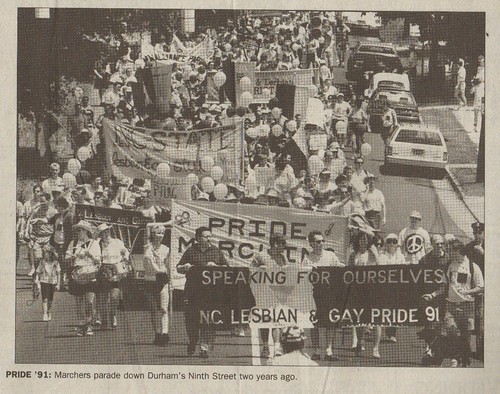
In the wake of his sliming by Helms' hateful tactics, Herzenberg decided he was out of the closet for good. His political activism and organizing flourished. He was elected as an openly gay Mondale delegate to the 1984 Democratic National Convention. He helped organize North Carolina's first Gay Pride Parade in 1986. He ran for the Chapel Hill Town Council as an openly gay candidate in 1985, and again in 1987 before he was finally elected.


Herzenberg was arguably the first gay candidate in U.S. history elected to office outside an urban area or historically gay enclave, and he did it by assembling a broad-based progressive coalition. His election was an important symbol of how the South was changing, and in some ways, Jesse Helms made it possible. Joe Herzenberg would have been thrilled to see the political landscape one year after his death, only one week away from the election of Barack Obama and a historic repudiation of the politics of division and hate.

Saturday, October 11, 2008

Joe Herzenberg's Yahrzeit

As the anniversary of Joe Herzenberg’s death nears I would like to share with you the Jewish custom for observing the Yahrzeit of a family member. The Hebrew Date is used instead of the actual date of death. This year the date will be November 14.

Traditionally family members mark the yearly anniversary of a death (called "yahrtzeit") in two ways:

Light a yahrizeit candle. A candle that burns for 24 hrs. Yahrzeit candles should be lit the evening before the date specified. This is because the Jewish day actually begins at sundown on the previous night. There is no prayer said with this lighting.

And giving some form of charity (tzedakah) in the name of the deceased.

Candles can be purchased at Harris Teeter in the ethnic section of the store or at the Chapel Hill Kehillah gift shop.

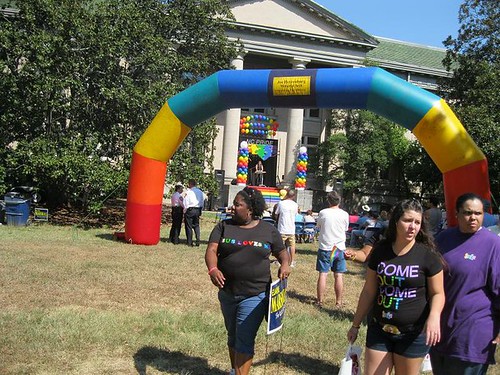
I gave a Rainbow Arch to NC Pride Fest that is now is the Joe Herzenberg Memorial Arch. It was dedicated September 26 at the Pride March in Durham.


Joe left 1/2 of his estate equally to Friends of Chapel Hill Parks and Recreation and Greenways for the Bolin Creek Greenway, especially for benches and other amenities, as well as actual construction; and the Inter-Faith Council for Social Services, Inc. for the operations of the homeless shelter and the kitchen. Each has received a check in the amount of $250,000.00.

L’shalom,

Kathie Young

Sunday, September 28, 2008

Gay Pride allies pin their hopes on Obama

N&O, Sept. 28, 2008

by Jesse James DeConto

DURHAM - "We are on the doorstep of the most important political election of our day," Chapel Hill Town Council member Mark Kleinschmidt told the crowd (at the N.C. Pride Festival on Saturday) on Duke's East Campus.

...

Kleinschmidt and others celebrated the late Chapel Hill Town Council member Joe Herzenberg, who in 1987 became the first openly gay elected official in North Carolina. The path to the stage passed beneath a 20-foot-high inflated arch -- the Rainbow Memorial Arch -- in Herzenberg's honor. He died in October.

"His election opened the door for the rest of us who followed," said Orange County Commissioner Mike Nelson, former mayor of Carrboro.

Thursday, June 19, 2008

Brilliant Flight - a love poem for Mama Nayo and Joe (VIDEO)

This video honors the lives of Joe and Nayo Barbara Malcolm Watkins ("Mama Nayo"), a Durham community activist and educator who died of cancer on January 22, 2008. It was created by artist and poet Ebony Noelle Golden.

Sunday, May 25, 2008

Blacks added to plaza names: Marker naming rights leaders will be installed in the fall

Chapel Hill News, May 25, 2008

By Meiling Arounnarath

CHAPEL HILL -- The names of the first people approved for the town's new historical marker were all white. Where were the black people who helped lead the civil rights struggle in Chapel Hill, the local NAACP asked.

The NAACP recently recommended four additional names be added to the sidewalk marker planned for the Peace and Justice Plaza outside the Franklin Street post office. The Chapel Hill Town Council wants to install the marker in the fall.

The Naming Committee originally approved Joe and Lucy Straley, Charlotte Adams and Joe Herzenberg, who were active in the local peace and civil rights movements and other causes.

The NAACP proposed Henry "Hank" Anderson III, James R. Brittain, Hubert Robinson and Gloria Williams.

...

The historical marker will be a tablet installed in front of the flagpole.

It will read: "Peace and Justice Plaza" at the top. Under that will be the names of the nine honored, in alphabetical order, said Town Council member Sally Greene, who sits on the Naming Committee. More names can be added later.

"Most of them are probably not as well-known as these other activists because, as someone has said recently, the black community tends to be invisible and overlooked," Yonni Chapman, a local civil rights historian, told the Town Council. "The NAACP, upon hearing the news of this initiative to honor peace and justice activists, certainly supported the names put forward, but we thought it would be appropriate to have some African-Americans added to that list."

The Peace and Justice Plaza wasn't just a focus of the anti-war movement, Chapman said.

"It was also the focal point of the civil rights movement, of all the Martin Luther King Jr. marches that have been held," he said. "It's been a rallying area for the black freedom struggle in Chapel Hill, which has been tremendously important to this entire community."

Friday, May 2, 2008

First names proposed for post office plaza

N&O, Orange Chat, May 2, 2008

by MARK SCHULTZ

The Chapel Hill Town Council will consider the first names to be engraved on a marker outside the Franklin Street post office on Monday.

The council voted in 2006 to name the spot the "Peace and Justice Plaza" in recognition of the political gatherings that have taken place there.

In a 2007 story, we reported that the the council voted to engrave the names of longtime activists Charlotte Adams and Joe and Lucy Straley on a 5 foot by 5 foot granite marker outside the post office.

Now comes word, by way of Monday's Town Council agenda, that town leaders have decided to add some other names to the marker.

The council will consider a recommendation to engrave the following names: Joe and Lucy Straley, Charlotte Adams, Joe Herzenberg, Hubert Robinson, James R. Brittain, Henry "Hank" Anderson III, and Gloria Williams.

Friday, November 16, 2007

Franklin Street's unofficial mayor remembered

Chapel Hill Herald, Nov. 16, 2007

BY BETH VELLIQUETTE

CHAPEL HILL -- His friends remembered him as courageous, cranky and caring, a world traveler who always returned to his favorite spot on Franklin Street, a postcard-sender, a movie-lover, a book-giver and a patriot.

Joe Herzenberg, who died from problems related to diabetes at the age of 66 on Oct. 28, was remembered during a memorial service Thursday at the Chapel Hill Kehillah. About 175 people, including state senators, mayors, councilmen, aldermen, activists and old and new friends attended the morning service.

Although publicly Mr. Herzenberg was known as the first openly gay elected official in North Carolina -- winning his race for Chapel Hill Town Council in 1987 -- and was admired for leading the way and opening doors for other young politicians, both gay and straight, to many he was also a dear friend.

State Sen. Ellie Kinnaird, who worked with him on many Democratic party events and issues, told of going to the movies with him for years and years, and then having dinner together afterward at Margaret's Cantina. "If I was reading a newspaper article late at night, I could call him at midnight to talk about it and know Joe would be up," Kinnaird said.

Traveling the world

Mr. Herzenberg, who sometimes sat in front of Pepper's Pizza with his trademark floppy hat and was known as the mayor of Franklin Street, had traveled throughout the nation and the world, including trips to Antarctica and Africa during the last years of his life.

His best friend, Kathie Young, remembered sleeping in a tent in Africa as the rain poured down. Mr. Herzenberg wrote in his journal how nice it was to sleep with the sound of the rain on the tent, "and how he got a good night's sleep because he couldn't hear Kathie snoring," she said with a laugh.

On his trips he studied the history, the culture and the country, said his friend Jonathan Courtland. "What he learned really helped inform his idea on how he could better help his community," Courtland said.

He met his goal of visiting all 50 states, and when he traveled he sent his friends postcards with little notes on them. "I'd love to see if we would all stack our postcards up how big the stack would be," Courtland said.

Mr. Herzenberg, described as a voracious reader, also was known for giving books away. Sometimes a friend would open the front door in the morning to find Mr. Herzenberg had left a book on the doorstep, or a friend's child would receive a book as a gift when Mr. Herzenberg stopped by for a visit.

Mr. Herzenberg, described as a patriot who loved the Constitution and the Bill of Rights, loved gathering with his friends, listening to Mozart and operas and talking about politics.

Leonard Rogoff, the founder of the Chapel Hill Kahillah, summarized Mr. Herzenberg's Jewish philosophy. "They tried to kill us. We won. Let's eat."


Memorial collage at Margaret's Cantina after Joe's service. Photo by Ruby Sinreich.

Thursday, November 15, 2007

We were family

Tribute by Kathie Young at Joe's memorial service in Chapel Hill, Nov. 15, 2007

Joe and I were best friends for about 30 years. We were family. All of you are aware of the various contributions Joe made to our community and society so I am not going to talk about any of them.

We traveled to Alaska and Africa together during his last years. We talked on the phone several times a day. Wednesday nights we had dinner together followed by grocery shopping. When he felt up to it after shopping I would leave him at Cafe Driade and Mark K. would give him a ride home.

As best friends we shared each others' joys and sadness. I am privileged to have been able to help Joe enjoy a more comfortable life for the past year. All of the time I spent with him will forever be with me.

Once several years ago Joe asked me to go to the movies to see Daniel Wallace’s “The Big Fish.” I asked what it was about. Joe said, “It’s about the kind of funeral I want.” I was surprised as the movie began because I didn’t understand what Joe meant. Midway through the movie I understood and both Joe and I cried like “girls” till the end. Those tears were wonderful tears of love, joy and understanding.

I left the theater knowing that Joe wanted me to be the person piecing together the stories he had gathered over the years. And I, too, like Will Bloom, began to understand Joe’s great feats and his great failings. I am so happy Joe let me carry him into the water.

I want to thank my husband, Roy, for being so understanding of my absences and my two sons, Fred and David for offering me so much strength and support when I needed it.

I will also miss Joe and am so happy that he was such a huge part of our lives.

Joe in Africa, 2006.