


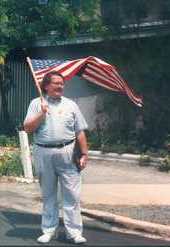

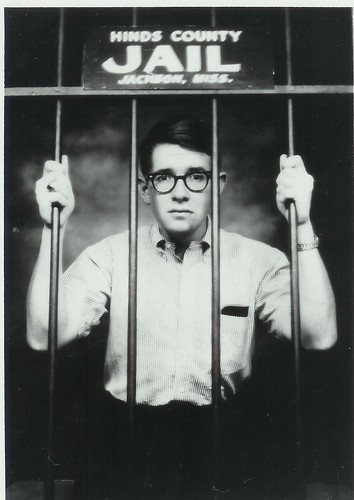

Wednesday, April 30, 1986

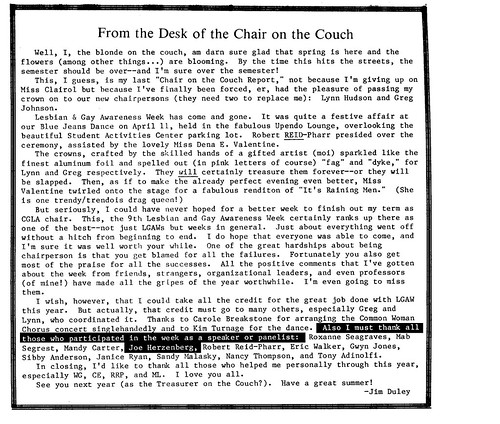
Tuesday, October 1, 1985
Sunday, September 1, 1985
"Gay-Baiting in Southern Politics," Southern Exposure, Sept/Oct 1985
Southern Exposure, Issue 13, Sept/Oct 1985.
By Joe Herzenberg
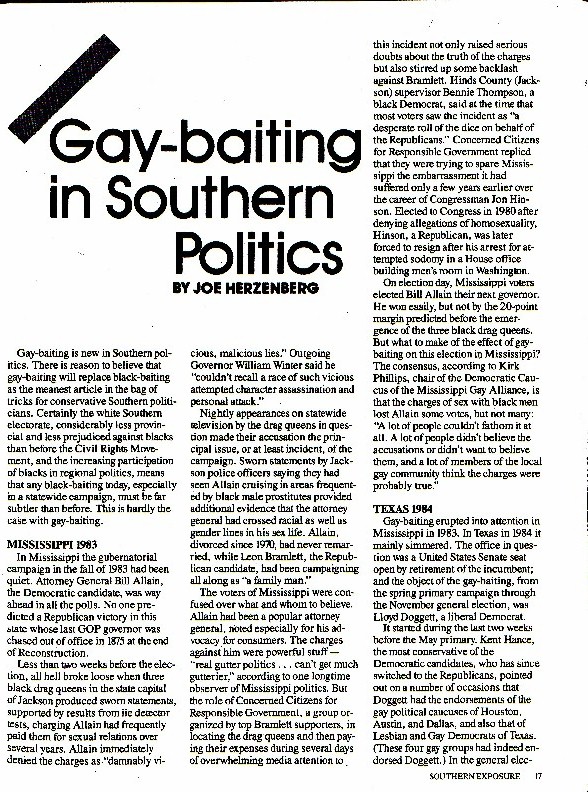
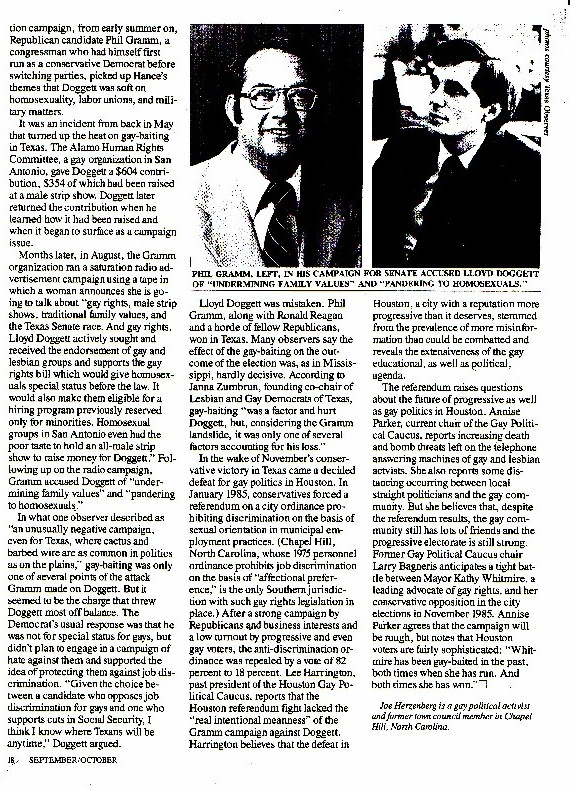
After being personally slimed by the hateful tactics of Jesse Helms' political machine during the 1984 Hunt-Helms Senate race, Joe wrote this article for Southern Exposure magazine's Fall 1985 issue. He cast light on how gay-baiting was a tactic used all over the South by the Republican Party in recent elections to scare up votes for its backwards, right-wing candidates.
Joe's article doesn't touch on his and Lightning Brown's own history as the most prominent targets attacked by gay bigots in North Carolina during 1984. He left that to his fellow gay activist Mab Segrest, who wrote a companion piece in the same issue titled "Anatomy of An Election."
By Joe Herzenberg
After being personally slimed by the hateful tactics of Jesse Helms' political machine during the 1984 Hunt-Helms Senate race, Joe wrote this article for Southern Exposure magazine's Fall 1985 issue. He cast light on how gay-baiting was a tactic used all over the South by the Republican Party in recent elections to scare up votes for its backwards, right-wing candidates.
Joe's article doesn't touch on his and Lightning Brown's own history as the most prominent targets attacked by gay bigots in North Carolina during 1984. He left that to his fellow gay activist Mab Segrest, who wrote a companion piece in the same issue titled "Anatomy of An Election."
"Anatomy of An Election," Southern Exposure, Sept/Oct 1985
Southern Exposure, Issue 13, Sept/Oct 1985.
By Mab Segrest
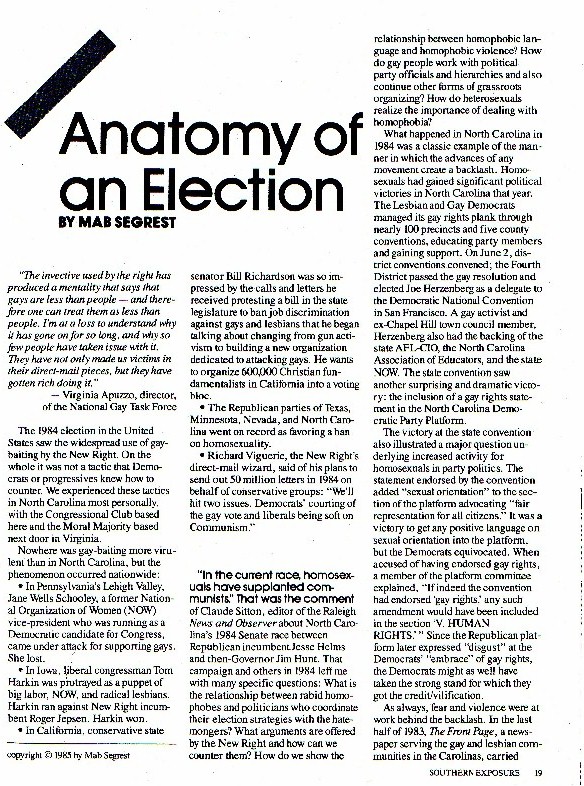

By Mab Segrest
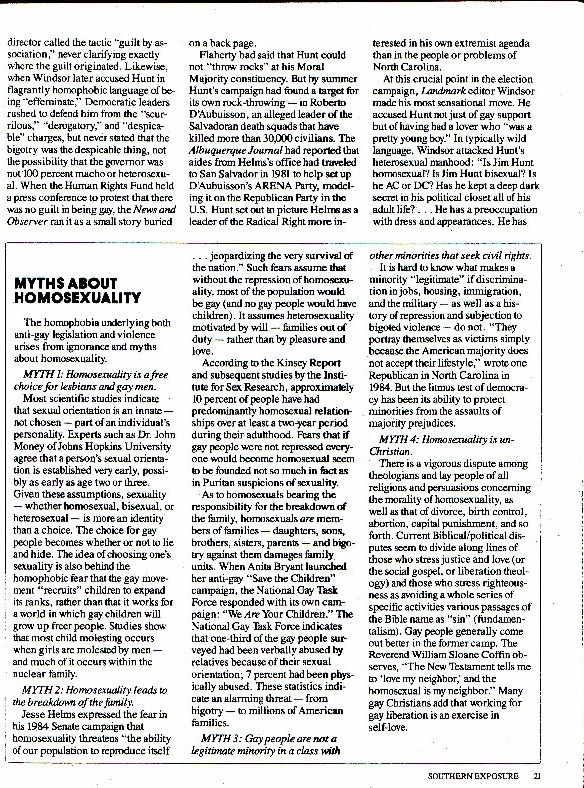
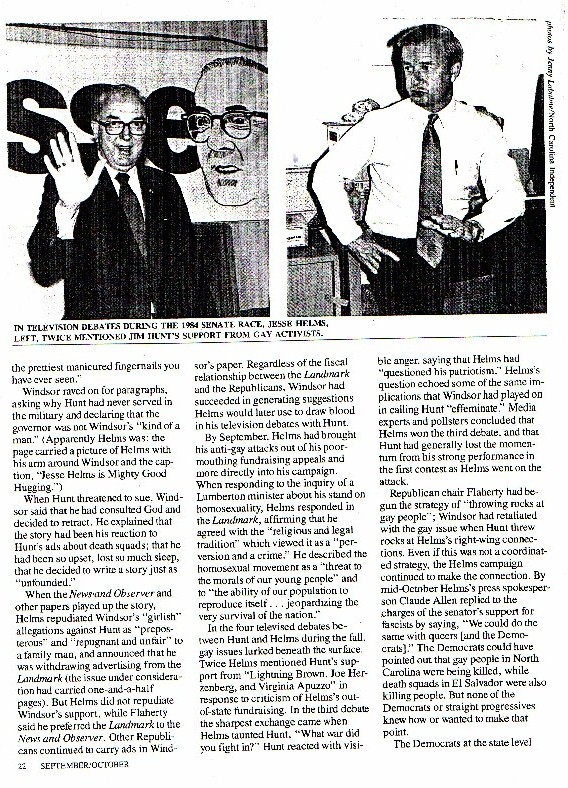
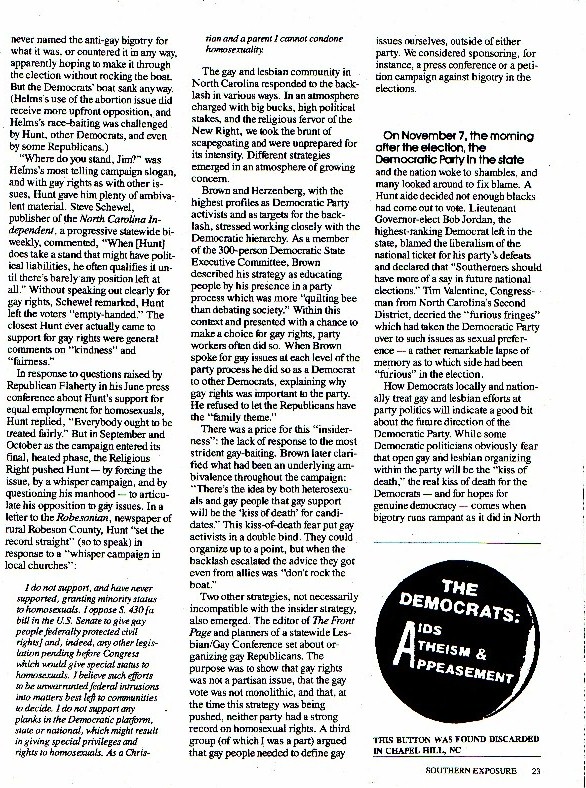
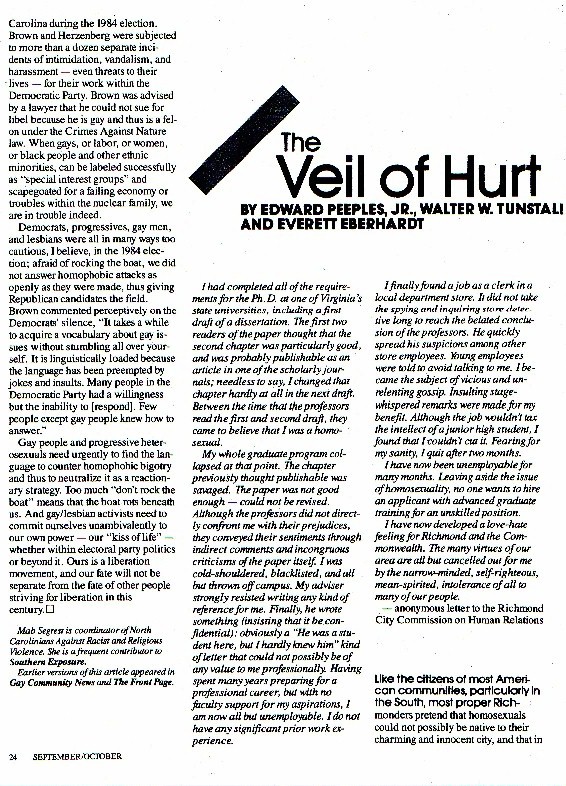
This article by gay activist and writer Mab Segrest appeared in Southern Exposure magazine's Fall 1985 issue. It provides a comprehensive look at how the Helms machine used shameful hate mongering against Joe, Lightning Brown, and the rest of North Carolina's gay and lesbian community to eke out Jesse's narrow 1984 re-election.
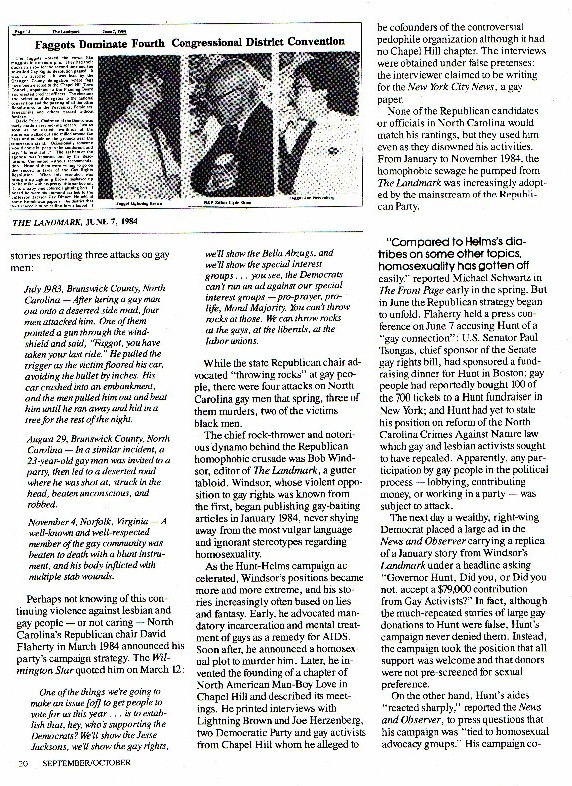
The inset of the article's second page is a reprint of a story that appeared in The Landmark, a virulently anti-gay publication printed in Chatham County, in June 1984, titled "Faggots Dominate Fourth Congressional District Convention." It was at this convention that Joe was elected as an openly gay Mondale delegate to the Democratic National Convention in San Francisco.
Sadly, this article is typical of the scurrilous bile that The Landmark published two or three times a month throughout 1984. It was distributed in regular editions of tens of thousands of free copies all over North Carolina, and its press run increased dramatically in the weeks leading up to Election Day. Every word of this hate-filled propaganda tool passing as a "newspaper" dripped with bigotry and prejudice.
"The faggots worked the crowd like maggots in a manure pile. They had their ducks in a row for the second time and the so-called Gay Rights resolution passed."
- The Landmark, June 7, 1984
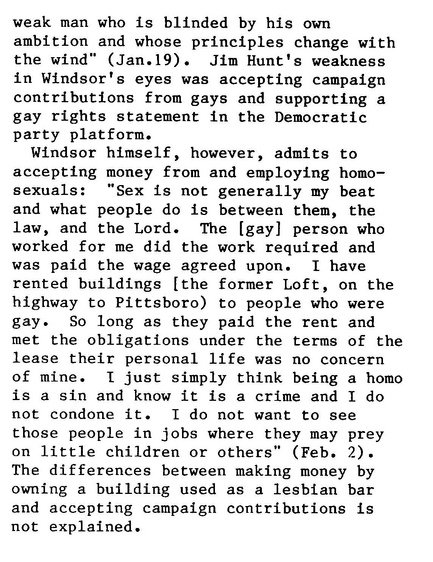
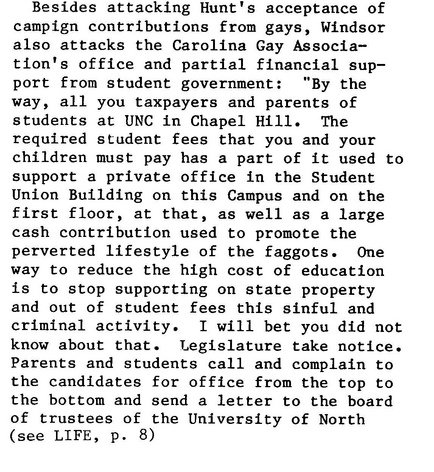
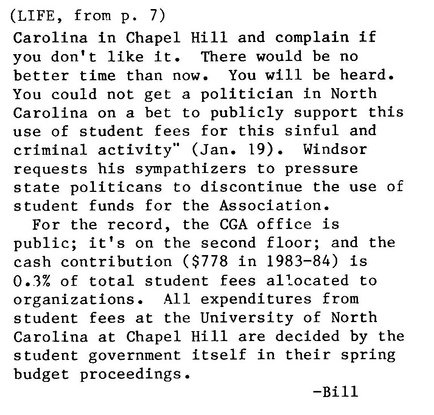
The paper's homophobic publisher, Bob Windsor of Chapel Hill, was a cog in the machine of right-wing Helms backers. According to lyndonlarouchewatch.org, Windsor was being used by the political organization of extremist Lyndon LaRouche to spread anti-gay filth around the state and help ensure Helms’ re-election.
Former LaRouche security staffer Charles Tate "says he was told in early 1984 that work would be done on Helms's behalf. This was no surprise to Tate: he knew the security staff had been in touch with a top Helms aide for several years…Security staffers discussed sending an infiltrator into the Hunt campaign, but decided they could do the job best through undercover phone calls."
Posing as reporters for the black and gay press, LaRouche staffers made and taped phone calls to gay activists and civil rights leaders around the country who were backing Hunt. Articles based on distorted excerpts from the phone calls were then published in issues of The Landmark.
"The idea was to show that Hunt was getting substantial local and national support from constituencies disliked by many conservative Democrats…At least some of the tapes used by The Landmark came from LaRouche's security staff.
In early March 1984, a LaRouchian phoned Virginia Apuzzo, director of the National Gay and Lesbian Task Force, pretending to be a news reporter. Charles Tate says he heard the call being made and "saw the tape recorder running." A transcript of Apuzzo’s remarks appeared in the March 29 issue of The Landmark, which also included excerpts from a phone conversation with Lightning Brown, a gay activist in Chapel Hill.
Brown says he received two calls. The first was from Grant Duay, a supposed reporter for a gay weekly, the New York City News. Brown said that Duay "asked about my fund raising for Hunt. The details ended up in The Landmark right away—it was frightening." Duay was in fact a notorious LaRouche operative who had previously used the New York City News as his cover for interviewing and taping political opponents of LaRouche. (In 1986 Duay would be arrested in Manhattan as part of a homosexual child pornography ring.)
Brown's second call was from the black LaRouchian. "I told him I felt sorry for the publisher of The Landmark and that I had prayed for him," said Brown, who is a Quaker. "My remark later appeared in The Landmark. It was supposed to prove I was a devil worshipper."
Landmark publisher Windsor was in close contact with the LaRouchians throughout that spring. He accompanied Tom Allred, Hunt's LaRouchian opponent in the Democratic primary, on a trip to Raleigh. "We toured the legislature and I introduced him to Liston Ramsey, speaker of the house, and many other people,” Windsor wrote in a front-page article about Allred.
In a 1987 phone interview Windsor said he had also attended a meeting held to recruit North Carolina conservatives to run on the LaRouche slate, Windsor claimed that a number of his conservative friends had contributed money to the NDPC (National Democratic Policy Committee – one of LaRouche’s national political organizations), including one $50,000 contribution.
- LaRouche and the New American Fascism, by Dennis King, Chapter 15 - LaRouche and the Reagan Revolution, from www.lyndonlarouchewatch.org)"
Besides running made-up stories that slandered Joe and Lightning in every way possible, including accusations that they had started a Chapel Hill NAMBLA (North American Man-Boy Love Association) chapter and were secretly "porno kings," The Landmark also published their home addresses and did everything possible to incite violence against the two of them.
No wonder, as Segrest recounts in her article, that "Brown and Herzenberg were subjected to more than a dozen separate incidents of intimidation, vandalism and harassment…for their work within the Democratic Party."
In a 1984 interview with the Independent Weekly when Joe and Lightning were awarded two of the Indy's first-ever Citizen Awards, Lightning told of how "two people even threatened to kill me on Rosemary Street." Joe called the attacks "very disruptive and at times painful." Asked if he had been scared, he admitted, with a subtlety that testified to his courage, "At moments."
At the time "Anatomy of An Election" was published in Southern Exposure, Mab Segrest served as coordinator of North Carolinians Against Racist and Religious Violence. Earlier versions of her article appeared in Gay Community News and The Front Page.
Saturday, December 22, 1984
Citizen Awards 1984 - Lightning Brown and Joe Herzenberg: Personal Dignity
North Carolina Independent, Dec. 22, 1984, Inaugural Citizen Awards
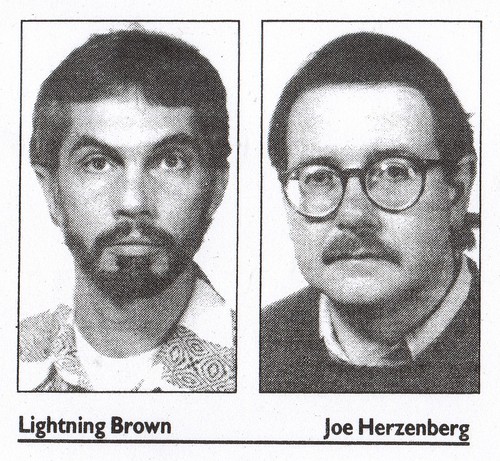
Lightning Brown and Joe Herzenberg: Personal Dignity
Most of us experienced the ugliness of the 1984 political races from a safe distance. We didn't like all the name-calling on TV but, heck, the mud wasn't flying directly at us, and we could simply turn off the tube when it got too thick.
Joe Herzenberg and Lightning Brown couldn't do that. Every few weeks during the height of the election season they read trash about themselves in a scandal-rag called The Landmark which is published in Chatham County and circulates widely around the state. The rest of the state's press finally repudiated Landmark editor Bob Windsor when he told vicious lies about Jim Hunt. But no such support came to Lightning and Joe.
For the last decade the two of them have been involved in every good cause in Chapel Hill. Joe, who is writing a biography of former UNC President Frank Porter Graham, served on the town council. Lightning, a computer programmer for the dental school, is currently vice-chair of the town's planning board and a member of the Democratic state executive committee.
Both were active in the Hunt for Senate campaign, especially in the gay community. When Bob Windsor found out, he published many pictures of the two and printed their home addresses. He accused them of being child molesters, implied they are porno kings and called them dozens of foul names.
And during the second U.S. Senate debate, Jesse Helms himself got into the act, invoking their names before an enormous television audience as if they were evil villians.
Through it all, Lightning, 37, and Joe, 43, showed immense courage. They stuck with the Hunt campaign (even though Hunt never denounced the attacks on them) and were the most visible representatives of the gay minority scapegoated by right-wingers. They did this despite the false rumors, the public notice when they didn't want it, the physical threats.
Lightning says the attacks were "political terrorism. They were extremely painful. They were evil and destructive gossip. Two people even threatened to kill me on Rosemary Street."
Joe says the attacks were "very disruptive and at times painful." Was he scared? "At moments."
And yet Lightning and Joe persisted. They organized Chapel Hill's famous East Franklin Street precinct as thoroughly as ever before and continued to raise funds for Hunt. Instead of hiding from Windsor's camera and Helms' innuendo, they remained in the public eye as campaign activists.
In 1984, candidates make only veiled appeals to the racism of voters. But gay and lesbian people - hundreds of thousands of North Carolinians - are fair game for name-calling and out-and-out threats.
That vile practice is not over. Though more and more North Carolinians know gays and lesbians at work and as friends, it will be a long time before that knowledge leads to acceptance. Meanwhile, the reaction from extremists will continue.
The public courage and personal dignity of Joe Herzenberg and Lightning Brown have done much to advance the time when this political terrorism will end. Too few people spoke forcefully on their behalf: Their public ordeal was, ironically, a lonely one. Lightning Brown says, "I haven't been living my own life for the past year. I fall back on some foundation of individual personhood when I can't rely on anything else."
Many people relied on him and Joe Herzenberg in 1984.
Lightning Brown and Joe Herzenberg: Personal Dignity
Most of us experienced the ugliness of the 1984 political races from a safe distance. We didn't like all the name-calling on TV but, heck, the mud wasn't flying directly at us, and we could simply turn off the tube when it got too thick.
Joe Herzenberg and Lightning Brown couldn't do that. Every few weeks during the height of the election season they read trash about themselves in a scandal-rag called The Landmark which is published in Chatham County and circulates widely around the state. The rest of the state's press finally repudiated Landmark editor Bob Windsor when he told vicious lies about Jim Hunt. But no such support came to Lightning and Joe.
For the last decade the two of them have been involved in every good cause in Chapel Hill. Joe, who is writing a biography of former UNC President Frank Porter Graham, served on the town council. Lightning, a computer programmer for the dental school, is currently vice-chair of the town's planning board and a member of the Democratic state executive committee.
Both were active in the Hunt for Senate campaign, especially in the gay community. When Bob Windsor found out, he published many pictures of the two and printed their home addresses. He accused them of being child molesters, implied they are porno kings and called them dozens of foul names.
And during the second U.S. Senate debate, Jesse Helms himself got into the act, invoking their names before an enormous television audience as if they were evil villians.
Through it all, Lightning, 37, and Joe, 43, showed immense courage. They stuck with the Hunt campaign (even though Hunt never denounced the attacks on them) and were the most visible representatives of the gay minority scapegoated by right-wingers. They did this despite the false rumors, the public notice when they didn't want it, the physical threats.
Lightning says the attacks were "political terrorism. They were extremely painful. They were evil and destructive gossip. Two people even threatened to kill me on Rosemary Street."
Joe says the attacks were "very disruptive and at times painful." Was he scared? "At moments."
And yet Lightning and Joe persisted. They organized Chapel Hill's famous East Franklin Street precinct as thoroughly as ever before and continued to raise funds for Hunt. Instead of hiding from Windsor's camera and Helms' innuendo, they remained in the public eye as campaign activists.
In 1984, candidates make only veiled appeals to the racism of voters. But gay and lesbian people - hundreds of thousands of North Carolinians - are fair game for name-calling and out-and-out threats.
That vile practice is not over. Though more and more North Carolinians know gays and lesbians at work and as friends, it will be a long time before that knowledge leads to acceptance. Meanwhile, the reaction from extremists will continue.
The public courage and personal dignity of Joe Herzenberg and Lightning Brown have done much to advance the time when this political terrorism will end. Too few people spoke forcefully on their behalf: Their public ordeal was, ironically, a lonely one. Lightning Brown says, "I haven't been living my own life for the past year. I fall back on some foundation of individual personhood when I can't rely on anything else."
Many people relied on him and Joe Herzenberg in 1984.
Sunday, July 15, 1984
Joe as an openly gay Mondale delegate to the 1984 Democratic National Convention in San Francisco
In the summer of 1984, Joe went to the Democratic National Convention in San Francisco. Joe had previously attended the 1972 Democratic Convention in Miami, along with his friend and colleague from Tougaloo College, John Dittmer, as an alternate delegate from Mississippi.
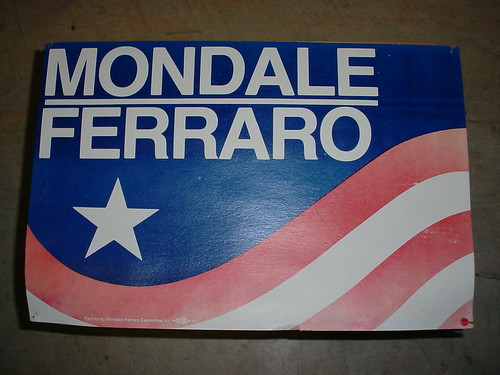
This time around, Joe had been elected from N.C.’s 4th congressional district as an openly gay Mondale delegate. Joe was one of only 65 openly gay delegates, alternates, and committee members in attendance. As recently as 1976, the number of openly gay delegates to the Democratic National Convention was four.
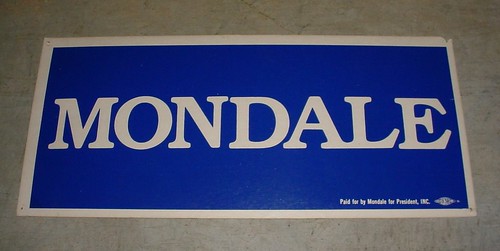
Joe saved this Mondale campaign sign from the 1984 Democratic National Convention.
On Sunday, July 15, Joe marched with his fellow delegates and alternates as the guests of honor at the head of a parade of 100,000 gay men, lesbians, and their supporters in the second ever National March for Lesbian and Gay Rights. They marched from the Castro district up Market Street to the George Moscone Center, where the convention would take place later that week.
Bobbi Campbell, the featured speaker in this video, was a gay activist and San Francisco's most prominent AIDS sufferer, first diagnosed in 1981. He would die of AIDS exactly one month after the march, on August 15, 1984.
It was not the first national gay and lesbian march (which took place in Washington, D.C. in 1979, in the wake of Harvey Milk’s assassination), or the biggest (three years later, in October, 1987, between 200,000 and 500,000 marchers would return to D.C.).
But this day, more than any other, was a political coming out for the gay liberation movement. It signaled that gays and lesbians were a force to be reckoned with in national Democratic politics, and Joe must have been thrilled to be marching at the front of the line.
Sunday, April 1, 1984
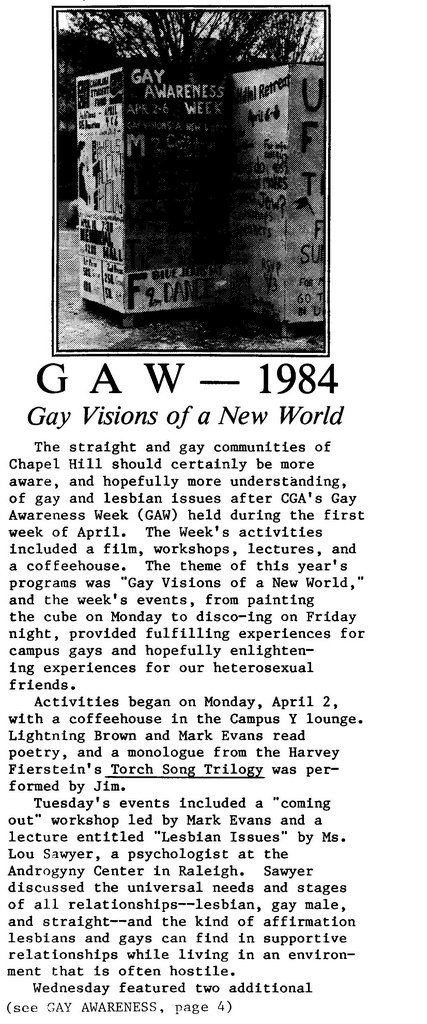
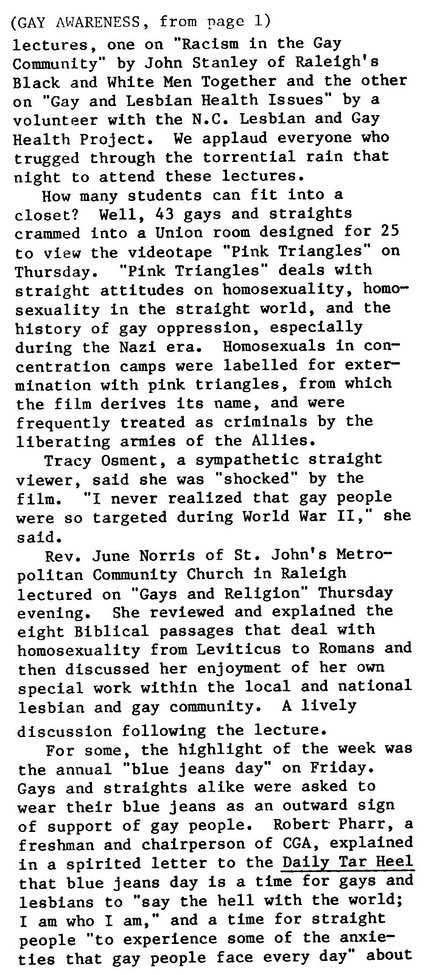
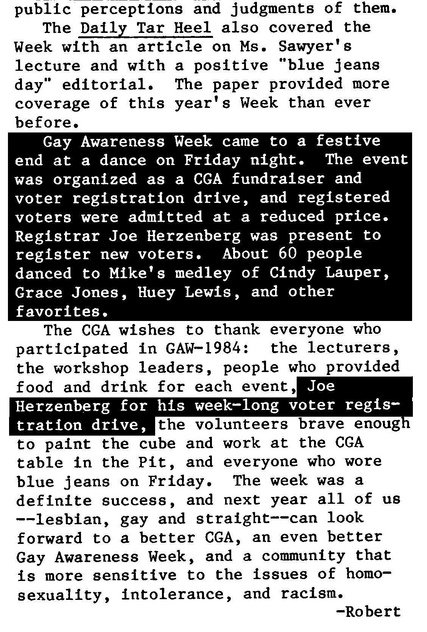

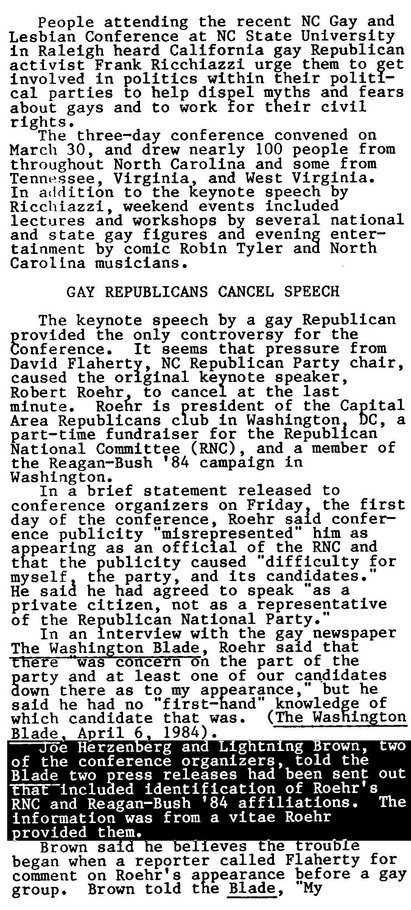
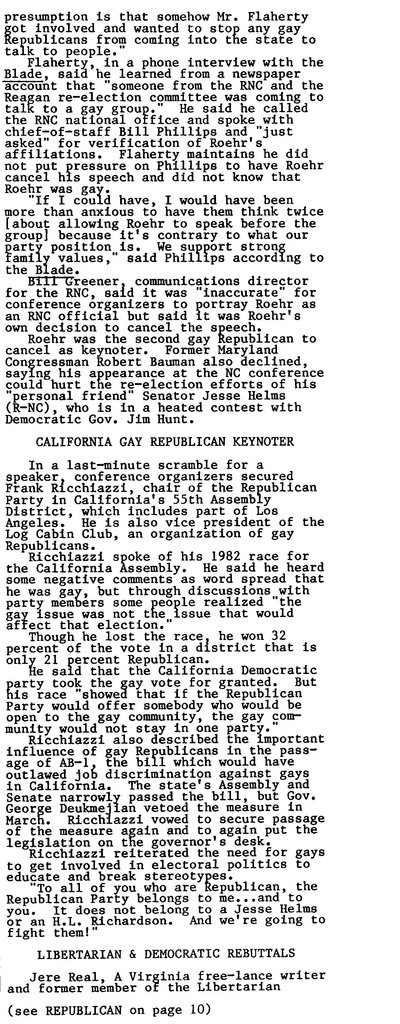
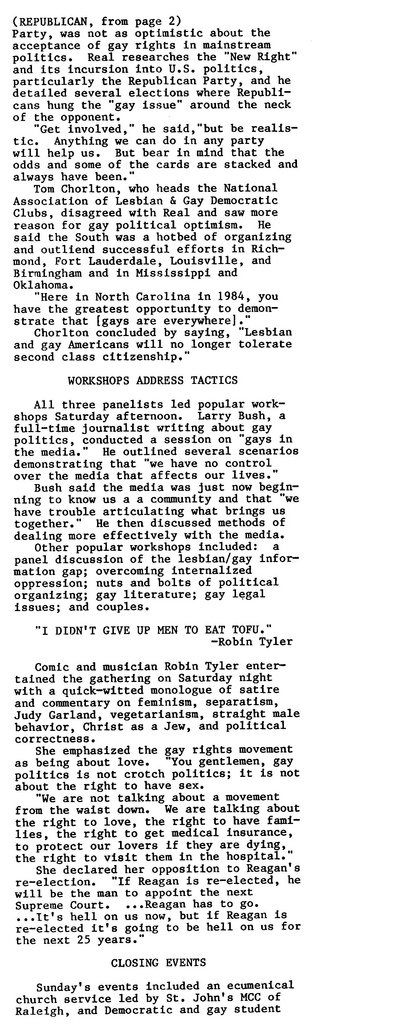
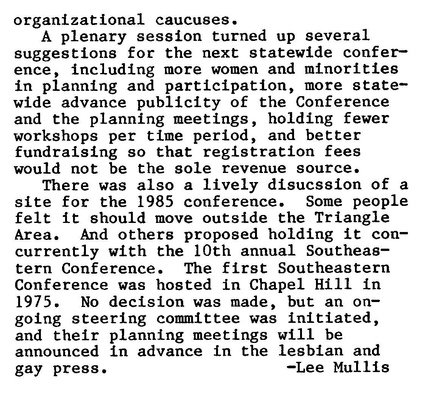
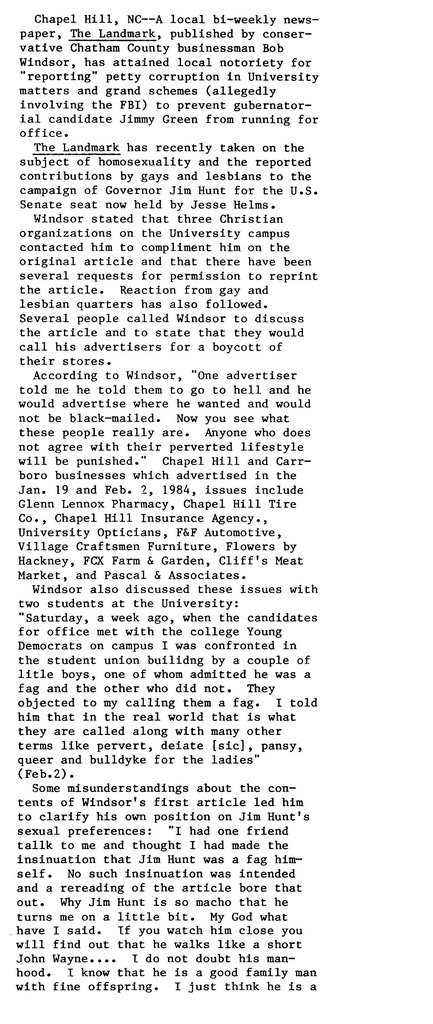
Thursday, March 1, 1984

Sunday, May 1, 1983
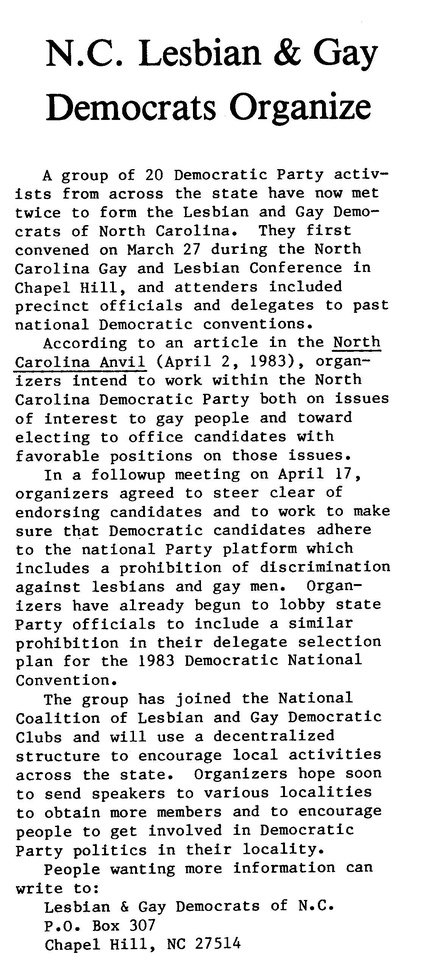
N.C. Lesbian & Gay Democrats Organize
Lambda, Carolina Gay Association Newsletter, page 2, May/June, 1983
(Editor's note - Although not mentioned in this article, Joe and Lightning Brown were key organizers and co-founders of the Lesbian & Gay Democrats of North Carolina.)
(Editor's note - Although not mentioned in this article, Joe and Lightning Brown were key organizers and co-founders of the Lesbian & Gay Democrats of North Carolina.)
Monday, November 1, 1982
Gay Democratic Club?
Lambda, Carolina Gay Association Newsletter, page 2, November, 1982

The organizing that grew out of Lightning and Joe's efforts to form a gay Democratic club in Orange County led to a meeting of approximately twenty activists from across the state on March 27, 1983 at the N.C. Gay and Lesbian Conference in Chapel Hill, and the subsequent founding of the Lesbian and Gay Democrats of North Carolina.
Sunday, March 7, 1982

Thursday, October 1, 1981
Lightning Strikes Town Council
Lambda, Carolina Gay Association Newsletter, page 3, October/November, 1981
Lightning Brown, a local member of the gay community, is currently running for a seat on the Town Council here in Chapel Hill…
Cont’d as PDF in Lamdba archives
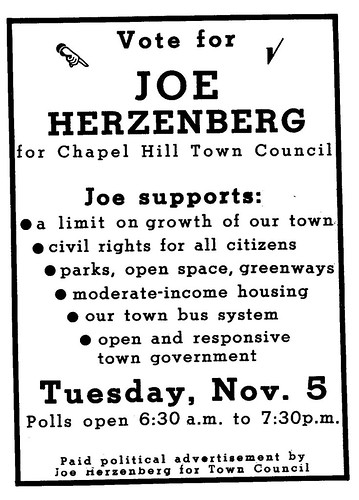
Tuesday, November 6, 1979
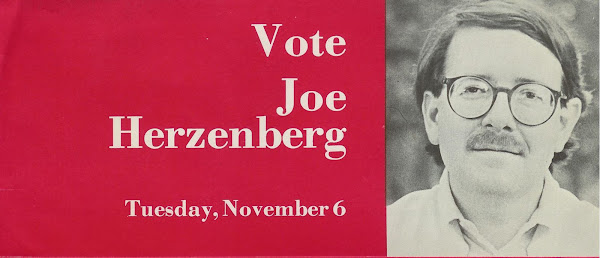
Joe’s first campaign for public office, 1979
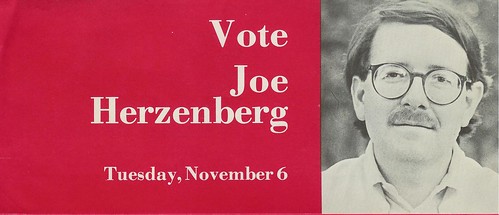
Campaign flyer from Joe’s first Chapel Hill Board of Aldermen race, 1979
During Joe's first unsuccessful campaign for the Chapel Hill Board of Aldermen (later re-named the Town Council), in 1979, he came in fifth in the race to fill four seats. He was not publicly out at this time, although as one longtime observer of the Triangle's gay community claimed when interviewed in 2000 by Chris McGinnis as part of Listening For A Change: A History of Gay Men and Transgender People in the South, "everyone knew Joe was gay."
Following the election, partially because of his status as the runner up with the highest vote total, Joe was appointed to fill Gerry Cohen’s unexpired term as Alderman, when Cohen stepped down to run for Mayor. He served two years in office, but would lose his race for re-election in 1981, the same year his partner, Lightning Brown, also ran unsuccessfully for the Board.
Sunday, December 31, 1978
Tuesday, October 15, 1974
Letter to James Meredith
Inventory of the James Howard Meredith Collection (MUM00293)
Elections. 1974.
b26f3 - Joseph Herzenberg to James Howard Meredith.
Re: Request that Meredith withdraw from the election in favor of Kenneth Dean.
October 15, 1974. Typed letter signed. Envelope. 1 page.
Elections. 1974.
b26f3 - Joseph Herzenberg to James Howard Meredith.
Re: Request that Meredith withdraw from the election in favor of Kenneth Dean.
October 15, 1974. Typed letter signed. Envelope. 1 page.
Saturday, April 28, 1973
Voter registration card from Joe’s first Chapel Hill address, 1973
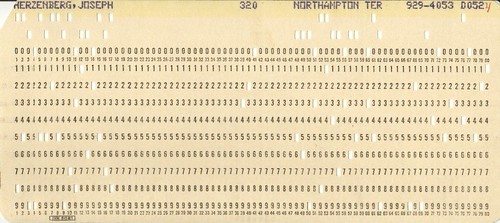
Joe served as precinct chair of East Franklin for 35 years, from 1972 until his death. When Joe went to the Orange County Board of Elections in Hillsborough in April, 1973 to pick up a computerized voter registration print-out of all the voters in his precinct, they gave him this copy of his own voter registration punchcard.
Over the years, he consistently organized a phenomenal Democratic turnout in East Franklin, as recounted in this story by Gerry Cohen, whose victorious Chapel Hill Town Council campaign Joe managed in the fall of 1973.
When Joe first came to Chapel Hill in 1969 as a history graduate student, working towards his PhD and researching the life of Frank Porter Graham, he lived off Airport Road in Northampton Terrace Apartments. A small path leads from the back of these apartments, winds up through the woods, and comes out on Cobb Terrace.
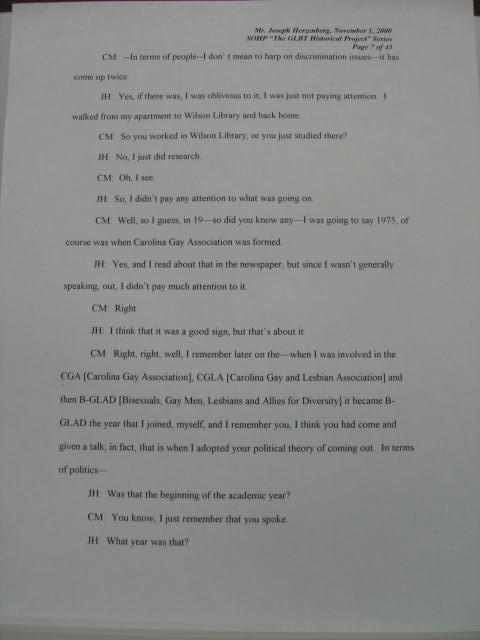
Interviewed by Chris McGinnis in 2000, Joe explained how during those initial few years, he was focused on his research and not paying attention to much else. "I walked from my apartment to Wilson Library and back home," said Joe. Every day, on his way to campus he would have gone up Cobb Terrace, a cool little street just a stone's throw away from downtown but set back from the world in a hidden corner. And passed right by the house at 6 Cobb Terrace, where Joe would end up living most of the rest of his life in Chapel Hill.
Wednesday, July 12, 1972
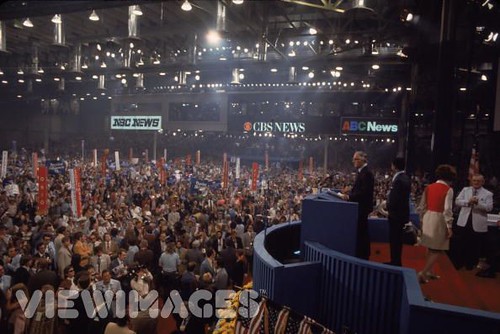
Joe votes on first ever gay rights plank at a national political party convention, Miami 1972
Joe attended the 1972 Democratic National Convention, along with his friend and colleague from Tougaloo College, John Dittmer, as an alternate delegate from Mississippi.
“The Mississippi Loyalist Democrats had booked a bunch of rooms at the convention hotel, and was not able to fill them,” recalled John Dittmer. “They looked for volunteers, and I asked Joe, then at Chapel Hill, if he wanted to go. The two of us went to Miami, and spent three long days and nights observing events.”
At five in the morning on July 12, the next to last day of the convention, with most of the regular Mississippi delegation gone to bed, the two of them finally made it to the floor as credentialed delegates and got to vote on a series of platform amendments too controversial for prime time.
They heard speeches by Jim Foster and Madeline Davis, the only two openly gay delegates that year, and the first ever openly gay speakers at a national political convention. Then they witnessed the introduction of the first ever gay rights plank to be debated by a major political party. Joe (and John as well) voted for it, even as the resolution went down to overwhelming defeat.
“I remember our walking out of the convention hall as the sun was rising, and Joe was not weary, but instead exhilarated by the experience,” said John Dittmer. “If he was not already hooked on a political career before that convention, he certainly was from that early morning on.”
Monday, November 30, 1970
Founding Mound Bayou
New York Times Sunday Magazine, Nov. 30, 1969, Page SM114
Founding Mound Bayou (Letter to the Editor)
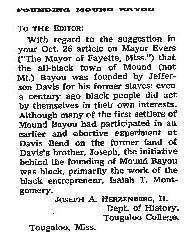
With regard to the suggestion in your Oct. 26 article on Mayor Evers ("The Mayor of Fayette, Miss.") that the all-black town of Mound (not Mt.) Bayou was founded by Jefferson Davis for his former slaves: even a century ago black people did act by themselves in their own interests.
Although many of the first settlers of Mound Bayou had participated in an earlier and abortive experiment at Davis Bend on the former land of Davis's brother, Joseph, the initiative behind the founding of Mound Bayou was black, primarily the work of the black entrepreneur, Isaiah T. Montgomery.
JOSEPH A. HERZENBERG, II.
Dept. of History, Tougaloo College. Tougaloo, Miss.
(Editor's note: Joe wrote this letter to the editor in 1969, but Blogger only allows posts to be categorized as far back as 1970.)
Founding Mound Bayou (Letter to the Editor)
With regard to the suggestion in your Oct. 26 article on Mayor Evers ("The Mayor of Fayette, Miss.") that the all-black town of Mound (not Mt.) Bayou was founded by Jefferson Davis for his former slaves: even a century ago black people did act by themselves in their own interests.
Although many of the first settlers of Mound Bayou had participated in an earlier and abortive experiment at Davis Bend on the former land of Davis's brother, Joseph, the initiative behind the founding of Mound Bayou was black, primarily the work of the black entrepreneur, Isaiah T. Montgomery.
JOSEPH A. HERZENBERG, II.
Dept. of History, Tougaloo College. Tougaloo, Miss.
(Editor's note: Joe wrote this letter to the editor in 1969, but Blogger only allows posts to be categorized as far back as 1970.)
Subscribe to:
Posts (Atom)