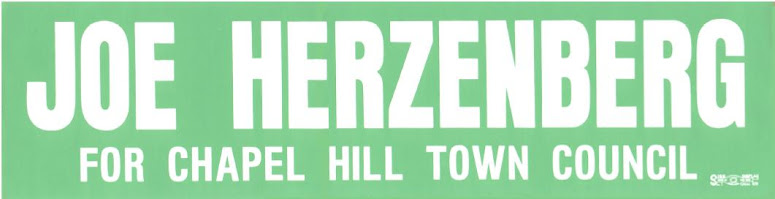
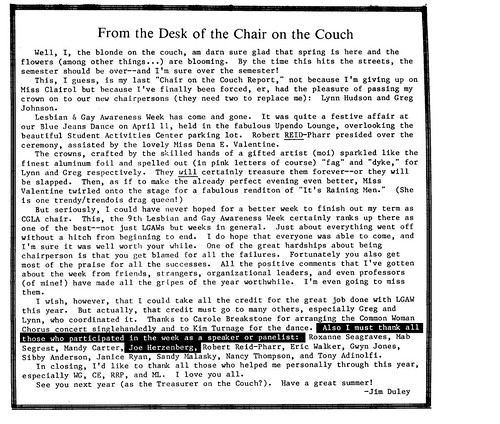
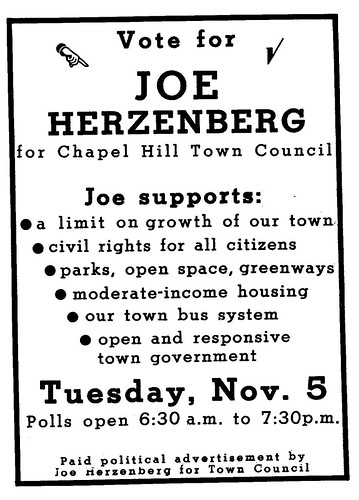
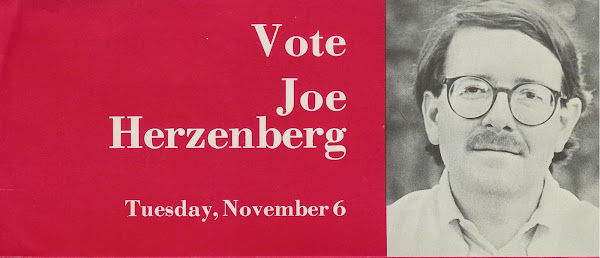
Campaign fundraiser reception invitation from 1987, Herzenberg for Town Council. Courtesy of Mark Donahue.






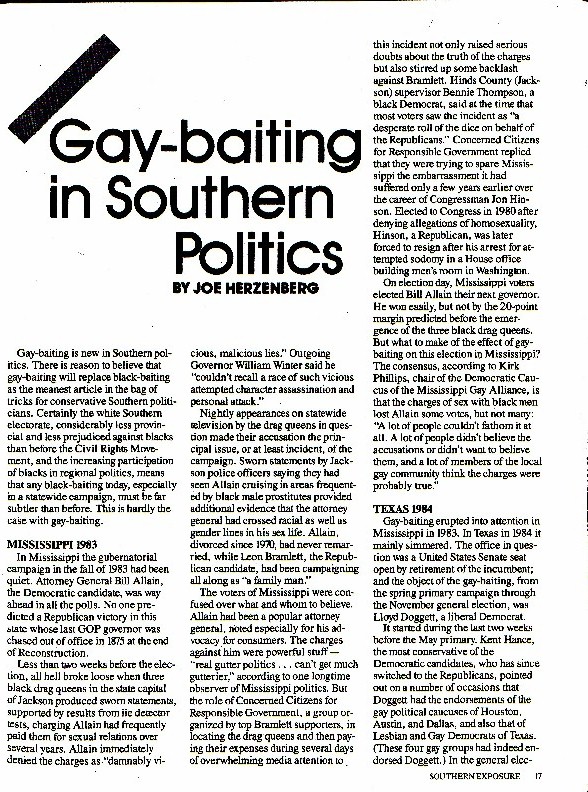
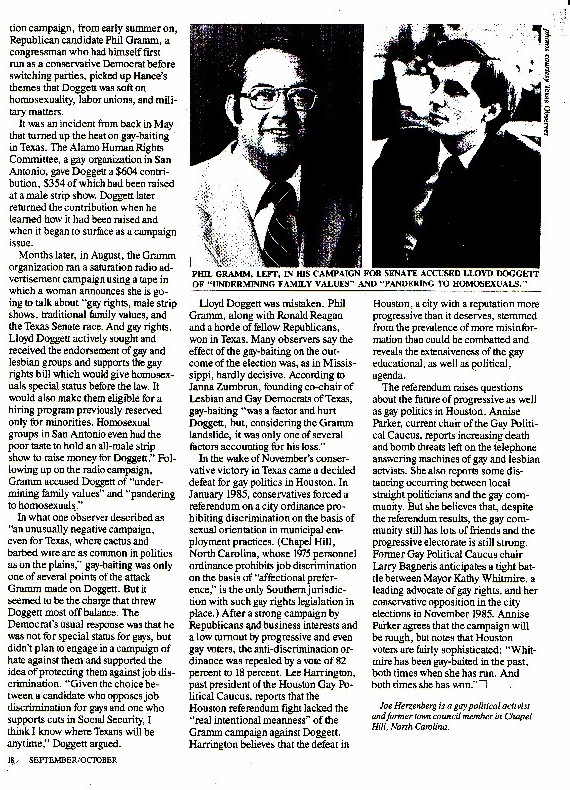
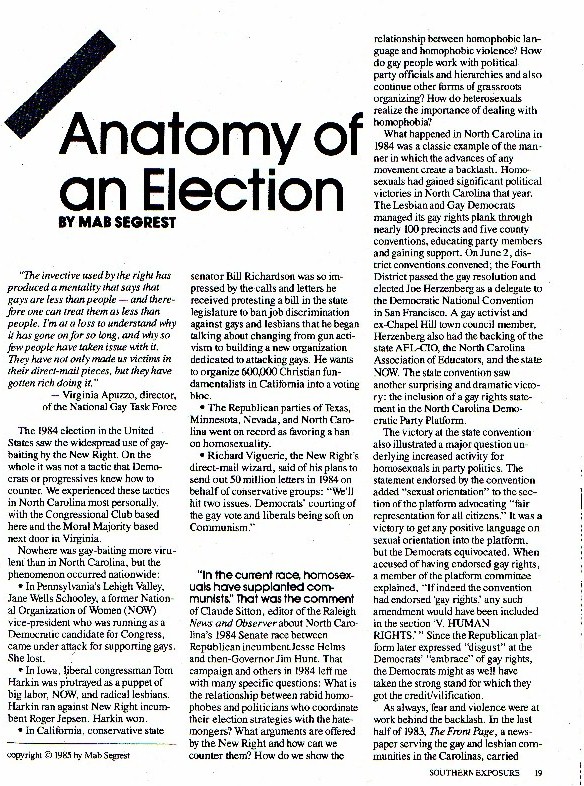
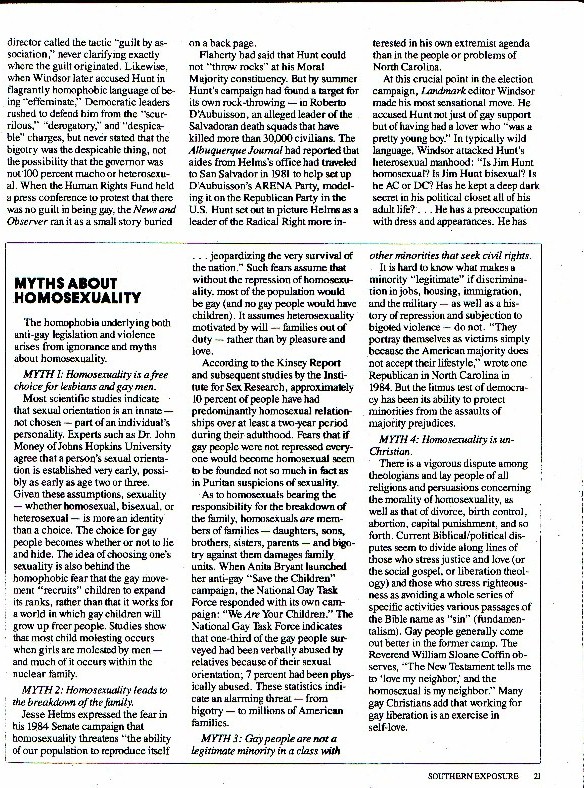
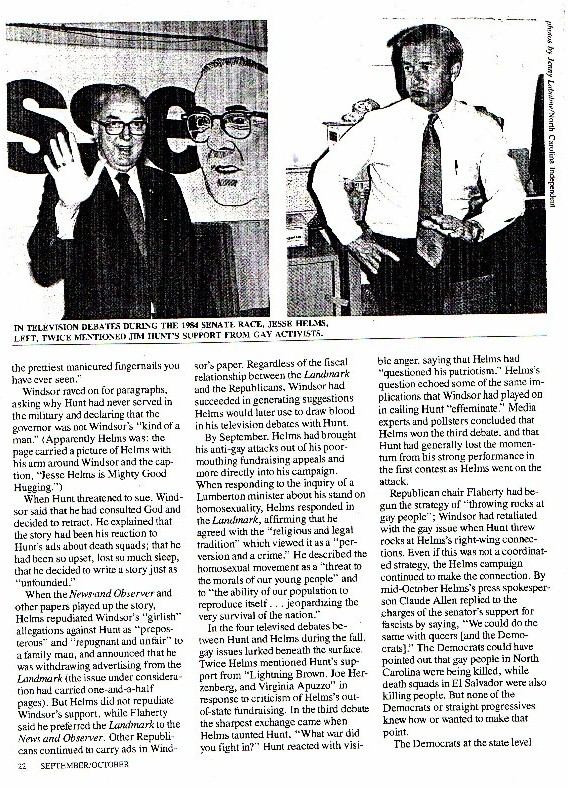
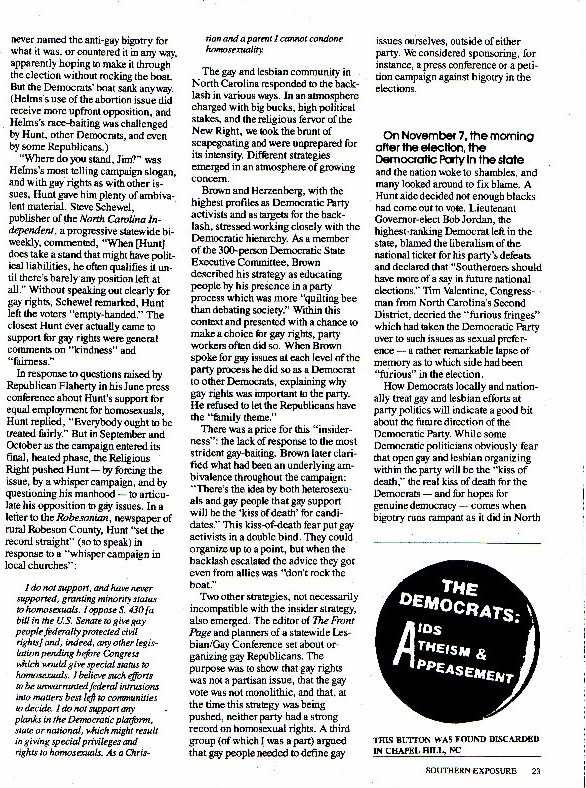
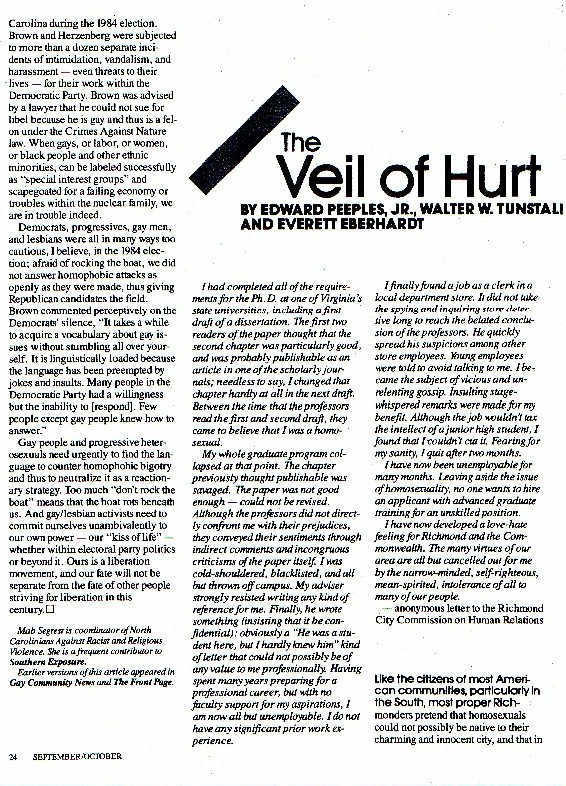
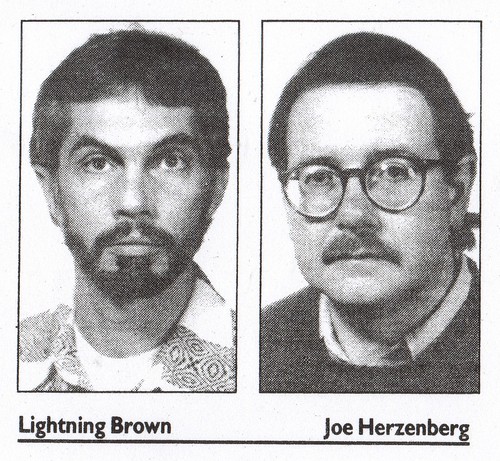
This article by gay activist and writer Mab Segrest appeared in Southern Exposure magazine's Fall 1985 issue. It provides a comprehensive look at how the Helms machine used shameful hate mongering against Joe, Lightning Brown, and the rest of North Carolina's gay and lesbian community to eke out Jesse's narrow 1984 re-election.
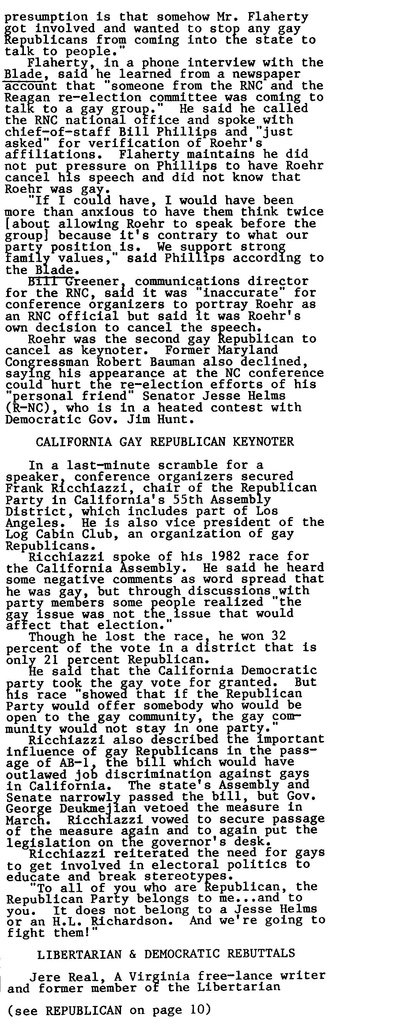
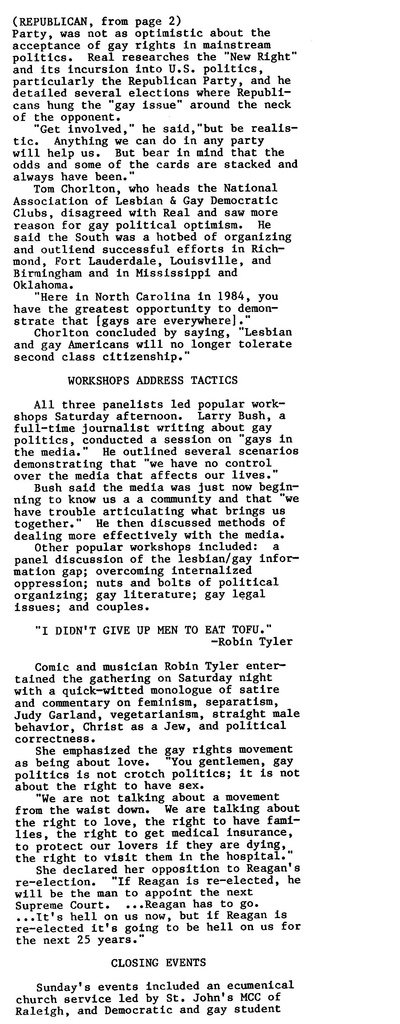
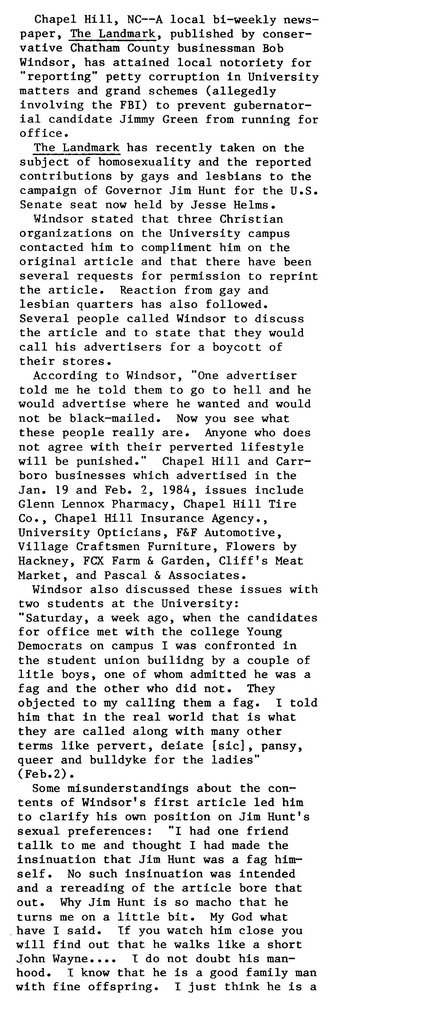
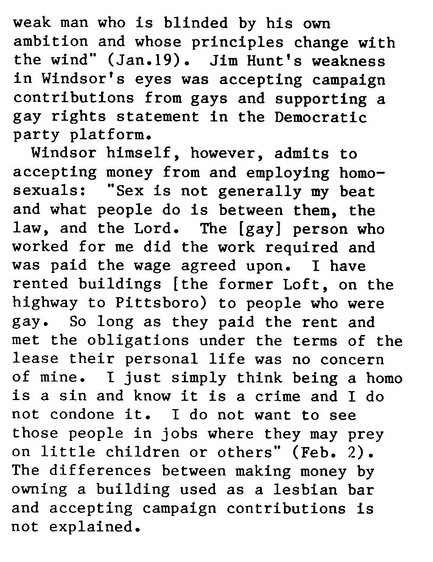
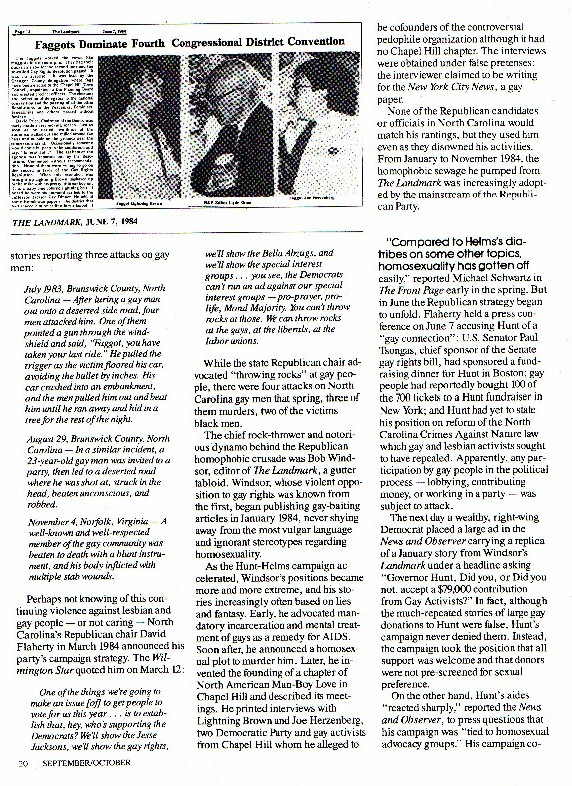
The inset of the article's second page is a reprint of a story that appeared in The Landmark, a virulently anti-gay publication printed in Chatham County, in June 1984, titled "Faggots Dominate Fourth Congressional District Convention." It was at this convention that Joe was elected as an openly gay Mondale delegate to the Democratic National Convention in San Francisco.

Sadly, this article is typical of the scurrilous bile that The Landmark published two or three times a month throughout 1984. It was distributed in regular editions of tens of thousands of free copies all over North Carolina, and its press run increased dramatically in the weeks leading up to Election Day. Every word of this hate-filled propaganda tool passing as a "newspaper" dripped with bigotry and prejudice.
"The faggots worked the crowd like maggots in a manure pile. They had their ducks in a row for the second time and the so-called Gay Rights resolution passed."
- The Landmark, June 7, 1984
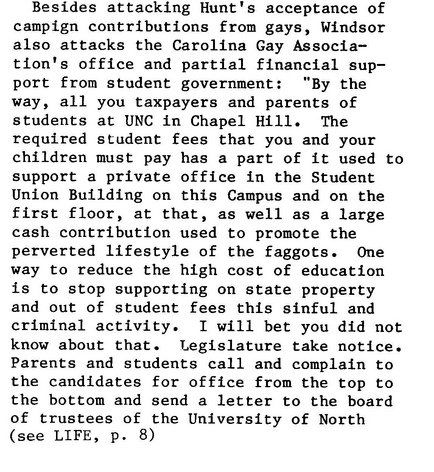
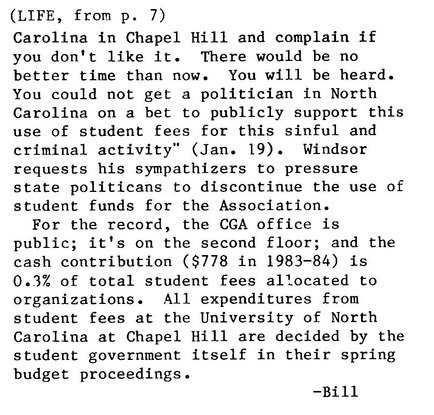
The paper's homophobic publisher, Bob Windsor of Chapel Hill, was a cog in the machine of right-wing Helms backers. According to lyndonlarouchewatch.org, Windsor was being used by the political organization of extremist Lyndon LaRouche to spread anti-gay filth around the state and help ensure Helms’ re-election.
Former LaRouche security staffer Charles Tate "says he was told in early 1984 that work would be done on Helms's behalf. This was no surprise to Tate: he knew the security staff had been in touch with a top Helms aide for several years…Security staffers discussed sending an infiltrator into the Hunt campaign, but decided they could do the job best through undercover phone calls."
Posing as reporters for the black and gay press, LaRouche staffers made and taped phone calls to gay activists and civil rights leaders around the country who were backing Hunt. Articles based on distorted excerpts from the phone calls were then published in issues of The Landmark.
"The idea was to show that Hunt was getting substantial local and national support from constituencies disliked by many conservative Democrats…At least some of the tapes used by The Landmark came from LaRouche's security staff.
In early March 1984, a LaRouchian phoned Virginia Apuzzo, director of the National Gay and Lesbian Task Force, pretending to be a news reporter. Charles Tate says he heard the call being made and "saw the tape recorder running." A transcript of Apuzzo’s remarks appeared in the March 29 issue of The Landmark, which also included excerpts from a phone conversation with Lightning Brown, a gay activist in Chapel Hill.
Brown says he received two calls. The first was from Grant Duay, a supposed reporter for a gay weekly, the New York City News. Brown said that Duay "asked about my fund raising for Hunt. The details ended up in The Landmark right away—it was frightening." Duay was in fact a notorious LaRouche operative who had previously used the New York City News as his cover for interviewing and taping political opponents of LaRouche. (In 1986 Duay would be arrested in Manhattan as part of a homosexual child pornography ring.)
Brown's second call was from the black LaRouchian. "I told him I felt sorry for the publisher of The Landmark and that I had prayed for him," said Brown, who is a Quaker. "My remark later appeared in The Landmark. It was supposed to prove I was a devil worshipper."
Landmark publisher Windsor was in close contact with the LaRouchians throughout that spring. He accompanied Tom Allred, Hunt's LaRouchian opponent in the Democratic primary, on a trip to Raleigh. "We toured the legislature and I introduced him to Liston Ramsey, speaker of the house, and many other people,” Windsor wrote in a front-page article about Allred.
In a 1987 phone interview Windsor said he had also attended a meeting held to recruit North Carolina conservatives to run on the LaRouche slate, Windsor claimed that a number of his conservative friends had contributed money to the NDPC (National Democratic Policy Committee – one of LaRouche’s national political organizations), including one $50,000 contribution.
- LaRouche and the New American Fascism, by Dennis King, Chapter 15 - LaRouche and the Reagan Revolution, from www.lyndonlarouchewatch.org)"
Besides running made-up stories that slandered Joe and Lightning in every way possible, including accusations that they had started a Chapel Hill NAMBLA (North American Man-Boy Love Association) chapter and were secretly "porno kings," The Landmark also published their home addresses and did everything possible to incite violence against the two of them.
No wonder, as Segrest recounts in her article, that "Brown and Herzenberg were subjected to more than a dozen separate incidents of intimidation, vandalism and harassment…for their work within the Democratic Party."
In a 1984 interview with the Independent Weekly when Joe and Lightning were awarded two of the Indy's first-ever Citizen Awards, Lightning told of how "two people even threatened to kill me on Rosemary Street." Joe called the attacks "very disruptive and at times painful." Asked if he had been scared, he admitted, with a subtlety that testified to his courage, "At moments."
At the time "Anatomy of An Election" was published in Southern Exposure, Mab Segrest served as coordinator of North Carolinians Against Racist and Religious Violence. Earlier versions of her article appeared in Gay Community News and The Front Page.
In the summer of 1984, Joe went to the Democratic National Convention in San Francisco. Joe had previously attended the 1972 Democratic Convention in Miami, along with his friend and colleague from Tougaloo College, John Dittmer, as an alternate delegate from Mississippi.
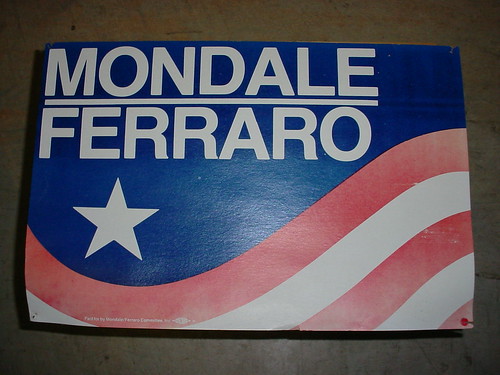
This time around, Joe had been elected from N.C.’s 4th congressional district as an openly gay Mondale delegate. Joe was one of only 65 openly gay delegates, alternates, and committee members in attendance. As recently as 1976, the number of openly gay delegates to the Democratic National Convention was four.
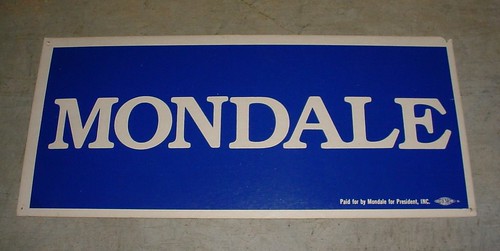
Joe saved this Mondale campaign sign from the 1984 Democratic National Convention.
On Sunday, July 15, Joe marched with his fellow delegates and alternates as the guests of honor at the head of a parade of 100,000 gay men, lesbians, and their supporters in the second ever National March for Lesbian and Gay Rights. They marched from the Castro district up Market Street to the George Moscone Center, where the convention would take place later that week.
Bobbi Campbell, the featured speaker in this video, was a gay activist and San Francisco's most prominent AIDS sufferer, first diagnosed in 1981. He would die of AIDS exactly one month after the march, on August 15, 1984.
It was not the first national gay and lesbian march (which took place in Washington, D.C. in 1979, in the wake of Harvey Milk’s assassination), or the biggest (three years later, in October, 1987, between 200,000 and 500,000 marchers would return to D.C.).
But this day, more than any other, was a political coming out for the gay liberation movement. It signaled that gays and lesbians were a force to be reckoned with in national Democratic politics, and Joe must have been thrilled to be marching at the front of the line.
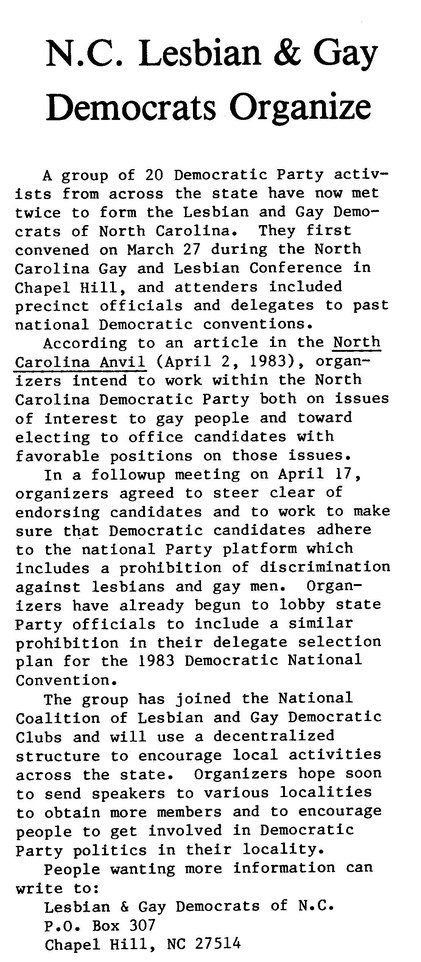

The organizing that grew out of Lightning and Joe's efforts to form a gay Democratic club in Orange County led to a meeting of approximately twenty activists from across the state on March 27, 1983 at the N.C. Gay and Lesbian Conference in Chapel Hill, and the subsequent founding of the Lesbian and Gay Democrats of North Carolina.
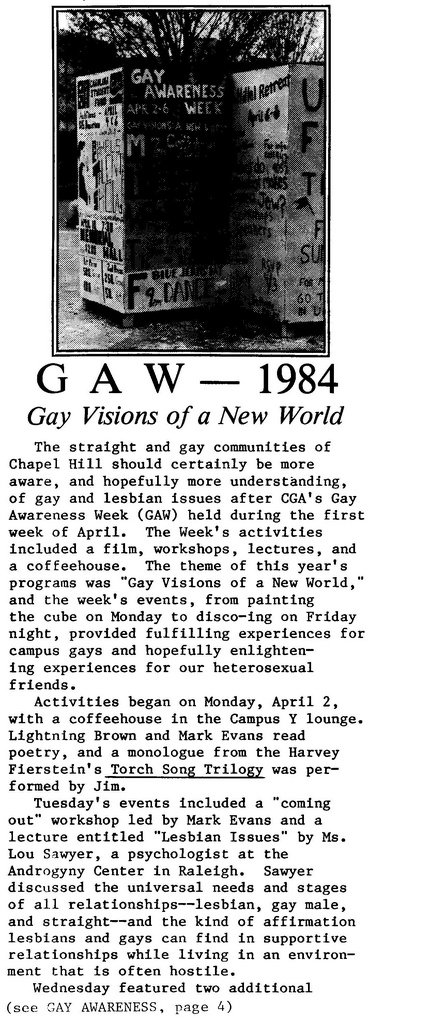
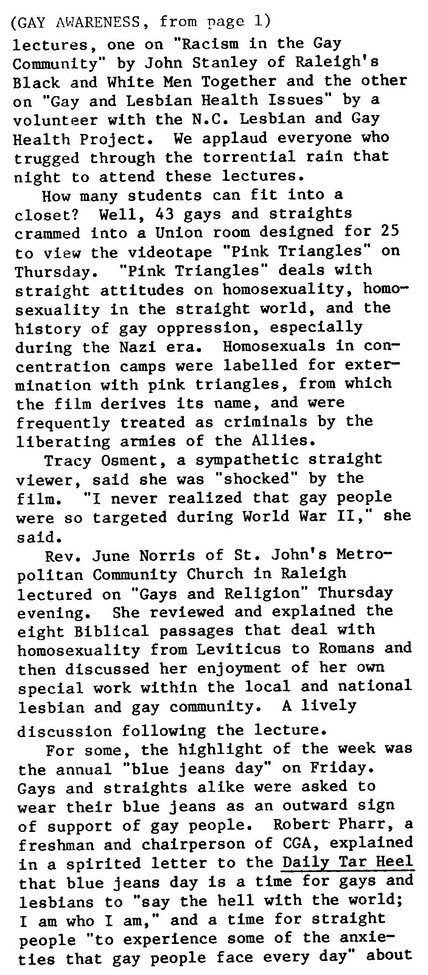
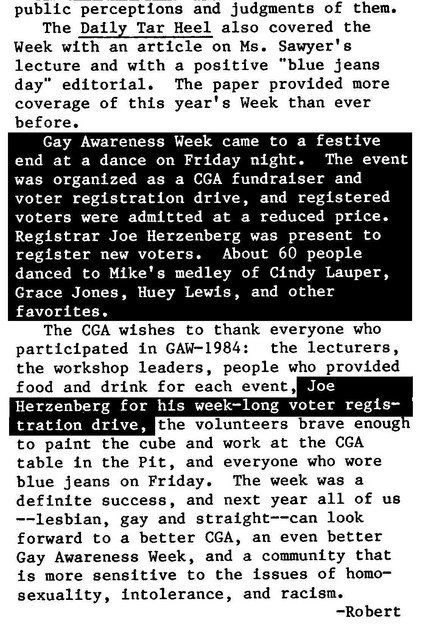
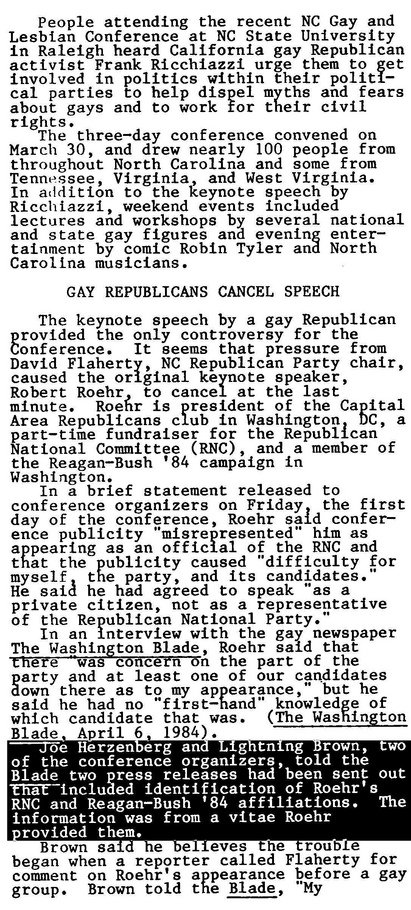
Lightning Brown, a local member of the gay community, is currently running for a seat on the Town Council here in Chapel Hill…
Cont’d as PDF in Lamdba archives
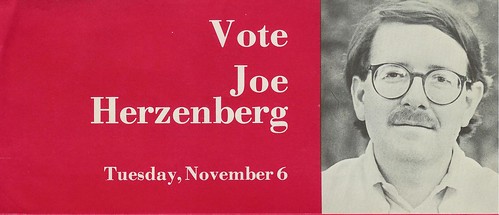
During Joe's first unsuccessful campaign for the Chapel Hill Board of Aldermen (later re-named the Town Council), in 1979, he came in fifth in the race to fill four seats. He was not publicly out at this time, although as one longtime observer of the Triangle's gay community claimed when interviewed in 2000 by Chris McGinnis as part of Listening For A Change: A History of Gay Men and Transgender People in the South, "everyone knew Joe was gay."
Following the election, partially because of his status as the runner up with the highest vote total, Joe was appointed to fill Gerry Cohen’s unexpired term as Alderman, when Cohen stepped down to run for Mayor. He served two years in office, but would lose his race for re-election in 1981, the same year his partner, Lightning Brown, also ran unsuccessfully for the Board.