



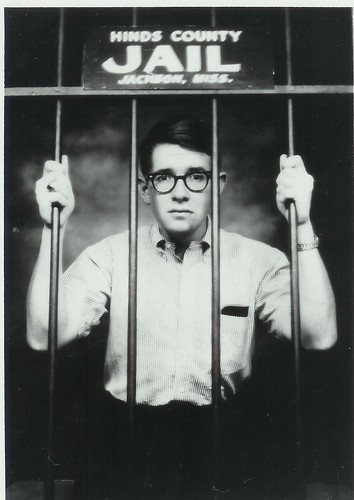
The News & Observer, July 2, 1996
By JOYCE CLARK, STAFF WRITER
Chapel Hill and Carrboro residents hoping to catch a fireworks show this Fourth of July will be out of luck unless they roam to Durham, Raleigh or Cary.
For the first time this decade, the town's annual fireworks display at Kenan Stadium will be on hiatus while renovations are made to the football stadium.
The festivities will move to Chapel Hill as residents converge on McCorkle Place at the University of North Carolina at Chapel Hill for picnicking, music and a synchronized laser light show.
...
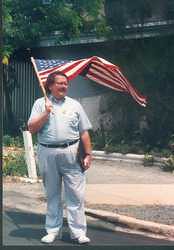
Joe Herzenberg, a longtime resident and former Town Council member who usually spends the Fourth of July at the Kenan Stadium celebration, said he plans to spend the afternoon picnicking at the Horace Williams House before heading over to McCorkle Place.
"I love fireworks," he said. "But I really don't like the idea of going to Durham, so I'm curious about what these laser lights are like. I'm loyal to my town."
Tuesday, July 2, 1996

Gays facing a changed atmosphere
The News & Observer, page A1, July 2, 1996
by RUTH SHEEHAN
It's been a tough spring for the gay community.
With national polls showing voters strongly opposing gay marriage, the General Assembly has banned same-sex unions. Congress is revving up its Defense of Marriage Act, and President Clinton has promised to sign it. Baptists are boycotting Disney for providing benefits to "domestic partners." And the N.C. Board of Education wants to instruct students that homosexuality is illegal and immoral.
...
The same-sex marriage legislation notwithstanding, gays and lesbians acknowledge that they have also seen many advances over the past four years.
...
To date, nine states have passed legislation prohibiting discrimination on the basis of sexual orientation. The towns of Chapel Hill and Carrboro offer benefits to domestic partners of their employees.
N.C. Pride PAC, which gives money to candidates who are sympathetic to gay issues, is among the top 20 political action committees in dollars raised. And the national Gay and Lesbian Victory Fund reports that of 511,000 elected officials, 105, including Carrboro Mayor Mike Nelson, are openly gay. That's the highest number ever, up from 75 in 1992, when the officials' national convention was in Chapel Hill.
Joe Herzenberg, a former Chapel Hill City Council member who was the first openly gay elected official in the state, said he and others at the convention overestimated the impact of Clinton's election.
"I thought this was a giant step forward," he said. Now, he said, he realizes that changes in society's attitudes toward homosexuality come in small steps - steps that have continued amid the backlash of the past few years. He said debate on these types of issues - positive or negative - is a step forward.
"In my life," said Herzenberg, 54, "I never would have expected to see a gay issue debated on the floor of the General Assembly."
by RUTH SHEEHAN
It's been a tough spring for the gay community.
With national polls showing voters strongly opposing gay marriage, the General Assembly has banned same-sex unions. Congress is revving up its Defense of Marriage Act, and President Clinton has promised to sign it. Baptists are boycotting Disney for providing benefits to "domestic partners." And the N.C. Board of Education wants to instruct students that homosexuality is illegal and immoral.
...
The same-sex marriage legislation notwithstanding, gays and lesbians acknowledge that they have also seen many advances over the past four years.
...
To date, nine states have passed legislation prohibiting discrimination on the basis of sexual orientation. The towns of Chapel Hill and Carrboro offer benefits to domestic partners of their employees.
N.C. Pride PAC, which gives money to candidates who are sympathetic to gay issues, is among the top 20 political action committees in dollars raised. And the national Gay and Lesbian Victory Fund reports that of 511,000 elected officials, 105, including Carrboro Mayor Mike Nelson, are openly gay. That's the highest number ever, up from 75 in 1992, when the officials' national convention was in Chapel Hill.
Joe Herzenberg, a former Chapel Hill City Council member who was the first openly gay elected official in the state, said he and others at the convention overestimated the impact of Clinton's election.
"I thought this was a giant step forward," he said. Now, he said, he realizes that changes in society's attitudes toward homosexuality come in small steps - steps that have continued amid the backlash of the past few years. He said debate on these types of issues - positive or negative - is a step forward.
"In my life," said Herzenberg, 54, "I never would have expected to see a gay issue debated on the floor of the General Assembly."
Wednesday, May 8, 1996
Ex-council member who resigned under a cloud up for town board
Chapel Hill Herald, May 8, 1996
By RAY GRONBERG
CHAPEL HILL -- Former Town Council Member Joe Herzenberg, who resigned in 1993 after pleading guilty to tax evasion, is vying for a seat on Chapel Hill's Greenways Commission.
Late last month Herzenberg won a unanimous endorsement from Greenways Commission members who reviewed applicants for two upcoming vacancies.
His nomination will go to the Town Council later this spring, but it's already produced a bit of tongue-wagging among the elected officials who will have to approve it.
Council Member Joe Capowski said Herzenberg's history raises doubts in his mind about the nomination.
"We need responsible recommendations from those boards and people on them who recognize the value of taxpayers' money, especially in light of the fact we're about to start talking about a million-dollar bond for parks and recreation and greenways," Capowski said.
Other council members, however, said they know of no reason to deny Herzenberg a seat.
"I don't see why [people] would be concerned with an advisory group," said Council Member Lee Pavao. "They can recommend funds to be allocated, but they themselves don't handle funds. It's the council that makes those decisions."
"Joe's difficulty with not paying taxes did raise doubts about the appropriateness of his retaining elected office, but I do not see a problem with him serving the community in an advisory capacity on something he cares deeply about," added Council Member Julie Andresen. "I think we ought to take advantage of it."
Herzenberg triggered a furor in August 1992 when he pleaded guilty to misdemeanor charges of failing to file his 1989 N.C. income tax return and 1990 state intangibles tax return.
The admission, the result of a negotiated plea with the attorney general's office, was accompanied by revelations that he had not filed state tax returns from 1978 to 1992 or intangibles returns from 1986 to 1992.
Officials who had seen Herzenberg, a fixture on the local political scene, lead the ticket in the 1991 council election soon called on him to resign.
When he didn't, they asked the N.C. General Assembly to give local voters permission to stage recall elections. Legislators agreed in 1993, and residents shortly afterward organized the county's first recall petition.
Organizers of that drive said then that they objected to the town's having a convicted tax evader in a position to rule on the use of taxpayer dollars.
Herzenberg resigned his seat on Sept. 23, 1993, as elections workers were close to validating the recall petition.
The former council member has remained active in local affairs since leaving office. Questions about the Greenways Commission post seemed to catch him by surprise Monday.
Herzenberg noted that his former colleagues appointed him to serve on another advisory group, the museum study committee, that went about its business for a year without fuss.
That appointment came in June 1994. Herzenberg was one of 12 people named to the panel by acclamation, according to council minutes.
The panel planned a municipal museum in the old Chapel Hill Library building on East Franklin Street. As part of that study it outlined the capital and operating budgets organizers will need to get the museum off the ground.
The museum committee wrapped up its work in May 1995. Herzenberg said he applied for the greenways post because "it just happened for the first time in like 20 years" he's not now on one of Chapel Hill's advisory boards.
Herzenberg added that he's looking forward to serving on a board that has been "sort of a stepchild" in town politics.
At one time the council considered merging the Greenways Commission with the town's Parks and Recreation Commission.
"Greenways needs a little boost in its efforts," Herzenberg said. "I don't want to critical, but I think it needs a little more focus, leadership, something or another."
He added that he doesn't think the events of 1992 and 1993 will prove a stumbling block to an appointment.
Capowski, however, said he wants to talk to his former colleague before making a decision.
"I'm concerned about his being part of the decision-making process about the spending of taxpayers' money unless he can assure us he has paid every bit of his back taxes" for the 14 years the attorney general's office said he hadn't filed, Capowski said.
As part of the plea, Herzenberg was required to pay $800 in back taxes for 1989 and $600 for 1990. He said Monday that, "to the best of my knowledge," he complied with that ruling.
But whether he has since paid for other years when he didn't file is a different issue -- one even Herzenberg says he can't answer.
"You're asking me questions I've not thought about for so long," Herzenberg said. "I think it's paid off, I'm not sure. I think we gave them some money, and they did not ask for more."
N.C. Department of Revenue officials declined Monday to comment on Herzenberg's case.
By RAY GRONBERG
CHAPEL HILL -- Former Town Council Member Joe Herzenberg, who resigned in 1993 after pleading guilty to tax evasion, is vying for a seat on Chapel Hill's Greenways Commission.
Late last month Herzenberg won a unanimous endorsement from Greenways Commission members who reviewed applicants for two upcoming vacancies.
His nomination will go to the Town Council later this spring, but it's already produced a bit of tongue-wagging among the elected officials who will have to approve it.
Council Member Joe Capowski said Herzenberg's history raises doubts in his mind about the nomination.
"We need responsible recommendations from those boards and people on them who recognize the value of taxpayers' money, especially in light of the fact we're about to start talking about a million-dollar bond for parks and recreation and greenways," Capowski said.
Other council members, however, said they know of no reason to deny Herzenberg a seat.
"I don't see why [people] would be concerned with an advisory group," said Council Member Lee Pavao. "They can recommend funds to be allocated, but they themselves don't handle funds. It's the council that makes those decisions."
"Joe's difficulty with not paying taxes did raise doubts about the appropriateness of his retaining elected office, but I do not see a problem with him serving the community in an advisory capacity on something he cares deeply about," added Council Member Julie Andresen. "I think we ought to take advantage of it."
Herzenberg triggered a furor in August 1992 when he pleaded guilty to misdemeanor charges of failing to file his 1989 N.C. income tax return and 1990 state intangibles tax return.
The admission, the result of a negotiated plea with the attorney general's office, was accompanied by revelations that he had not filed state tax returns from 1978 to 1992 or intangibles returns from 1986 to 1992.
Officials who had seen Herzenberg, a fixture on the local political scene, lead the ticket in the 1991 council election soon called on him to resign.
When he didn't, they asked the N.C. General Assembly to give local voters permission to stage recall elections. Legislators agreed in 1993, and residents shortly afterward organized the county's first recall petition.
Organizers of that drive said then that they objected to the town's having a convicted tax evader in a position to rule on the use of taxpayer dollars.
Herzenberg resigned his seat on Sept. 23, 1993, as elections workers were close to validating the recall petition.
The former council member has remained active in local affairs since leaving office. Questions about the Greenways Commission post seemed to catch him by surprise Monday.
Herzenberg noted that his former colleagues appointed him to serve on another advisory group, the museum study committee, that went about its business for a year without fuss.
That appointment came in June 1994. Herzenberg was one of 12 people named to the panel by acclamation, according to council minutes.
The panel planned a municipal museum in the old Chapel Hill Library building on East Franklin Street. As part of that study it outlined the capital and operating budgets organizers will need to get the museum off the ground.
The museum committee wrapped up its work in May 1995. Herzenberg said he applied for the greenways post because "it just happened for the first time in like 20 years" he's not now on one of Chapel Hill's advisory boards.
Herzenberg added that he's looking forward to serving on a board that has been "sort of a stepchild" in town politics.
At one time the council considered merging the Greenways Commission with the town's Parks and Recreation Commission.
"Greenways needs a little boost in its efforts," Herzenberg said. "I don't want to critical, but I think it needs a little more focus, leadership, something or another."
He added that he doesn't think the events of 1992 and 1993 will prove a stumbling block to an appointment.
Capowski, however, said he wants to talk to his former colleague before making a decision.
"I'm concerned about his being part of the decision-making process about the spending of taxpayers' money unless he can assure us he has paid every bit of his back taxes" for the 14 years the attorney general's office said he hadn't filed, Capowski said.
As part of the plea, Herzenberg was required to pay $800 in back taxes for 1989 and $600 for 1990. He said Monday that, "to the best of my knowledge," he complied with that ruling.
But whether he has since paid for other years when he didn't file is a different issue -- one even Herzenberg says he can't answer.
"You're asking me questions I've not thought about for so long," Herzenberg said. "I think it's paid off, I'm not sure. I think we gave them some money, and they did not ask for more."
N.C. Department of Revenue officials declined Monday to comment on Herzenberg's case.
Sunday, April 14, 1996
Pep rally attracts county Democrats
Chapel Hill Herald, April 14, 1996
By JADA HARRIS ATWATER
HILLSBOROUGH -- All the county's "movers and shakers" were present as Orange County's Democrats gathered Saturday for a pep rally in the Margaret Lane Court House.
The annual Orange County Democratic Convention included everything from greetings from the Democratic president to barbecue cooked by the local Democratic sheriff.
...
Delegates sought support for ... Jim Hunt, for governor; and Harvey Gantt, to replace Sen. Jesse Helms in the U.S. Senate.
In supporting Gantt, former Chapel Hill Councilman Joe Herzenberg said Democrats would do the state and the country a great honor by voting Gantt into office.
"I think this time we can make it," Herzenberg said.
"We can finally bring our senior senator home where he can spend more time with his grandchildren, who I'm sure miss him," he added, to the delight of the audience.
By JADA HARRIS ATWATER
HILLSBOROUGH -- All the county's "movers and shakers" were present as Orange County's Democrats gathered Saturday for a pep rally in the Margaret Lane Court House.
The annual Orange County Democratic Convention included everything from greetings from the Democratic president to barbecue cooked by the local Democratic sheriff.
...
Delegates sought support for ... Jim Hunt, for governor; and Harvey Gantt, to replace Sen. Jesse Helms in the U.S. Senate.
In supporting Gantt, former Chapel Hill Councilman Joe Herzenberg said Democrats would do the state and the country a great honor by voting Gantt into office.
"I think this time we can make it," Herzenberg said.
"We can finally bring our senior senator home where he can spend more time with his grandchildren, who I'm sure miss him," he added, to the delight of the audience.
Sunday, March 10, 1996
No evidence Helms ever made zoo remark
Chapel Hill Herald, March 10, 1996
I am writing in the defense of Jesse Helms.
There is supposed to be this "zoo" remark of his: Just put a fence around Chapel Hill, he allegedly said.
It is a great and appropriate quotation coming from our distinguished U.S. senator, and who, friend or foe, would deny the sentiment to him? But, extensive research some years ago found no evidence that he indeed had ever made this memorable statement. Instead credit can readily be given to one Chubb Seawell, today not a well-remembered soul, but 30 years ago a famous wit and occasional substitute for Helms' conservative broadcast editorials.
Jesse Helms has enough truly awful attributes. Why burden him with something he never actually said?
Joe Herzenberg
Chapel Hill
I am writing in the defense of Jesse Helms.
There is supposed to be this "zoo" remark of his: Just put a fence around Chapel Hill, he allegedly said.
It is a great and appropriate quotation coming from our distinguished U.S. senator, and who, friend or foe, would deny the sentiment to him? But, extensive research some years ago found no evidence that he indeed had ever made this memorable statement. Instead credit can readily be given to one Chubb Seawell, today not a well-remembered soul, but 30 years ago a famous wit and occasional substitute for Helms' conservative broadcast editorials.
Jesse Helms has enough truly awful attributes. Why burden him with something he never actually said?
Joe Herzenberg
Chapel Hill
Tuesday, February 13, 1996
Brown community activist until death came Monday
Chapel Hill Herald, Feb. 13, 1996
By MARK SCHULTZ
CARRBORO -- Lightning Brown always liked to have the last word.
On Monday, just hours after he died, the AIDS Service Agency of Orange County released his obituary.
He had written it himself.
Born Allan Brown, the 48-year-old lawyer and community activist picked the name Lightning in a bolt of independence after he told his parents he was gay and they temporarily disowned him.
"It's just my favorite thing," Brown explained of his chosen name last year. "It's so exciting. I used to take people out in rainstorms just so we could see it."
Best known locally for his tireless advocacy on behalf of Bolin Creek, a frail Brown visited Chapel Hill Town Hall last year to ask Town Council members to name a portion of the Bolin Creek Greenway after him.
The Greenways Commission is scheduled to discuss the request on Wednesday, chairwoman Andrea Rohrbacher said.
"I am strongly in favor of it," she said Monday afternoon. Commission members will discuss several options, including naming the entire greenways or just a portion. The existing portion, from Airport Road to Elizabeth Street, is already named for early preservationist Alice Welch, though the sign with her name has not yet been installed.
The Greenways Commission was supposed to have taken up Brown's request last month, but because of bad weather postponed the meeting, Rohrbacher said.
"I still feel badly, though I'm not sure it would have gone all the way [through the approval process] by now," she said.
The commission will make a recommendation to the town's naming committee, which will make a recommendation to the Town Council.
Brown died about 12:50 p.m. with family and friends at his bedside in the residence for people with AIDS on North Greensboro Street and Robert Hunt Drive in Carrboro.
His brother, Andy Brown, said he hopes people will remember Brown for his honesty, integrity and commitment. "I'm 16 years his junior," said Andy Brown, a law student. "Much of the character that drove him to do those political things I found admirable and hope to emulate."
A leader in both the Democratic Party and local gay and lesbian politics since 1976, Brown served on the Chapel Hill Planning Board, Greenways Task Force, the county's Low/Moderate Income Housing Task Force and the Chapel Hill Stormwater Management Task Force.
Friend Joe Herzenberg wasn't surprised Brown had written his own obituary, or that he chose to live his final months in the public spotlight.
"It fits into the context of his life very well," Herzenberg , a former Town Council member, said. "Because he was a public person. ... He was always open and out about everything."
Brown graduated from law school in 1991. That same year he brought a 10-minute video to the Town Council showing sewage debris and cracked manholes along the Bolin Creek sewer line down the hill from his Clark Road home.
The line had been overflowing after heavy storms for 15 years, Brown said. His persistence -- he threatened the Orange Water and Sewer Authority with the state's Clean Water Act -- pressured OWASA to finally make repairs.
Ironically, Brown was appointed to the OWASA board of directors last year, but could serve only a few months.
Brown had been frank about having AIDS, which he got from unprotected sex, saying he wanted to tell people so that they could protect themselves. He suffered from renal failure, lymphoma and a yeast infection that affected his entire body.
"His family is just the most amazing people I have ever met," said Sarah Butzen, a caregiver at the house on North Greensboro Street and Robert Hunt Drive.
Indeed, even after he was confined to his bed, Brown continued to hold court. At the AIDS Service Agency's Christmas open house, guests had to line up in the hallway outside his room in order to see him.
More recently, Herzenberg said he just popped his head in to say hello so as not to disturb a conversation Brown, who liked to write poetry, was having with noted author and Duke University professor Reynolds Price.
"It was wonderful the way his community rallied to support him," Butzen said. "He actually was never alone."
But his death may have brought Brown relief. Asked the hardest part of having AIDS during a 1995 interview, he did not hesitate.
"Wanting to die ... and knowing it's going to take a while," he said. "I want peace."
The son of Marie and Byron Brown of Encino, Calif., Brown is survived by two sisters, Susan Penrod of Piedmont, Calif., and Nancy Brown of Sherman Oaks, Calif.; and two brothers, Peter Brown of Decatur, Ga., and Andy Brown of Sacramento, Calif.
A memorial will be held at 4 p.m. Thursday at the Friends Meeting House in Chapel Hill. Donations to ACT-UP Triangle may be made c/o Stuart Fisher, 4201 University Drive, Suite 102, Durham 27707.
By MARK SCHULTZ
CARRBORO -- Lightning Brown always liked to have the last word.
On Monday, just hours after he died, the AIDS Service Agency of Orange County released his obituary.
He had written it himself.
Born Allan Brown, the 48-year-old lawyer and community activist picked the name Lightning in a bolt of independence after he told his parents he was gay and they temporarily disowned him.
"It's just my favorite thing," Brown explained of his chosen name last year. "It's so exciting. I used to take people out in rainstorms just so we could see it."
Best known locally for his tireless advocacy on behalf of Bolin Creek, a frail Brown visited Chapel Hill Town Hall last year to ask Town Council members to name a portion of the Bolin Creek Greenway after him.
The Greenways Commission is scheduled to discuss the request on Wednesday, chairwoman Andrea Rohrbacher said.
"I am strongly in favor of it," she said Monday afternoon. Commission members will discuss several options, including naming the entire greenways or just a portion. The existing portion, from Airport Road to Elizabeth Street, is already named for early preservationist Alice Welch, though the sign with her name has not yet been installed.
The Greenways Commission was supposed to have taken up Brown's request last month, but because of bad weather postponed the meeting, Rohrbacher said.
"I still feel badly, though I'm not sure it would have gone all the way [through the approval process] by now," she said.
The commission will make a recommendation to the town's naming committee, which will make a recommendation to the Town Council.
Brown died about 12:50 p.m. with family and friends at his bedside in the residence for people with AIDS on North Greensboro Street and Robert Hunt Drive in Carrboro.
His brother, Andy Brown, said he hopes people will remember Brown for his honesty, integrity and commitment. "I'm 16 years his junior," said Andy Brown, a law student. "Much of the character that drove him to do those political things I found admirable and hope to emulate."
A leader in both the Democratic Party and local gay and lesbian politics since 1976, Brown served on the Chapel Hill Planning Board, Greenways Task Force, the county's Low/Moderate Income Housing Task Force and the Chapel Hill Stormwater Management Task Force.
Friend Joe Herzenberg wasn't surprised Brown had written his own obituary, or that he chose to live his final months in the public spotlight.
"It fits into the context of his life very well," Herzenberg , a former Town Council member, said. "Because he was a public person. ... He was always open and out about everything."
Brown graduated from law school in 1991. That same year he brought a 10-minute video to the Town Council showing sewage debris and cracked manholes along the Bolin Creek sewer line down the hill from his Clark Road home.
The line had been overflowing after heavy storms for 15 years, Brown said. His persistence -- he threatened the Orange Water and Sewer Authority with the state's Clean Water Act -- pressured OWASA to finally make repairs.
Ironically, Brown was appointed to the OWASA board of directors last year, but could serve only a few months.
Brown had been frank about having AIDS, which he got from unprotected sex, saying he wanted to tell people so that they could protect themselves. He suffered from renal failure, lymphoma and a yeast infection that affected his entire body.
"His family is just the most amazing people I have ever met," said Sarah Butzen, a caregiver at the house on North Greensboro Street and Robert Hunt Drive.
Indeed, even after he was confined to his bed, Brown continued to hold court. At the AIDS Service Agency's Christmas open house, guests had to line up in the hallway outside his room in order to see him.
More recently, Herzenberg said he just popped his head in to say hello so as not to disturb a conversation Brown, who liked to write poetry, was having with noted author and Duke University professor Reynolds Price.
"It was wonderful the way his community rallied to support him," Butzen said. "He actually was never alone."
But his death may have brought Brown relief. Asked the hardest part of having AIDS during a 1995 interview, he did not hesitate.
"Wanting to die ... and knowing it's going to take a while," he said. "I want peace."
The son of Marie and Byron Brown of Encino, Calif., Brown is survived by two sisters, Susan Penrod of Piedmont, Calif., and Nancy Brown of Sherman Oaks, Calif.; and two brothers, Peter Brown of Decatur, Ga., and Andy Brown of Sacramento, Calif.
A memorial will be held at 4 p.m. Thursday at the Friends Meeting House in Chapel Hill. Donations to ACT-UP Triangle may be made c/o Stuart Fisher, 4201 University Drive, Suite 102, Durham 27707.
Lightning Brown recalled as fighter on local, gay issues: Chapel Hill activist dies at 48
The News & Observer, Feb. 13, 1996
By Chris O'Brien
CHAPEL HILL - Even as he lay dying in a Carrboro home for AIDS patients in recent weeks, Lightning Brown couldn't stop working on local issues.
Brown was drafting an ordinance to clarify Chapel Hill's rules for people who run businesses in their homes. It was issues like this one, obscure yet crucial to people's lives, that fired Brown's blood during the past 20 years of being one of the most consistent and persuasive community activists in town. The only thing that finally could stop Brown from getting his way, it seems, was the AIDS virus that finally overwhelmed him Monday. He was 48.
"We have lost a great friend," said Joe Herzenberg, a former Town Council member. "And not just me, but the whole town."
Brown gained his greatest notoriety in 1981 when he became what was thought to be the first openly gay man to run for public office in North Carolina. He did nothing to shrink from his sexual preferences.
But he was unnerved by the amount of prejudice and the number of threats he encountered during the race.
"I think he got a lot of flak that was frightening," said Nancy Brown, his sister, who moved to Chapel Hill several months ago to care for him.
Though he failed in his bid for the Town Council, he became an inspiration for the local gay community.
"He tended to get his way because he kept at it," said Doug Ferguson, a founding member of the Orange Lesbian and Gay Association. "His intent was to make Chapel Hill a great place to live."
Brown's loss in the council race did nothing to diminish his involvement in public life. He became absorbed in local issues. It all flowed from Brown's philosophy, Herzenberg said.
"He believed that local issues mattered the most," he said. "He thought these were the things that really had an impact on people's lives."
That meant organizing apartment tenants in the early 1980s against the threat of building owners who wanted to upgrade to expensive condominiums. It also meant helping the town hammer out a plan to build greenways along area creeks and streams.
And it meant fighting for gay rights not just in the political arena, but also on the personal level. He encouraged gays and lesbians in the area to get involved with organizations and public life so that straight people would meet them and overcome their prejudices.
"He thought that was the most effective route toward gay liberation," Herzenberg said.
Brown came to the Triangle from Oregon in 1976 when he helped a friend move to the area.
Short of money, he stuck around and never left. He took several jobs with the University of North Carolina at Chapel Hill, including computer programming.
In 1990, Brown graduated from UNC's law school, but his illness kept him from practicing. So he turned his energies to things such as participating in clinical studies for HIV patients, his sister said.
Last year, Brown was appointed to the Orange Water and Sewer Authority board, of which he had been a frequent critic. He also lobbied local boards a year ago to pass laws banning discrimination against homosexuals.
And when the Chapel Hill Town Council passed a resolution in November honoring him, Brown took the occasion to lobby against a proposed gun sculpture on Franklin Street. He also asked the council to name the Bolin Creek Greenway - which he helped create - after him.
A memorial service will be held at 4 p.m. Thursday at the Friends Meeting House on Raleigh Road in Chapel Hill.
The family requests that donations be sent to ACT-UP Triangle.
By Chris O'Brien
CHAPEL HILL - Even as he lay dying in a Carrboro home for AIDS patients in recent weeks, Lightning Brown couldn't stop working on local issues.
Brown was drafting an ordinance to clarify Chapel Hill's rules for people who run businesses in their homes. It was issues like this one, obscure yet crucial to people's lives, that fired Brown's blood during the past 20 years of being one of the most consistent and persuasive community activists in town. The only thing that finally could stop Brown from getting his way, it seems, was the AIDS virus that finally overwhelmed him Monday. He was 48.
"We have lost a great friend," said Joe Herzenberg, a former Town Council member. "And not just me, but the whole town."
Brown gained his greatest notoriety in 1981 when he became what was thought to be the first openly gay man to run for public office in North Carolina. He did nothing to shrink from his sexual preferences.
But he was unnerved by the amount of prejudice and the number of threats he encountered during the race.
"I think he got a lot of flak that was frightening," said Nancy Brown, his sister, who moved to Chapel Hill several months ago to care for him.
Though he failed in his bid for the Town Council, he became an inspiration for the local gay community.
"He tended to get his way because he kept at it," said Doug Ferguson, a founding member of the Orange Lesbian and Gay Association. "His intent was to make Chapel Hill a great place to live."
Brown's loss in the council race did nothing to diminish his involvement in public life. He became absorbed in local issues. It all flowed from Brown's philosophy, Herzenberg said.
"He believed that local issues mattered the most," he said. "He thought these were the things that really had an impact on people's lives."
That meant organizing apartment tenants in the early 1980s against the threat of building owners who wanted to upgrade to expensive condominiums. It also meant helping the town hammer out a plan to build greenways along area creeks and streams.
And it meant fighting for gay rights not just in the political arena, but also on the personal level. He encouraged gays and lesbians in the area to get involved with organizations and public life so that straight people would meet them and overcome their prejudices.
"He thought that was the most effective route toward gay liberation," Herzenberg said.
Brown came to the Triangle from Oregon in 1976 when he helped a friend move to the area.
Short of money, he stuck around and never left. He took several jobs with the University of North Carolina at Chapel Hill, including computer programming.
In 1990, Brown graduated from UNC's law school, but his illness kept him from practicing. So he turned his energies to things such as participating in clinical studies for HIV patients, his sister said.
Last year, Brown was appointed to the Orange Water and Sewer Authority board, of which he had been a frequent critic. He also lobbied local boards a year ago to pass laws banning discrimination against homosexuals.
And when the Chapel Hill Town Council passed a resolution in November honoring him, Brown took the occasion to lobby against a proposed gun sculpture on Franklin Street. He also asked the council to name the Bolin Creek Greenway - which he helped create - after him.
A memorial service will be held at 4 p.m. Thursday at the Friends Meeting House on Raleigh Road in Chapel Hill.
The family requests that donations be sent to ACT-UP Triangle.
Friday, January 26, 1996
Some want to remember shooting spree, others want to forget: Chapel Hill marks grim anniversary
The News & Observer, Jan. 26, 1996
CHAPEL HILL - There were no flowers or wreaths Thursday. A bullet hole in a wall of Orrin Robbins' law office was one of the few visible reminders of the tragedy that rocked this college town a year ago today.
For many it is still surreal. Armed with a World War II rifle, a psychotic University of North Carolina law student shot and killed two men, then injured a police officer as he marched up Henderson Street toward the campus. Wendell Williamson's shooting rampage put to rest any remaining illusions that Chapel Hill was immune to random urban violence.
Perceptions differ a year later. Some residents say it's important to remember the traumatic parts of life as well as those that enrich. Others simply want to forget.
...
Joe Herzenberg, a former Chapel Hill Town Council member, saw Williamson walk up Cobb Terrace and was the first person to call 911.
"It was a very odd experience," Herzenberg said. "It was like having a movie screen descend in your neighborhood. It didn't seem very real."
To Herzenberg, the shootings sometimes feel as though they took place yesterday. Other times, it seems like it was 10 years ago.
Although Herzenberg said he thinks of the incident as a sad milestone in the town's history, he stressed that violent crime in Chapel Hill predates Williamson. Herzenberg cited the shooting of Kristin Lodge-Miller, the jogger murdered on Estes Drive in 1993.
"I don't think {the Williamson shootings} really changed my perception of the town very dramatically," Herzenberg said. "They did hit close to home, though."
Tuesday, January 23, 1996


Wednesday, November 29, 1995
Lightning's last request: Greenway legacy
Chapel Hill Herald, Nov. 29, 1995
By MARK SCHULTZ
CHAPEL HILL -- He picked the name because he has always loved the look of electricity streaking across the night time sky.
"It's just my favorite thing," Lightning Brown said Tuesday afternoon. "It's so exciting. I used to take people out in rain storms just so we could see it."
Like the name he chose for himself, Brown, 47, said he also always has liked to stand out.
That's why he says it was no big deal, when honored for service to Chapel Hill this week, that he used the occasion to ask a favor -- to have the council name the Bolin Creek Greenway after him.
"I don't think anyone was surprised," Brown said. "I don't think there are any other contenders."
And, if the fact that he's dying wins support, Brown said he'll take it -- because he's earned it.
"It puts my life in perspective," he said from his bed at the residence for people with AIDS in Carrboro. "It shows that I've given [the town] the last full measure of my attention until I need it, just for dying."
Allan Brown, the oldest of five children of a Catholic family, was born in Virginia, grew up in Los Angeles and studied German comparative literature at the University of Oregon in Eugene.
He came to Chapel Hill in 1976 to help friends renovate a house. All he knew about his new home, he said, was that Chapel Hill was "the Berkeley of the South."
He interrupts himself and looks over at his sister Nancy, a 42-year-old trial lawyer from Los Angeles who has come to North Carolina to help care for her older brother.
"I think I want my covers," he says, looking down at the blanket folded beneath his feet.
"Are you cold?" Nancy asks. "My arms are cold," he replies, lifting bone-thin arms up and under the blanket. Never a big man, Brown used to weigh 150 pounds. He's down to 102.
He realized he was gay in graduate school when he was 24. "I was a good Catholic boy," he jokes, his eyes expressionless behind large framed glasses. "Which means socially retarded."
He took the name Lightning after he told his parents and they temporarily disowned him.
"They didn't want to have a gay son; they disowned me for about 2 1/2 years," he explained. "So I changed my name as a way of claiming my new identity."
Brown quit his computer programmer job in UNC's Health Affairs Division in the late 1980s to attend law school.
He graduated in 1991. That same year he brought a 10-minute video to the Town Council showing sewage debris and cracked manholes along the Bolin Creek sewer line down the hill from his Clark Road home.
The line had been overflowing after heavy storms for 15 years, Brown said. His persistence -- he threatened the Orange Water and Sewer Authority with the state's Clean Water Act -- pressured OWASA to finally make repairs.
"He was persistent and persuasive, and sometimes that is required to get public agencies to pay attention," said OWASA Chairman Barry Jacobs, who was not on the agency at the time. "Hopefully that wouldn't still be the case."
Ironically, Brown was appointed to the OWASA board of directors earlier this year but could serve only a few months. He moved into the AIDS Service Agency house about two months ago.
"I think it's a pity I didn't get in two years ago," he said. "I just would have had more of a hand in the excitement of taming [OWASA's executive director] Everett Billingsley."
Monday night's recognition honored Brown for serving on the town Planning Board, Greenways Commission, Low and Moderate Income Housing Task Force and Stormwater Management Task Force.
Brown, who most recently lobbied the county commissioners on putting gay people in the county's civil rights ordinance, also was commended for his commitment to "civil liberties and rights, affordable housing, recycling and the environment."
"He's always been in the forefront about standing up for gay rights," said Joe Herzenberg, who worked with Brown for Jim Hunt in the 1980s. "But most of the things he's stood up for have not been gay rights. Nobody has done more for the greenways system in Chapel Hill than he has."
"Some might think it's presumptuous for him to ask [that the town name the Bolin Creek Greenway after him]," Herzenberg added, "but it's highly appropriate."
Chris Moran, the new executive director of the Inter-Faith Council for Social Service, worked with Brown on the low-income housing task force.
"He was really determined to get it right," Moran recalled Tuesday. "In fact he typed the report himself."
"He's a terrific guy, he's always been for the underdog," Moran added. "We need more like Lightning in this community to remind us of the things that need to get done."
At the AIDS Service Agency residence, Brown continues to get visitors and people seeking political advice. And he continues to speak out for the way he wants Chapel Hill to be.
"We still haven't learned to take care of our poor people," he said, referring to Monday night's report calling for an overhaul of the town's public housing department.
"We're so expensive that if you don't make a certain amount of money you can't be here," he added. "It's a great injustice and great pity. Things used to be cheaper. Rents were cheaper. The percentage of black people was greater."
Brown talked frankly Tuesday and said he wanted to speak about his illness for this article.
"I am dying of AIDS," he said. "I got it from a boyfriend who I didn't have the sense to say `No' to when he wanted to have intercourse without a condom."
He takes 12 to 15 pills a day and is in an experimental drug trial to prevent going blind. Each afternoon he gets hooked to an intravenous saline solution to keep his body from drying out.
Last year Brown fought off lymphoma in the right side of his face with chemotherapy. Last summer doctors finally discovered he had esophogeal reflux, where food comes back up. "I'd choke a lot. It was very difficult," he said.
Now, a good day is being able to sit up for breakfast at the table. Tuesday was a good day, he said.
He even got to visit his Clark Road house. "The views are irreplaceable," he said.
As difficult as Brown's illness has been on him, it has been hard too for family and friends. His last partner cared for him through his cancer, but "ultimately he looked at it squarely and decided it was more than he could handle," Brown said.
A few months ago he had to give up his dog Magic, a mixed breed that sat patiently outside as his master sipped an afternoon latte at a downtown coffee house.
"I wish him as much happiness as we can ring out of every day," his sister Nancy said. "But it hurts. It's like my heart is being torn out."
Grainger Barrett, for whom Brown worked before going to law school, had trouble speaking about it.
"He's the first person I felt close to that I've known to have AIDS," the Chapel Hill lawyer said in a halting voice Tuesday evening. "I have hurt so much. Both my wife and I have always loved him."
Barrett praised Brown, who made an unsuccessful run for Town Council in 1981, for never compromising on his goals.
"He was a brave person when it took a lot more bravery and tenacity to be gay and high profile the way he was," Barrett said. "He never wavered from saying, 'I have the right to be who I am.' "
Brown could have moved back to California to be with his family. But he decided years ago to stay in Chapel Hill, Nancy said, "and we all respected his wishes."
Asked the hardest part of having AIDS, Brown beats around no bushes.
"Wanting to die ... and knowing it's going to take a while," he said. "I want peace."
Photo Caption: PUBLIC SERVANT - Community activist Lightning Brown, presented an award for public service by Chapel Hill on Tuesday, wants the town to name the Bolin Creek Greenway in his honor.
By MARK SCHULTZ
CHAPEL HILL -- He picked the name because he has always loved the look of electricity streaking across the night time sky.
"It's just my favorite thing," Lightning Brown said Tuesday afternoon. "It's so exciting. I used to take people out in rain storms just so we could see it."
Like the name he chose for himself, Brown, 47, said he also always has liked to stand out.
That's why he says it was no big deal, when honored for service to Chapel Hill this week, that he used the occasion to ask a favor -- to have the council name the Bolin Creek Greenway after him.
"I don't think anyone was surprised," Brown said. "I don't think there are any other contenders."
And, if the fact that he's dying wins support, Brown said he'll take it -- because he's earned it.
"It puts my life in perspective," he said from his bed at the residence for people with AIDS in Carrboro. "It shows that I've given [the town] the last full measure of my attention until I need it, just for dying."
Allan Brown, the oldest of five children of a Catholic family, was born in Virginia, grew up in Los Angeles and studied German comparative literature at the University of Oregon in Eugene.
He came to Chapel Hill in 1976 to help friends renovate a house. All he knew about his new home, he said, was that Chapel Hill was "the Berkeley of the South."
He interrupts himself and looks over at his sister Nancy, a 42-year-old trial lawyer from Los Angeles who has come to North Carolina to help care for her older brother.
"I think I want my covers," he says, looking down at the blanket folded beneath his feet.
"Are you cold?" Nancy asks. "My arms are cold," he replies, lifting bone-thin arms up and under the blanket. Never a big man, Brown used to weigh 150 pounds. He's down to 102.
He realized he was gay in graduate school when he was 24. "I was a good Catholic boy," he jokes, his eyes expressionless behind large framed glasses. "Which means socially retarded."
He took the name Lightning after he told his parents and they temporarily disowned him.
"They didn't want to have a gay son; they disowned me for about 2 1/2 years," he explained. "So I changed my name as a way of claiming my new identity."
Brown quit his computer programmer job in UNC's Health Affairs Division in the late 1980s to attend law school.
He graduated in 1991. That same year he brought a 10-minute video to the Town Council showing sewage debris and cracked manholes along the Bolin Creek sewer line down the hill from his Clark Road home.
The line had been overflowing after heavy storms for 15 years, Brown said. His persistence -- he threatened the Orange Water and Sewer Authority with the state's Clean Water Act -- pressured OWASA to finally make repairs.
"He was persistent and persuasive, and sometimes that is required to get public agencies to pay attention," said OWASA Chairman Barry Jacobs, who was not on the agency at the time. "Hopefully that wouldn't still be the case."
Ironically, Brown was appointed to the OWASA board of directors earlier this year but could serve only a few months. He moved into the AIDS Service Agency house about two months ago.
"I think it's a pity I didn't get in two years ago," he said. "I just would have had more of a hand in the excitement of taming [OWASA's executive director] Everett Billingsley."
Monday night's recognition honored Brown for serving on the town Planning Board, Greenways Commission, Low and Moderate Income Housing Task Force and Stormwater Management Task Force.
Brown, who most recently lobbied the county commissioners on putting gay people in the county's civil rights ordinance, also was commended for his commitment to "civil liberties and rights, affordable housing, recycling and the environment."
"He's always been in the forefront about standing up for gay rights," said Joe Herzenberg, who worked with Brown for Jim Hunt in the 1980s. "But most of the things he's stood up for have not been gay rights. Nobody has done more for the greenways system in Chapel Hill than he has."
"Some might think it's presumptuous for him to ask [that the town name the Bolin Creek Greenway after him]," Herzenberg added, "but it's highly appropriate."
Chris Moran, the new executive director of the Inter-Faith Council for Social Service, worked with Brown on the low-income housing task force.
"He was really determined to get it right," Moran recalled Tuesday. "In fact he typed the report himself."
"He's a terrific guy, he's always been for the underdog," Moran added. "We need more like Lightning in this community to remind us of the things that need to get done."
At the AIDS Service Agency residence, Brown continues to get visitors and people seeking political advice. And he continues to speak out for the way he wants Chapel Hill to be.
"We still haven't learned to take care of our poor people," he said, referring to Monday night's report calling for an overhaul of the town's public housing department.
"We're so expensive that if you don't make a certain amount of money you can't be here," he added. "It's a great injustice and great pity. Things used to be cheaper. Rents were cheaper. The percentage of black people was greater."
Brown talked frankly Tuesday and said he wanted to speak about his illness for this article.
"I am dying of AIDS," he said. "I got it from a boyfriend who I didn't have the sense to say `No' to when he wanted to have intercourse without a condom."
He takes 12 to 15 pills a day and is in an experimental drug trial to prevent going blind. Each afternoon he gets hooked to an intravenous saline solution to keep his body from drying out.
Last year Brown fought off lymphoma in the right side of his face with chemotherapy. Last summer doctors finally discovered he had esophogeal reflux, where food comes back up. "I'd choke a lot. It was very difficult," he said.
Now, a good day is being able to sit up for breakfast at the table. Tuesday was a good day, he said.
He even got to visit his Clark Road house. "The views are irreplaceable," he said.
As difficult as Brown's illness has been on him, it has been hard too for family and friends. His last partner cared for him through his cancer, but "ultimately he looked at it squarely and decided it was more than he could handle," Brown said.
A few months ago he had to give up his dog Magic, a mixed breed that sat patiently outside as his master sipped an afternoon latte at a downtown coffee house.
"I wish him as much happiness as we can ring out of every day," his sister Nancy said. "But it hurts. It's like my heart is being torn out."
Grainger Barrett, for whom Brown worked before going to law school, had trouble speaking about it.
"He's the first person I felt close to that I've known to have AIDS," the Chapel Hill lawyer said in a halting voice Tuesday evening. "I have hurt so much. Both my wife and I have always loved him."
Barrett praised Brown, who made an unsuccessful run for Town Council in 1981, for never compromising on his goals.
"He was a brave person when it took a lot more bravery and tenacity to be gay and high profile the way he was," Barrett said. "He never wavered from saying, 'I have the right to be who I am.' "
Brown could have moved back to California to be with his family. But he decided years ago to stay in Chapel Hill, Nancy said, "and we all respected his wishes."
Asked the hardest part of having AIDS, Brown beats around no bushes.
"Wanting to die ... and knowing it's going to take a while," he said. "I want peace."
Photo Caption: PUBLIC SERVANT - Community activist Lightning Brown, presented an award for public service by Chapel Hill on Tuesday, wants the town to name the Bolin Creek Greenway in his honor.
Saturday, November 25, 1995
Focus on Gay Politics - N.C. mayor finds acceptance
Atlanta Journal Constitution, Nov. 25, 1995
From Carrboro, N.C., to Maine to San Francisco, openly gay and lesbian politicians are making an impact. Gay activists also hope to play an influential role in the upcoming presidential campaign.
By KRISTIN EDDY, Staff Writer
Carrboro, N.C. - At the White House, he was confronted by Secret Service agents wearing rubber gloves, but here in the town where he will become mayor Dec. 5, Michael Nelson is hardly noticed when he lunches at Maggie's, a soup and sandwich spot on the main street.
As an openly gay candidate, Nelson won handily, garnering more votes than his two opponents combined, and managed to defuse an issue that once meant certain political failure, not just in this conservative state, but anywhere.
"I think being openly gay is a political positive," said Nelson, 31, in an interview last week. "People think - and rightly so - that if you can be open and honest about something that can damage your career, you are going to be honest about other things."
Joe Herzenberg, a former town councilman [in Chapel Hill] who is gay and Nelson's political mentor, agrees.
"A gay candidate gives people something to come out and vote for, whether the voters are gay, or not gay but sympathetic," Herzenberg says. "I think Mike's being gay made him distinctive in a positive way."
...
Growing up near Camp Lejeune as the son of a Marine, Nelson came to this area as a student at the University of North Carolina, majoring in political science. He says he was always involved in social issues, campaigning for the equal rights amendment, the National Abortion Rights Action League, gay rights and the local Democratic party.
He became Herzenberg's campaign manager in 1987 on Herzenberg 's third and finally successful try for public office.
"I think he was one of those people who became a political junkie early on," Herzenberg, 54, says of Nelson. "He is not obsessed with politics, but a good deal of his life is involved with it."
Nelson says his family, which includes a brother in Atlanta and a sister in Chicago, may have found his success in politics a segue to acceptance. Although supportive of him now, Nelson says their reactions to his coming out as a gay man ranged from "some anger and hostility, then stunned disbelief." The turning point for Nelson's mother, he says, was when he ran for the board of aldermen several years ago and lost by just 32 votes:
"I almost won, and she said, 'Hey, there are people out there who support him even though he is gay'."
...
From Carrboro, N.C., to Maine to San Francisco, openly gay and lesbian politicians are making an impact. Gay activists also hope to play an influential role in the upcoming presidential campaign.
By KRISTIN EDDY, Staff Writer
Carrboro, N.C. - At the White House, he was confronted by Secret Service agents wearing rubber gloves, but here in the town where he will become mayor Dec. 5, Michael Nelson is hardly noticed when he lunches at Maggie's, a soup and sandwich spot on the main street.
As an openly gay candidate, Nelson won handily, garnering more votes than his two opponents combined, and managed to defuse an issue that once meant certain political failure, not just in this conservative state, but anywhere.
"I think being openly gay is a political positive," said Nelson, 31, in an interview last week. "People think - and rightly so - that if you can be open and honest about something that can damage your career, you are going to be honest about other things."
Joe Herzenberg, a former town councilman [in Chapel Hill] who is gay and Nelson's political mentor, agrees.
"A gay candidate gives people something to come out and vote for, whether the voters are gay, or not gay but sympathetic," Herzenberg says. "I think Mike's being gay made him distinctive in a positive way."
...
Growing up near Camp Lejeune as the son of a Marine, Nelson came to this area as a student at the University of North Carolina, majoring in political science. He says he was always involved in social issues, campaigning for the equal rights amendment, the National Abortion Rights Action League, gay rights and the local Democratic party.
He became Herzenberg's campaign manager in 1987 on Herzenberg 's third and finally successful try for public office.
"I think he was one of those people who became a political junkie early on," Herzenberg, 54, says of Nelson. "He is not obsessed with politics, but a good deal of his life is involved with it."
Nelson says his family, which includes a brother in Atlanta and a sister in Chicago, may have found his success in politics a segue to acceptance. Although supportive of him now, Nelson says their reactions to his coming out as a gay man ranged from "some anger and hostility, then stunned disbelief." The turning point for Nelson's mother, he says, was when he ran for the board of aldermen several years ago and lost by just 32 votes:
"I almost won, and she said, 'Hey, there are people out there who support him even though he is gay'."
...
Thursday, November 9, 1995
Gay community pleased with win in Carrboro
The News & Observer, Nov. 9, 1995
CARRBORO - Being mayor of this former mill town may not carry much political clout around the country. But now that Mike Nelson has been elected to the office, there will be a lot of people looking to him for leadership.
That's because on Tuesday, Nelson became only the fifth openly gay mayor in the country. And though Nelson insists nothing is extraordinary about his win, he still finds himself the highest-ranking openly gay elected official in the state. One day after his election, members of the local gay and lesbian community were beaming with pride. For them, Nelson's win shows that they can be judged on their ideas and not their sexuality. And for Chapel Hill and Carrboro, it cements a reputation for tolerance and being a kind of Southern haven for homosexuals.
...
Chapel Hill and Carrboro earned their liberal stripes years ago. Howard Lee became the first black mayor of a Southern town when Chapel Hill voters picked him in 1969. For some gays, that was a defining moment that showed the area was open to different peoples.
"I thought it was very important," said Joe Herzenberg, who became Chapel Hill's first openly gay council member in 1987. "His election was indicative of the degree of political acceptance here."
...
But perhaps the best example of the area's attitude toward homosexuals is Nelson's victory. Just two years after being elected to the Board of Aldermen, Nelson won almost twice as many votes as each of his two opponents.
"I think that in this area - and nothing indicates this more than Mike's victory - there are not very significant barriers for gay people," Herzenberg said.
CARRBORO - Being mayor of this former mill town may not carry much political clout around the country. But now that Mike Nelson has been elected to the office, there will be a lot of people looking to him for leadership.
That's because on Tuesday, Nelson became only the fifth openly gay mayor in the country. And though Nelson insists nothing is extraordinary about his win, he still finds himself the highest-ranking openly gay elected official in the state. One day after his election, members of the local gay and lesbian community were beaming with pride. For them, Nelson's win shows that they can be judged on their ideas and not their sexuality. And for Chapel Hill and Carrboro, it cements a reputation for tolerance and being a kind of Southern haven for homosexuals.
...
Chapel Hill and Carrboro earned their liberal stripes years ago. Howard Lee became the first black mayor of a Southern town when Chapel Hill voters picked him in 1969. For some gays, that was a defining moment that showed the area was open to different peoples.
"I thought it was very important," said Joe Herzenberg, who became Chapel Hill's first openly gay council member in 1987. "His election was indicative of the degree of political acceptance here."
...
But perhaps the best example of the area's attitude toward homosexuals is Nelson's victory. Just two years after being elected to the Board of Aldermen, Nelson won almost twice as many votes as each of his two opponents.
"I think that in this area - and nothing indicates this more than Mike's victory - there are not very significant barriers for gay people," Herzenberg said.
Wednesday, November 8, 1995
Verdict offers little solace to town still scarred by shootings
The News & Observer, Nov. 8, 1995
By Jane Stancill, Staff Writer
Chapel Hill - In a stone wall on peaceful Cobb Terrace, soon there will be a simple black and silver plaque.
"Two young men lost their lives near this spot on Jan. 26, 1995, in a shooting tragedy that wounded the whole community," it reads, along with the names of the victims - Kevin Eric Reichardt and Ralph Woodrow Walker.
The deadly outburst of Wendell Williamson left a bruise on Chapel Hill's soul, a mark unsoothed by an Orange County jury's verdict of not guilty by reason of insanity.
For many in the college town, the terror of that sunny January day remains fresh. They remember the image of a young man wearing army fatigues and a blank stare, marching matter-of-factly up Henderson Street with a high-powered rifle. Then the shots.
...
Joe Herzenberg, former Town Council member and resident of Cobb Terrace...was one of the first people to dial 911 when the shooting began. Herzenberg plans to install the memorial plaque in his stone wall.
"The unofficial slogan of the town is 'the Southern Part of Heaven,' " he said. "Memorials to the dead help bring us back to Earth where we really are."
By Jane Stancill, Staff Writer
Chapel Hill - In a stone wall on peaceful Cobb Terrace, soon there will be a simple black and silver plaque.
"Two young men lost their lives near this spot on Jan. 26, 1995, in a shooting tragedy that wounded the whole community," it reads, along with the names of the victims - Kevin Eric Reichardt and Ralph Woodrow Walker.
The deadly outburst of Wendell Williamson left a bruise on Chapel Hill's soul, a mark unsoothed by an Orange County jury's verdict of not guilty by reason of insanity.
For many in the college town, the terror of that sunny January day remains fresh. They remember the image of a young man wearing army fatigues and a blank stare, marching matter-of-factly up Henderson Street with a high-powered rifle. Then the shots.
...
Joe Herzenberg, former Town Council member and resident of Cobb Terrace...was one of the first people to dial 911 when the shooting began. Herzenberg plans to install the memorial plaque in his stone wall.
"The unofficial slogan of the town is 'the Southern Part of Heaven,' " he said. "Memorials to the dead help bring us back to Earth where we really are."
Wednesday, September 20, 1995
An anniversary for gay rights in Chapel Hill
Chapel Hill Herald, Sept. 20, 1995
On Sept. 15, 1975, the Chapel Hill Board of Aldermen (as the Town Council was called then), in response to a petition from Carolina Gay Association (as B-GLAD was then called), adopted by unanimous vote a town personnel ordinance that included protection on the basis of "affectional orientation" for town employees.
At the time there were 26 jurisdictions in the nation that offered protection of some sort, by ordinance, on the basis of sexual orientation, but none of these were in the South.
We indeed owe our thanks to then Mayor Howard Lee and the members of the Board of Aldermen -- Gerry Cohen, Tommy Gardner, Shirley Marshall, the late Sid Rancer, R.D. Smith, and Alice Welsh -- for this advance in civil rights protection.
Over the last score of years, Chapel Hill and then Carrboro elected openly gay officials, the first (and only, so far) in North Carolina, and more recently Carrboro and the Chapel Hill adopted domestic partnership legislation. (Indeed Orange County is the only county in the nation with two municipalities offering such legislation.) And now there is a gay candidate for mayor in Carrboro.
All this in many ways started 20 years ago this month, when a handful of UNC students petitioned the Chapel Hill governing board and then got what they asked for. Let us rejoice.
Joe Herzenberg
Chapel Hill
On Sept. 15, 1975, the Chapel Hill Board of Aldermen (as the Town Council was called then), in response to a petition from Carolina Gay Association (as B-GLAD was then called), adopted by unanimous vote a town personnel ordinance that included protection on the basis of "affectional orientation" for town employees.
At the time there were 26 jurisdictions in the nation that offered protection of some sort, by ordinance, on the basis of sexual orientation, but none of these were in the South.
We indeed owe our thanks to then Mayor Howard Lee and the members of the Board of Aldermen -- Gerry Cohen, Tommy Gardner, Shirley Marshall, the late Sid Rancer, R.D. Smith, and Alice Welsh -- for this advance in civil rights protection.
Over the last score of years, Chapel Hill and then Carrboro elected openly gay officials, the first (and only, so far) in North Carolina, and more recently Carrboro and the Chapel Hill adopted domestic partnership legislation. (Indeed Orange County is the only county in the nation with two municipalities offering such legislation.) And now there is a gay candidate for mayor in Carrboro.
All this in many ways started 20 years ago this month, when a handful of UNC students petitioned the Chapel Hill governing board and then got what they asked for. Let us rejoice.
Joe Herzenberg
Chapel Hill
Thursday, July 27, 1995
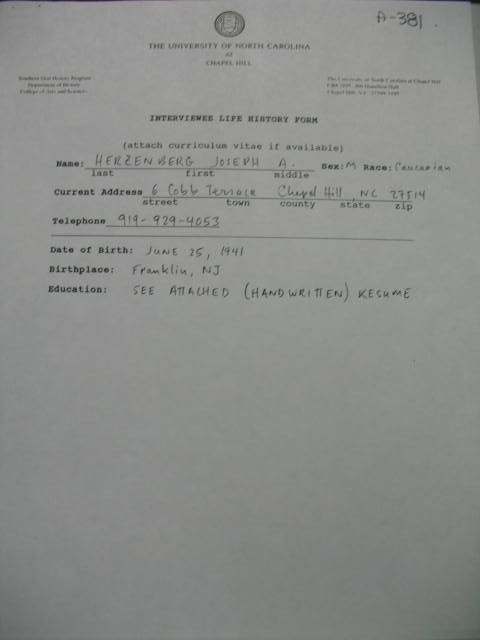
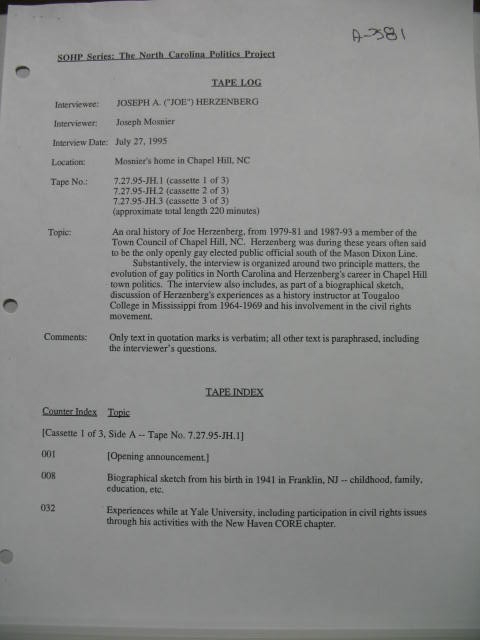
Oral History Interview with Joe Herzenberg, conducted by Joseph Mosnier
Oral History Interview with Joe Herzenberg, conducted by Joseph Mosnier, July 27, 1995.
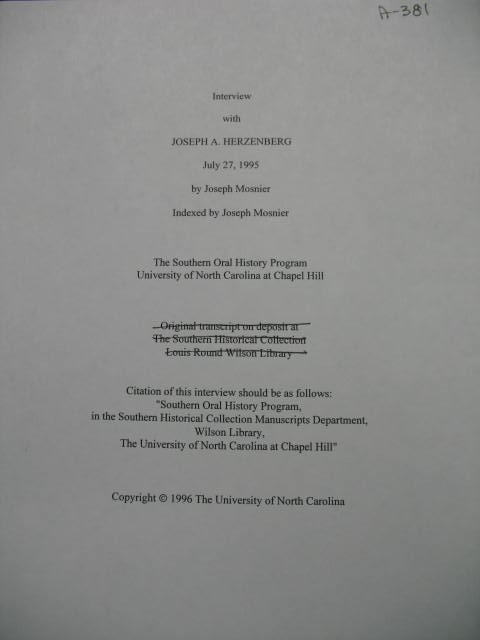
Interview Number: A-0381. Archived for listening as part of the Southern Oral History Program at the Southern Historical Collection Manuscripts Department in Wilson Libary, UNC-Chapel Hill.
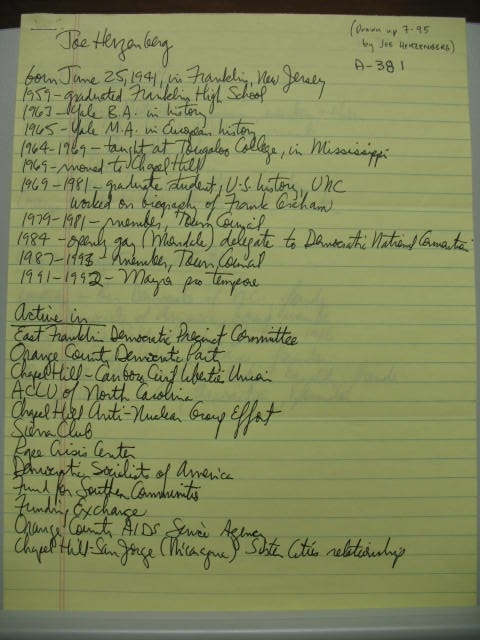
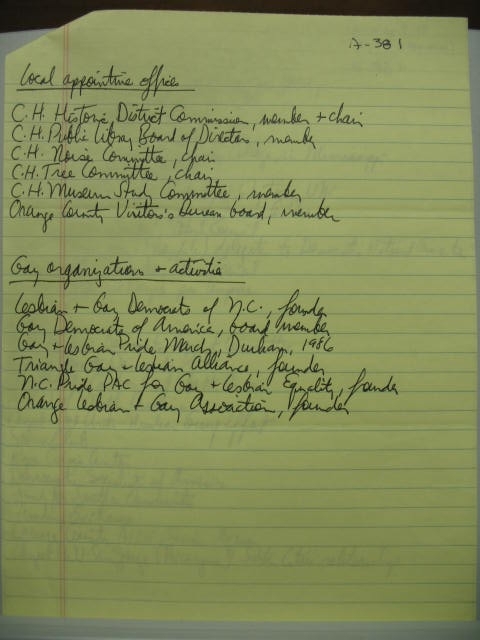
Nearly four hours in length, this was Joe's most in-depth, wide ranging recorded conversation about his life and times. Having conducted several oral history interviews himself with figures like Anne Queen and the Rev. Charles M. Jones for the Southern Oral History Program during the 1970's, Joe was aware this interview was an opportunity to record what he had witnessed during three decades of immersion in the North Carolina political scene, as seen from his perspective as a historian, activist, and political strategist.
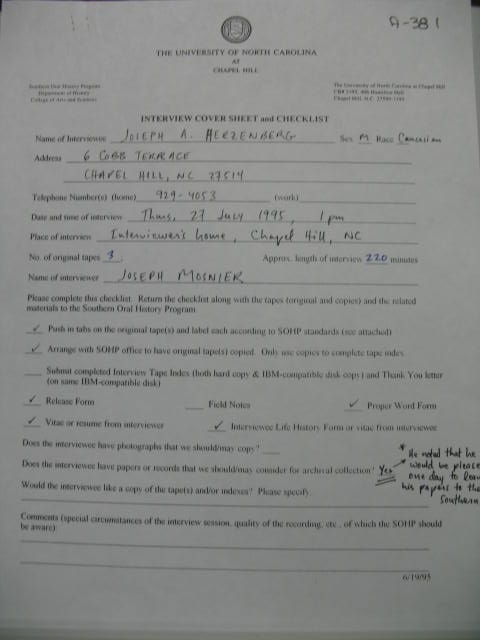
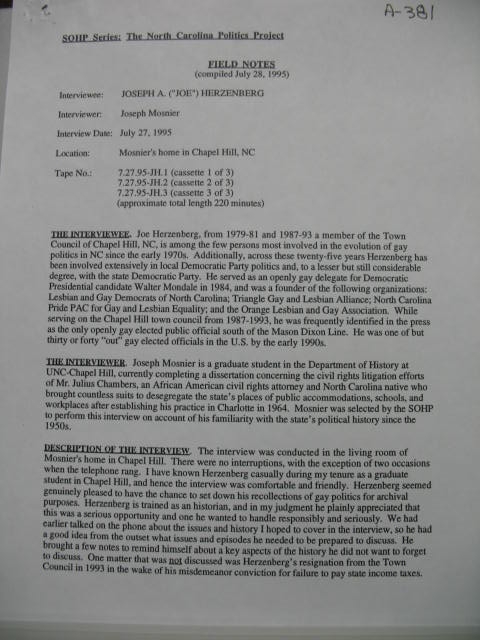
As described by his interviewer, Joseph Mosnier, Joe "seemed genuinely pleased to have the chance to set down his recollections of gay politics for archival purposes."
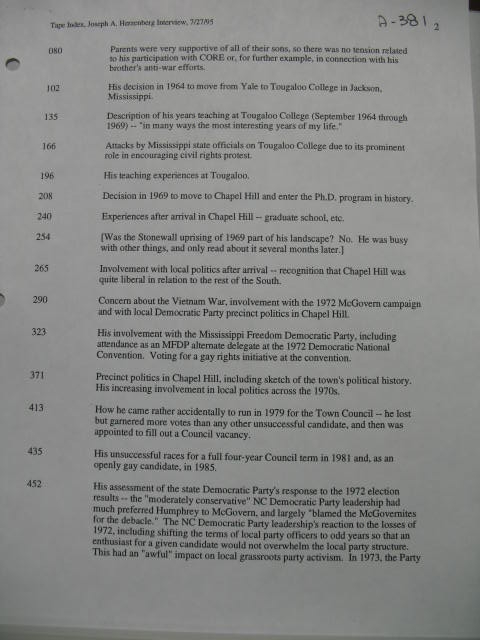
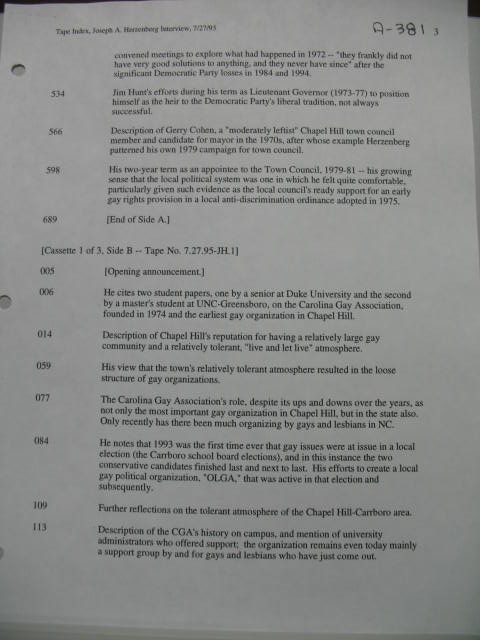
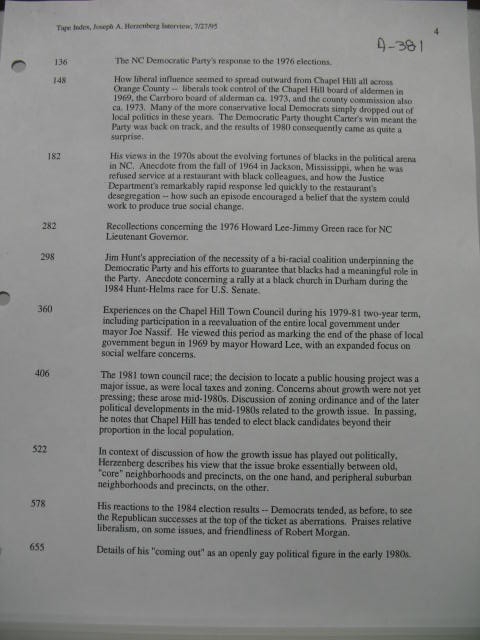
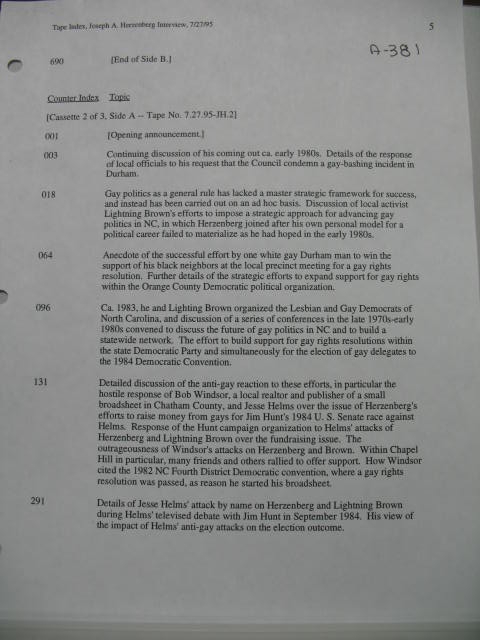
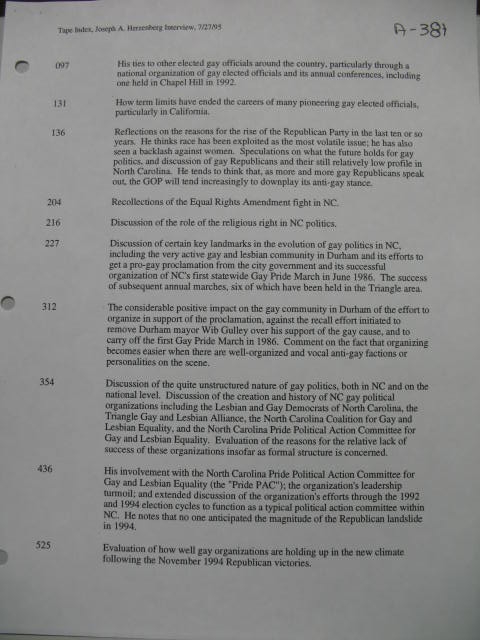
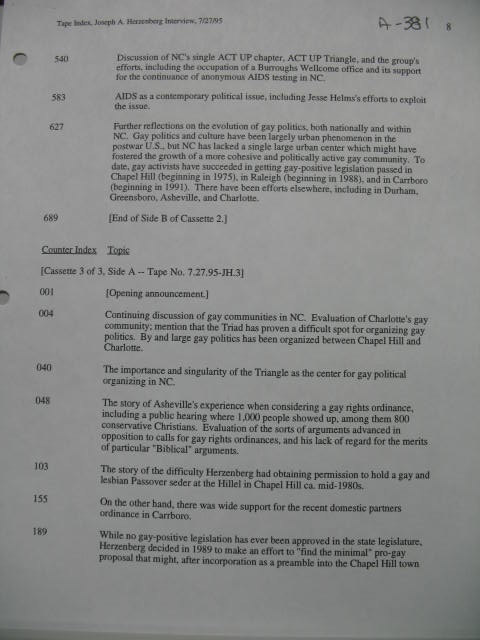
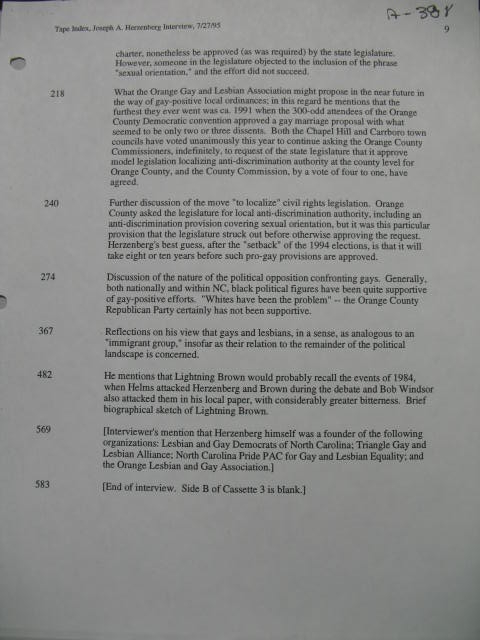
No transcript of this interview is currently available, but the interviewer's field notes, handwritten life history drawn up by Joe, and a tape log that summarizes the topics covered are all reproduced below.
Interview Number: A-0381. Archived for listening as part of the Southern Oral History Program at the Southern Historical Collection Manuscripts Department in Wilson Libary, UNC-Chapel Hill.
Nearly four hours in length, this was Joe's most in-depth, wide ranging recorded conversation about his life and times. Having conducted several oral history interviews himself with figures like Anne Queen and the Rev. Charles M. Jones for the Southern Oral History Program during the 1970's, Joe was aware this interview was an opportunity to record what he had witnessed during three decades of immersion in the North Carolina political scene, as seen from his perspective as a historian, activist, and political strategist.
As described by his interviewer, Joseph Mosnier, Joe "seemed genuinely pleased to have the chance to set down his recollections of gay politics for archival purposes."
No transcript of this interview is currently available, but the interviewer's field notes, handwritten life history drawn up by Joe, and a tape log that summarizes the topics covered are all reproduced below.


Tuesday, July 25, 1995
Note from Joe - Saw the preview of Kids
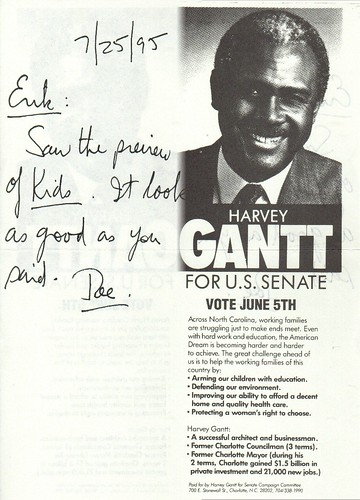
Note from Joe, 1995.
A lot of the notes I got from Joe were on leftover pieces of campaign literature from past elections. Even more so than when he backed Jim Hunt against Jesse Helms in 1984, Joe put his heart and soul into supporting Harvey Gantt's two campaigns against Helms for US Senate.
Friday, June 23, 1995
Birth of gay rights movement observed: 13th annual Stonewall Supper
Commemorates riots, raises money for local groups
Chapel Hill Herald, June 23, 1995
By MARK SCHULTZ
CHAPEL HILL -- There's a time to party and a time to get political, the former head of North Carolina's gay political-action committee told about 75 people at the 13th-annual Stonewall Supper this week.
The supper is held each June in Chapel Hill to commemorate the Stonewall riots in New York City, generally regarded as the birth of the modern gay rights movement. This year's speaker was Derek Charles Livingston, the former director of N.C. Pride PAC and one of the organizers of the 1993 National March on Washington.
"We spend millions on all-gay cruises, all-lesbian cruises, we support several magazines, the most successful of which have virtually no political content," Livingston said.
"And yet Sharon Bottoms [a lesbian mother denied custody] is still separated from her son, Jesse Helms can hold the Ryan White Act hostage, and the Supreme Court says one group of Irish can discriminate against another group of Irish."
"The party's over -- go home," Livingston said. "It is time to go home to every institution and demand our recognition and what belongs to us."
The Stonewall Supper began in a Carrboro restaurant with about two dozen people in 1983. Organized by a committee headed by former Town Council Member Joe Herzenberg, the event raises money for community groups, this year the new Triangle Gay Men's Chorus and Durham's Lesbian and Gay Health Project's breast cancer program.
As he does each year, Herzenberg recapped the year's achievements. Topping the 23-item list, he cited domestic partnership legislation in Carrboro and Chapel Hill, adding sexual orientation to the city schools' multicultural program and U.S. Rep. Fred Heineman's pledge not to discriminate against gays and lesbians in his office hiring.
Carrboro Alderman Mike Nelson received mention and applause for his recent trip with other elected gay and lesbian officials to Washington, D.C., and for his work getting domestic partners recognized in Carrboro.
"I think we've come a long way," Herzenberg said. "Although, of course, there's still a long way to go."
Livingston linked discrimination against gays and lesbians to sexism and racism and said the gay community must build coalitions and also work against these prejudices within the gay movement.
For example, the NAACP supported the March on Washington and Coretta Scott King supported lifting the ban on gay people in the military, Livingston said. "When we fail to support these organizations in favor of a myopic view, we hurt ourselves," he said.
"There is a time to party and celebrate and dance," Livingston said. "But in life there is a time for party and time for work and there is much work to be done in North Carolina."
Chapel Hill Herald, June 23, 1995
By MARK SCHULTZ
CHAPEL HILL -- There's a time to party and a time to get political, the former head of North Carolina's gay political-action committee told about 75 people at the 13th-annual Stonewall Supper this week.
The supper is held each June in Chapel Hill to commemorate the Stonewall riots in New York City, generally regarded as the birth of the modern gay rights movement. This year's speaker was Derek Charles Livingston, the former director of N.C. Pride PAC and one of the organizers of the 1993 National March on Washington.
"We spend millions on all-gay cruises, all-lesbian cruises, we support several magazines, the most successful of which have virtually no political content," Livingston said.
"And yet Sharon Bottoms [a lesbian mother denied custody] is still separated from her son, Jesse Helms can hold the Ryan White Act hostage, and the Supreme Court says one group of Irish can discriminate against another group of Irish."
"The party's over -- go home," Livingston said. "It is time to go home to every institution and demand our recognition and what belongs to us."
The Stonewall Supper began in a Carrboro restaurant with about two dozen people in 1983. Organized by a committee headed by former Town Council Member Joe Herzenberg, the event raises money for community groups, this year the new Triangle Gay Men's Chorus and Durham's Lesbian and Gay Health Project's breast cancer program.
As he does each year, Herzenberg recapped the year's achievements. Topping the 23-item list, he cited domestic partnership legislation in Carrboro and Chapel Hill, adding sexual orientation to the city schools' multicultural program and U.S. Rep. Fred Heineman's pledge not to discriminate against gays and lesbians in his office hiring.
Carrboro Alderman Mike Nelson received mention and applause for his recent trip with other elected gay and lesbian officials to Washington, D.C., and for his work getting domestic partners recognized in Carrboro.
"I think we've come a long way," Herzenberg said. "Although, of course, there's still a long way to go."
Livingston linked discrimination against gays and lesbians to sexism and racism and said the gay community must build coalitions and also work against these prejudices within the gay movement.
For example, the NAACP supported the March on Washington and Coretta Scott King supported lifting the ban on gay people in the military, Livingston said. "When we fail to support these organizations in favor of a myopic view, we hurt ourselves," he said.
"There is a time to party and celebrate and dance," Livingston said. "But in life there is a time for party and time for work and there is much work to be done in North Carolina."
Monday, May 29, 1995
Detailed plan for Chapel Hill museum ready
The News & Observer, May 29, 1995
By JANE STANCILL
CHAPEL HILL -- A plan for the town's first permanent history museum is taking shape.
After months of research, a museum study committee appointed by the Town Council last year has come up with a detailed proposal for a Chapel Hill museum.
The group's report says a museum could be up and running in two years if the town donates the former library on Franklin Street for its use. Support would come through grants from business and government, and private donations.
...
The idea first gained popularity last year during the town's bicentennial celebration. Museum backers asked for space in the town's old library, and before long, yard signs popped up all over town supporting the notion of a museum. About $30,000 in pledges also poured in.
A 12-member study committee spent the past year researching museum funding possibilities and visiting other museums across North Carolina. Members spent more than 1,000 hours on the task.
They were encouraged by what they found. They looked at eight museums in North Carolina, with annual budgets ranging from $120,000 to $5.3 million. A few were in small towns.
"There are towns with far less in financial resources than we have that have made quite a go of their museums," said committee member Joe Herzenberg.
Some are run by local governments; others are owned and operated by non-profit corporations.
Herzenberg and other members think the non-profit organization may be the better way to go.
"I'm not the first one to say this is not the best time for local governments to be thinking about taking on new departments," Herzenberg said.
The key, committee members say, will be the use of the old library. Having a place to begin part-time museum operations is the only way to get major support through grants and corporate donations.
During the two-year beginning phase, the museum would probably require about $44,000 in operating money each year, the committee estimated.
...
Herzenberg said the success of the bicentennial demonstrated the town's interest in history.
"We've only begun to tap the barrel of volunteers in this town," he said. "The main questions are time and money. But I think there are a lot of interested and clever people who want to make this happen."
By JANE STANCILL
CHAPEL HILL -- A plan for the town's first permanent history museum is taking shape.
After months of research, a museum study committee appointed by the Town Council last year has come up with a detailed proposal for a Chapel Hill museum.
The group's report says a museum could be up and running in two years if the town donates the former library on Franklin Street for its use. Support would come through grants from business and government, and private donations.
...
The idea first gained popularity last year during the town's bicentennial celebration. Museum backers asked for space in the town's old library, and before long, yard signs popped up all over town supporting the notion of a museum. About $30,000 in pledges also poured in.
A 12-member study committee spent the past year researching museum funding possibilities and visiting other museums across North Carolina. Members spent more than 1,000 hours on the task.
They were encouraged by what they found. They looked at eight museums in North Carolina, with annual budgets ranging from $120,000 to $5.3 million. A few were in small towns.
"There are towns with far less in financial resources than we have that have made quite a go of their museums," said committee member Joe Herzenberg.
Some are run by local governments; others are owned and operated by non-profit corporations.
Herzenberg and other members think the non-profit organization may be the better way to go.
"I'm not the first one to say this is not the best time for local governments to be thinking about taking on new departments," Herzenberg said.
The key, committee members say, will be the use of the old library. Having a place to begin part-time museum operations is the only way to get major support through grants and corporate donations.
During the two-year beginning phase, the museum would probably require about $44,000 in operating money each year, the committee estimated.
...
Herzenberg said the success of the bicentennial demonstrated the town's interest in history.
"We've only begun to tap the barrel of volunteers in this town," he said. "The main questions are time and money. But I think there are a lot of interested and clever people who want to make this happen."
Monday, April 24, 1995
Gays, lesbians ask to reword partners plan: Proposal due before council
Chapel Hill Herald, April 24, 1995
By SHARON BROOKS HODGE
CHAPEL HILL -- While generally pleased with a domestic partners policy the Town Council is expected to consider tonight, the Orange Lesbian and Gay Association will recommend minor changes.
The association, with about 10 active members and some 200 on its mailing list, is a political group that lobbies for gay rights. The group met Thursday night to discuss proposed changes in town policies that would broaden the rights of gay and lesbian town employees.
Discrimination based on sexual orientation has been prohibited in Chapel Hill's hiring practices for two decades, but some benefits -- such as medical coverage -- remain out of reach for partners of gay workers.
If passed, the domestic partners policy would allow unmarried couples to register with the town. It also would allow town employees to use sick leave to care for a gay or lesbian partner.
Such partners first must provide documents, such as a joint mortgage, proving financial and legal ties. Providing sick leave would cost Chapel Hill about $6,700 annually, Town Manager Cal Horton said.
Horton is also recommending that domestic partners be defined as: "Two individuals who live together in an intimate, long-term relationship of infinite duration, with an exclusive mutual commitment equivalent to that of marriage."
That wording is more restrictive than a similar policy Carrboro's Board of Aldermen adopted in September. Carrboro, which became the first municipality in the state to extend formal, legal recognition to unwed couples, does not stipulate that they have a "long-term relationship of infinite duration."
Association member Joe Herzenberg, a former Town Council member, said reaction to the policy was "generally positive."
But several lawyers associated with the group "went over it with a microscope and prepared a small list of things they'd like to see changed," Herzenberg said. Suggested changes included the proposed definition of a domestic partnership.
Town Attorney Ralph Karpinos, who met with a small association contingent Friday, said he was aware of members' concerns. However, he said he does not think that there is any substantive difference between the Chapel Hill and Carrboro definitions of domestic partners.
"We came up with a definition that we thought was appropriate. Just because it isn't the same as Carrboro's doesn't mean there's something wrong with it," he said.
Doug Ferguson, also an association member, said he does not want the dialogue Monday to turn into "quibbling over details." Consequently the group may recommend delaying a vote while specific issues are ironed out, he added.
Ferguson described the registration of domestic partners as being mostly symbolic. But it will become increasingly important as more private companies extend benefits to couples who have registration certificates, he said.
In a memo to the council, Horton said that eight town employees would extend health insurance to same gender partners, if allowed. Another 22 employees would do so for partners of the opposite sex. But the town does not have clear authority to insure domestic partners, Horton and Karpinos said.
Ferguson said association members disagree with the town's interpretation of state law.
Also the policy proposed by Karpinos and Horton does not mention children of the domestic partnerships, which is something Herzenberg said the association would like to see included.
"It's a minor, but significant issue," he said. Herzenberg said he believes tonight's meeting will proceed without controversy.
In Carrboro, the issue drew opposition from members of a local church. But during the eight years Herzenberg served on the Chapel Hill Town Council, only two people voiced any opposition to "anything gay related," he said.
"Chapel Hill is a town that is tolerant and accepts diversity," Herzenberg said.
By SHARON BROOKS HODGE
CHAPEL HILL -- While generally pleased with a domestic partners policy the Town Council is expected to consider tonight, the Orange Lesbian and Gay Association will recommend minor changes.
The association, with about 10 active members and some 200 on its mailing list, is a political group that lobbies for gay rights. The group met Thursday night to discuss proposed changes in town policies that would broaden the rights of gay and lesbian town employees.
Discrimination based on sexual orientation has been prohibited in Chapel Hill's hiring practices for two decades, but some benefits -- such as medical coverage -- remain out of reach for partners of gay workers.
If passed, the domestic partners policy would allow unmarried couples to register with the town. It also would allow town employees to use sick leave to care for a gay or lesbian partner.
Such partners first must provide documents, such as a joint mortgage, proving financial and legal ties. Providing sick leave would cost Chapel Hill about $6,700 annually, Town Manager Cal Horton said.
Horton is also recommending that domestic partners be defined as: "Two individuals who live together in an intimate, long-term relationship of infinite duration, with an exclusive mutual commitment equivalent to that of marriage."
That wording is more restrictive than a similar policy Carrboro's Board of Aldermen adopted in September. Carrboro, which became the first municipality in the state to extend formal, legal recognition to unwed couples, does not stipulate that they have a "long-term relationship of infinite duration."
Association member Joe Herzenberg, a former Town Council member, said reaction to the policy was "generally positive."
But several lawyers associated with the group "went over it with a microscope and prepared a small list of things they'd like to see changed," Herzenberg said. Suggested changes included the proposed definition of a domestic partnership.
Town Attorney Ralph Karpinos, who met with a small association contingent Friday, said he was aware of members' concerns. However, he said he does not think that there is any substantive difference between the Chapel Hill and Carrboro definitions of domestic partners.
"We came up with a definition that we thought was appropriate. Just because it isn't the same as Carrboro's doesn't mean there's something wrong with it," he said.
Doug Ferguson, also an association member, said he does not want the dialogue Monday to turn into "quibbling over details." Consequently the group may recommend delaying a vote while specific issues are ironed out, he added.
Ferguson described the registration of domestic partners as being mostly symbolic. But it will become increasingly important as more private companies extend benefits to couples who have registration certificates, he said.
In a memo to the council, Horton said that eight town employees would extend health insurance to same gender partners, if allowed. Another 22 employees would do so for partners of the opposite sex. But the town does not have clear authority to insure domestic partners, Horton and Karpinos said.
Ferguson said association members disagree with the town's interpretation of state law.
Also the policy proposed by Karpinos and Horton does not mention children of the domestic partnerships, which is something Herzenberg said the association would like to see included.
"It's a minor, but significant issue," he said. Herzenberg said he believes tonight's meeting will proceed without controversy.
In Carrboro, the issue drew opposition from members of a local church. But during the eight years Herzenberg served on the Chapel Hill Town Council, only two people voiced any opposition to "anything gay related," he said.
"Chapel Hill is a town that is tolerant and accepts diversity," Herzenberg said.
Friday, April 21, 1995
Chapel Hill may expand rights of gays
The News & Observer, April 21, 1995
CHAPEL HILL -- For 20 years, the town of Chapel Hill has had a policy that prohibits discrimination against its gay employees.
Now town leaders are considering going further, extending some benefits to gay employees and allowing gay residents to register their unions officially. If enacted, the policies would be among the most liberal in the state. On Monday night, the Chapel Hill Town Council will consider a series of policies that would affect its employees. Among them:
- Allowing paid sick leave to care for partners.
-Redefining the word "family" in the development ordinance to include registered domestic partners.
-Prohibiting supervisory relationships between employees who are domestic partners.
-Requiring domestic partners of elected leaders to disclose their real estate holdings.
Chapel Hill Council member Mark Chilton, who proposed the changes last year, said it's a matter of fairness.
"I think that essentially this is recognition on the part of our town government that families are a lot different and more complex in the 1990s than they were in the 1950s," he said. "It is perhaps even overdue."
...
On Thursday, gay leaders applauded Chapel Hill's initiative.
Former Town Council member Joe Herzenberg, who was the town's first openly gay elected official, recalled the story of a town employee who had been fired from a previous job in another state because he was gay. When the man moved to Chapel Hill, he was protected by the town's anti-discrimination clause.
"Some people kind of growl at things that are symbolic, but I think symbolic things are very important," he said. "This isn't just symbolic. Some people will benefit from this, will feel better and have better lives."
CHAPEL HILL -- For 20 years, the town of Chapel Hill has had a policy that prohibits discrimination against its gay employees.
Now town leaders are considering going further, extending some benefits to gay employees and allowing gay residents to register their unions officially. If enacted, the policies would be among the most liberal in the state. On Monday night, the Chapel Hill Town Council will consider a series of policies that would affect its employees. Among them:
- Allowing paid sick leave to care for partners.
-Redefining the word "family" in the development ordinance to include registered domestic partners.
-Prohibiting supervisory relationships between employees who are domestic partners.
-Requiring domestic partners of elected leaders to disclose their real estate holdings.
Chapel Hill Council member Mark Chilton, who proposed the changes last year, said it's a matter of fairness.
"I think that essentially this is recognition on the part of our town government that families are a lot different and more complex in the 1990s than they were in the 1950s," he said. "It is perhaps even overdue."
...
On Thursday, gay leaders applauded Chapel Hill's initiative.
Former Town Council member Joe Herzenberg, who was the town's first openly gay elected official, recalled the story of a town employee who had been fired from a previous job in another state because he was gay. When the man moved to Chapel Hill, he was protected by the town's anti-discrimination clause.
"Some people kind of growl at things that are symbolic, but I think symbolic things are very important," he said. "This isn't just symbolic. Some people will benefit from this, will feel better and have better lives."
Subscribe to:
Posts (Atom)