



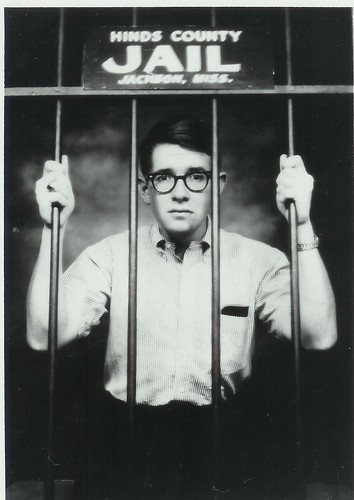
Chapel Hill News, Feb. 21, 2001 - Roses and Raspberries
Roses to Joe Herzenberg of Chapel Hill and Bonnie Davis of Hillsborough, co-winners of this year's Pauli Murray Human Relations Award.
The honor is given by the Orange County Human Relations Commission to residents who have served the pursuit of equality, justice and human rights for all citizens.
The award is made in the name of the Rev. Pauli Murray, the first ordained black woman priest in the Episcopal Church, who lived in Durham and performed services at Chapel of the Cross in Chapel Hill.
Herzenberg deserves recognition for his persistent advocacy on behalf of the disenfranchised and victims of discrimination. A former Chapel Hill Town Council member, he is chair of the Chapel Hill Greenway Commission and the Merritt Pasture Access Committee.
...
The awards will be presented Sunday at 1 p.m. in a ceremony at A.L. Stanback Middle School.
Wednesday, February 21, 2001

Sunday, February 18, 2001
Award honors 4 for human relations work
Chapel Hill Herald, Feb. 18, 2001
HILLSBOROUGH - The Orange County Human Relations Commission has named three residents and a local business as winners of this year's Pauli Murray Human Relations awards.
For the first time, the individual Murray Human Relations Award went to two people - Bonnie Davis of Hillsborough and Joe Herzenberg of Chapel Hill.
...
The overall aim of the Murray awards is to honor those with a "significant history of promoting and fostering better human relations among the diverse residents of Orange County."
The award program gets its name from the Rev. Pauli Murray, who focused on human relations in many roles, including her work as the first black woman in the country ordained in the Episcopal Church, in 1977.
...
The individual Murray award goes to residents who have worked to foster conciliation, human rights, diversity and/or equality in Orange County.
...
Joe Herzenberg moved to Chapel Hill in 1969 to study American history as a graduate student. His first history professor told Herzenberg about Pauli Murray, and he was so intrigued, he tracked down a copy of her book, "Proud Shoes."
"She's just a great role model for anybody," Herzenberg said about Murray. "She viewed herself as an American, of both African and European descent. She never saw anything narrowly. She saw the civil rights movement as a way to liberate not just black people, but white people as well. She was pretty much interested in everything."
Herzenberg, 59, is a native of Franklin, N.J., and he had been teaching at a black college in Mississippi before he came to Chapel Hill. He has been active in local politics and issues for many years, serving on a number of advisory boards and committees.
He is chairman of Chapel Hill's Greenways Commission and the Merritt Pasture Access Committee. He served eight years on the Chapel Hill Town Council before resigning in 1993, in the midst of controversy over his pleading guilty to a tax evasion charge.
Herzenberg laughed Friday in recalling the recent phone call in which he learned about the award. He said he initially joked with the caller that he didn't want the award, because he felt such awards were supposed to go to older residents.
"I'm actually quite happy," he said. "This award is one that I'm especially honored to get."
Herzenberg said his focus in the past three decades primarily has been on civil rights for black residents and on gay and lesbian rights.
HILLSBOROUGH - The Orange County Human Relations Commission has named three residents and a local business as winners of this year's Pauli Murray Human Relations awards.
For the first time, the individual Murray Human Relations Award went to two people - Bonnie Davis of Hillsborough and Joe Herzenberg of Chapel Hill.
...
The overall aim of the Murray awards is to honor those with a "significant history of promoting and fostering better human relations among the diverse residents of Orange County."
The award program gets its name from the Rev. Pauli Murray, who focused on human relations in many roles, including her work as the first black woman in the country ordained in the Episcopal Church, in 1977.
...
The individual Murray award goes to residents who have worked to foster conciliation, human rights, diversity and/or equality in Orange County.
...
Joe Herzenberg moved to Chapel Hill in 1969 to study American history as a graduate student. His first history professor told Herzenberg about Pauli Murray, and he was so intrigued, he tracked down a copy of her book, "Proud Shoes."
"She's just a great role model for anybody," Herzenberg said about Murray. "She viewed herself as an American, of both African and European descent. She never saw anything narrowly. She saw the civil rights movement as a way to liberate not just black people, but white people as well. She was pretty much interested in everything."
Herzenberg, 59, is a native of Franklin, N.J., and he had been teaching at a black college in Mississippi before he came to Chapel Hill. He has been active in local politics and issues for many years, serving on a number of advisory boards and committees.
He is chairman of Chapel Hill's Greenways Commission and the Merritt Pasture Access Committee. He served eight years on the Chapel Hill Town Council before resigning in 1993, in the midst of controversy over his pleading guilty to a tax evasion charge.
Herzenberg laughed Friday in recalling the recent phone call in which he learned about the award. He said he initially joked with the caller that he didn't want the award, because he felt such awards were supposed to go to older residents.
"I'm actually quite happy," he said. "This award is one that I'm especially honored to get."
Herzenberg said his focus in the past three decades primarily has been on civil rights for black residents and on gay and lesbian rights.
Wednesday, February 14, 2001
UNC removal of magnolia for utilities irks residents
Chapel Hill Herald, Feb. 14, 2001
CHAPEL HILL - For three decades, Ken Jackson has enjoyed the view of the UNC campus he has from his jewelry store window.
Thus, the recent removal of a towering magnolia tree near Franklin Street has saddened Jackson and others who treasure the beauty of the campus.
"I was very heartsick," said Jackson, who owns Franklin Street's Wentworth & Sloan. "I've looked at that tree every day for the last 30 years. It's a loss."
The tree came down about two weeks ago, the result of a new campus building project. It was in the way and its destruction couldn't be avoided, said UNC officials, themselves sorry to see the tree go.
Jackson, for one, accepts the university's explanation that the tree had to be removed to install a utility line. But others in town aren't so easily convinced.
"It seems to me they could have planned better," said Joe Herzenberg, a town resident who, as a member of the Town Council in the late 1980s, led a town task force on tree protection. "They took the shortest distance between two points for this utility line. If they had gone 20 yards to the east, closer to Battle Hall, they could have avoided the roots of the tree."
The tree stood back from the street just west of Battle-Vance-Pettigrew. It was slated to be preserved, but construction on a new Institute for the Arts and Humanities nearby took an unplanned twist. To hook the new institute into an existing water line on the north side of Franklin Street, construction workers had to build a larger, deeper hole than was originally thought. The hole was needed to bore under Franklin Street to reach the water line. The other option, to tear up Franklin Street and build a new line under it, was less feasible. So, the tree had to be removed.
"I really had nowhere to go on this," said Kirk Pelland, UNC's grounds director. "The tree couldn't be saved."
And university officials say there's nothing to Herzenberg's claim that they simply could have moved the path of the utility line slightly, to work around the tree.
"It's not that easy, and you have to weigh your disruptions," said Anna Wu, UNC's associate director for facilities planning and design. "It proved to be the best alternative."
But the decision has left Herzenberg unsatisfied, a sentiment he expressed in a recent letter penned to UNC Chancellor James Moeser. The decision, he said, points to a larger issue involving the university's philosophy concerning campus development.
"The big point is that the university has its eye on master plans, on campus and for the Horace Williams property," he said. "They tend to be not as careful about the smaller points, which are also important - in this case, the tree."
But facilities planners say the university does make those so-called "smaller points" a priority and pledge to beautify the area around the institute once construction finishes. Bruce Runberg, associate vice chancellor for facilities services, has pledged to plant a new magnolia tree nearby to replace the old one.
"Our intention is to go back and re-landscape that area," Wu said. "We will restore that area."
Jackson, the jewelry store owner, accepts the price of progress. Still, he's sorry to see the old magnolia go. "It was an older tree," he said. "The older I got, the greater appreciation I had for older things. It was a beautiful tree."
CHAPEL HILL - For three decades, Ken Jackson has enjoyed the view of the UNC campus he has from his jewelry store window.
Thus, the recent removal of a towering magnolia tree near Franklin Street has saddened Jackson and others who treasure the beauty of the campus.
"I was very heartsick," said Jackson, who owns Franklin Street's Wentworth & Sloan. "I've looked at that tree every day for the last 30 years. It's a loss."
The tree came down about two weeks ago, the result of a new campus building project. It was in the way and its destruction couldn't be avoided, said UNC officials, themselves sorry to see the tree go.
Jackson, for one, accepts the university's explanation that the tree had to be removed to install a utility line. But others in town aren't so easily convinced.
"It seems to me they could have planned better," said Joe Herzenberg, a town resident who, as a member of the Town Council in the late 1980s, led a town task force on tree protection. "They took the shortest distance between two points for this utility line. If they had gone 20 yards to the east, closer to Battle Hall, they could have avoided the roots of the tree."
The tree stood back from the street just west of Battle-Vance-Pettigrew. It was slated to be preserved, but construction on a new Institute for the Arts and Humanities nearby took an unplanned twist. To hook the new institute into an existing water line on the north side of Franklin Street, construction workers had to build a larger, deeper hole than was originally thought. The hole was needed to bore under Franklin Street to reach the water line. The other option, to tear up Franklin Street and build a new line under it, was less feasible. So, the tree had to be removed.
"I really had nowhere to go on this," said Kirk Pelland, UNC's grounds director. "The tree couldn't be saved."
And university officials say there's nothing to Herzenberg's claim that they simply could have moved the path of the utility line slightly, to work around the tree.
"It's not that easy, and you have to weigh your disruptions," said Anna Wu, UNC's associate director for facilities planning and design. "It proved to be the best alternative."
But the decision has left Herzenberg unsatisfied, a sentiment he expressed in a recent letter penned to UNC Chancellor James Moeser. The decision, he said, points to a larger issue involving the university's philosophy concerning campus development.
"The big point is that the university has its eye on master plans, on campus and for the Horace Williams property," he said. "They tend to be not as careful about the smaller points, which are also important - in this case, the tree."
But facilities planners say the university does make those so-called "smaller points" a priority and pledge to beautify the area around the institute once construction finishes. Bruce Runberg, associate vice chancellor for facilities services, has pledged to plant a new magnolia tree nearby to replace the old one.
"Our intention is to go back and re-landscape that area," Wu said. "We will restore that area."
Jackson, the jewelry store owner, accepts the price of progress. Still, he's sorry to see the old magnolia go. "It was an older tree," he said. "The older I got, the greater appreciation I had for older things. It was a beautiful tree."
Friday, February 2, 2001
Schools do the right thing on Boy Scouts
Chapel Hill Herald, Feb. 2, 2001 - Letter to the Editor
What our Chapel Hill-Carrboro Board of Education voted was not only fair and wise - but the right thing to do. The school board cannot support programs, however splendid, that are not open to all children.
The Boy Scouts may be a wonderful organization. If so, the organization should be open to all boys. And I'm pleased to note that local Scout leaders seem to be opposed to the exclusionary policy of the national organization. That policy, sooner or later, will be changed.
Joe Herzenberg
Chapel Hill
What our Chapel Hill-Carrboro Board of Education voted was not only fair and wise - but the right thing to do. The school board cannot support programs, however splendid, that are not open to all children.
The Boy Scouts may be a wonderful organization. If so, the organization should be open to all boys. And I'm pleased to note that local Scout leaders seem to be opposed to the exclusionary policy of the national organization. That policy, sooner or later, will be changed.
Joe Herzenberg
Chapel Hill
Wednesday, November 1, 2000
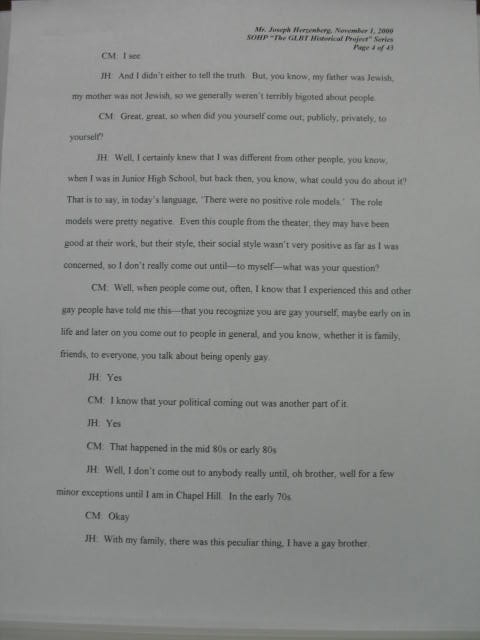
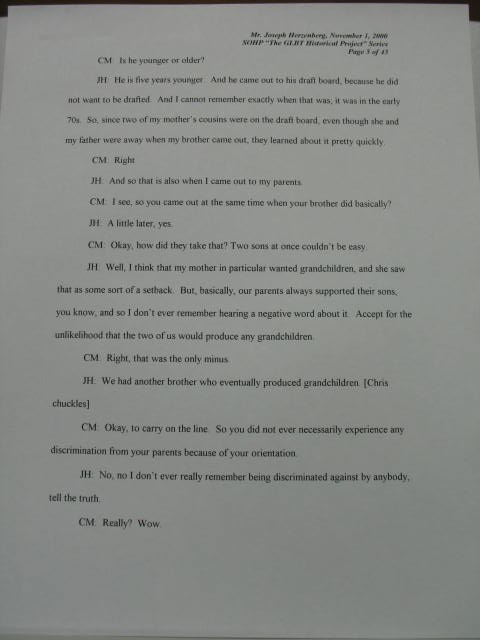
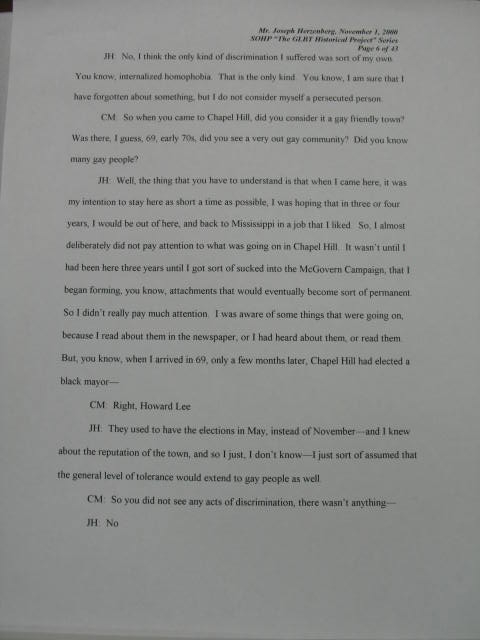
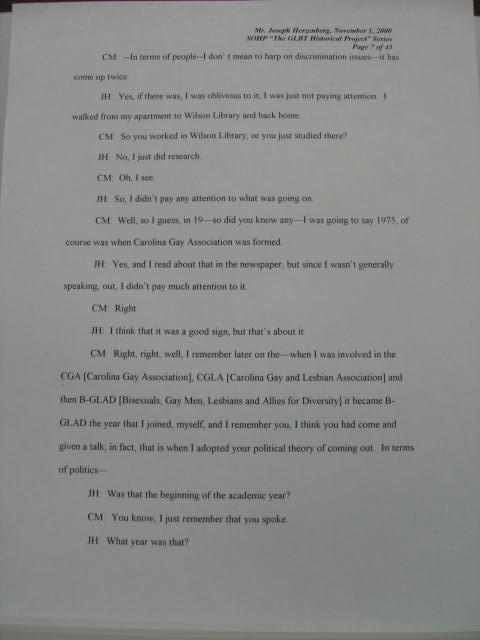
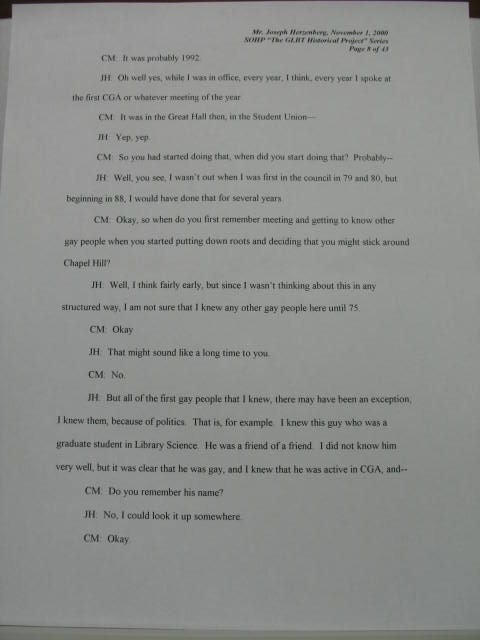
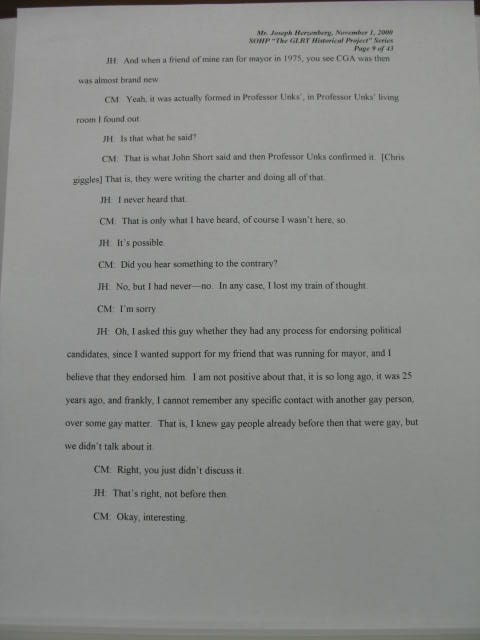
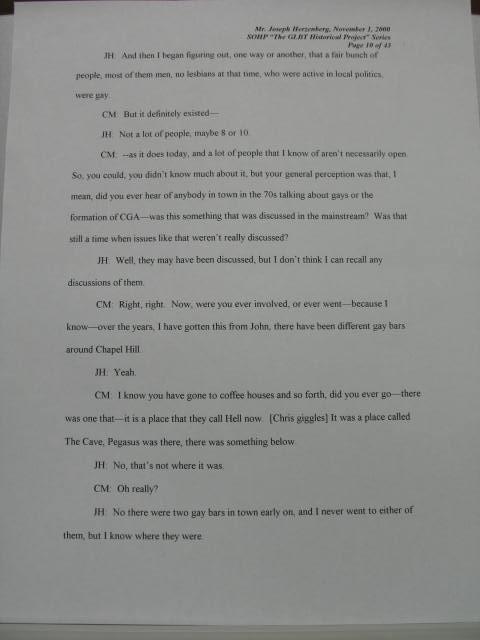
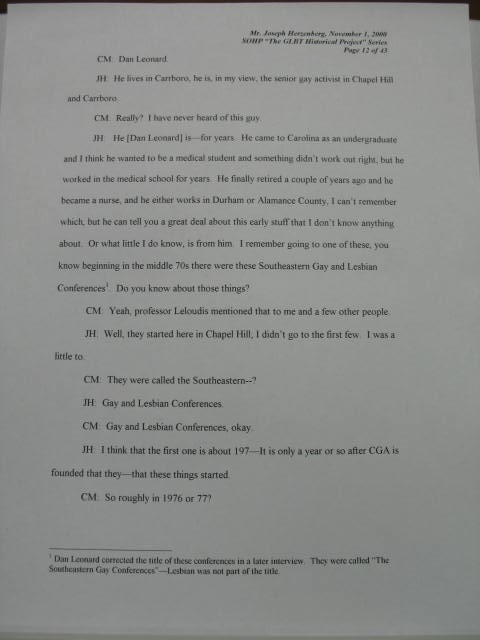
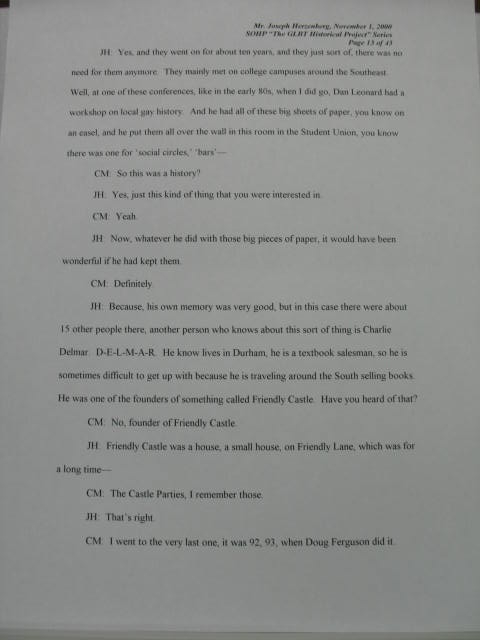
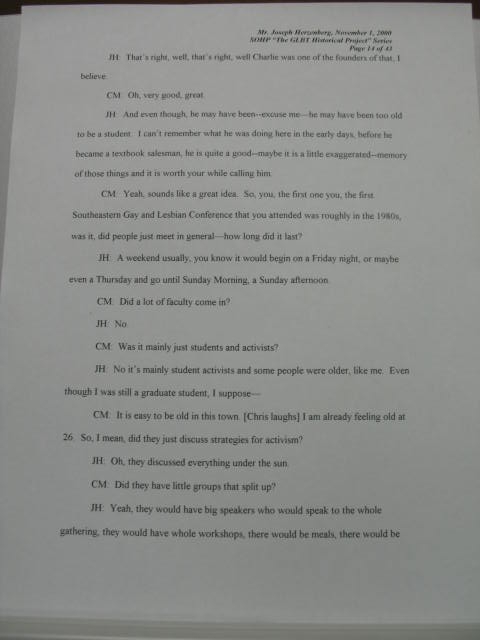
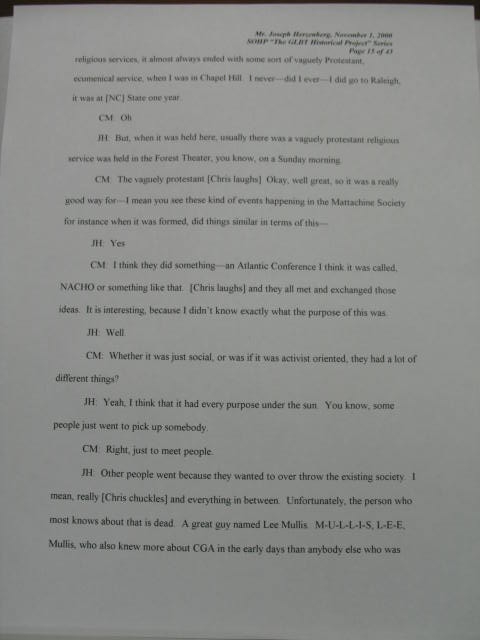
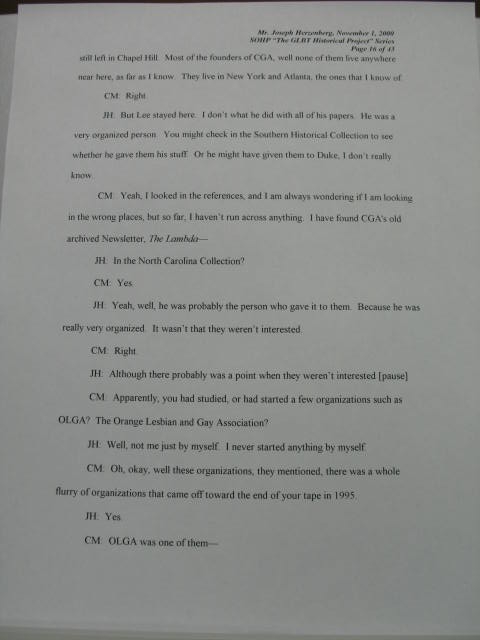
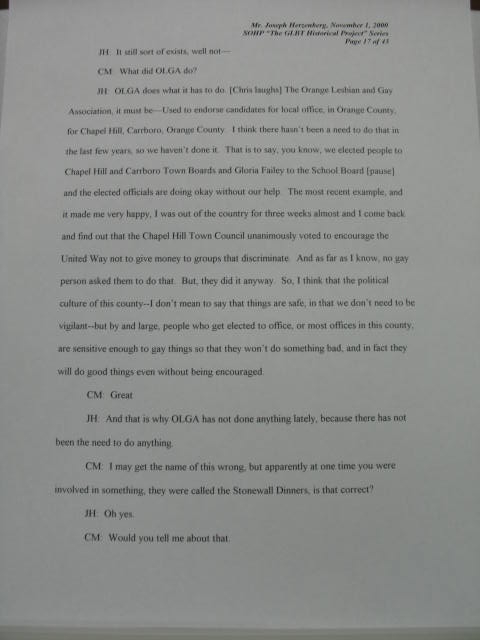
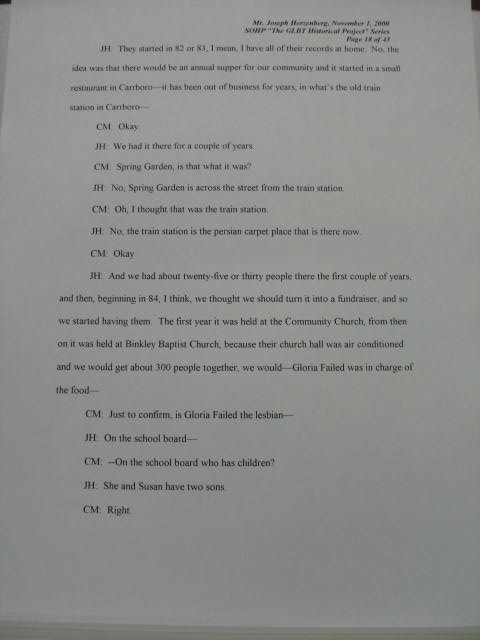
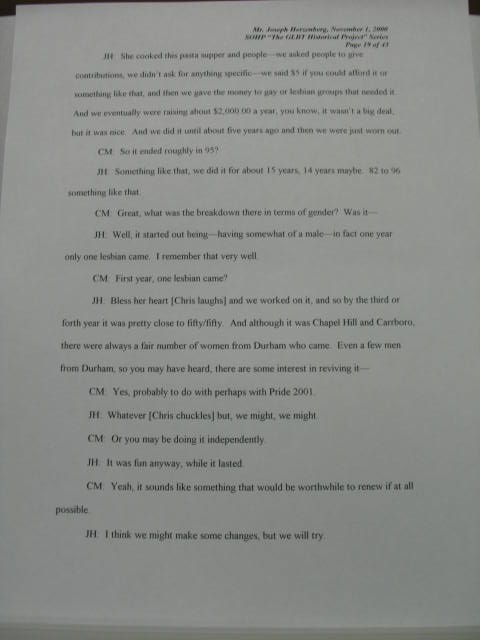
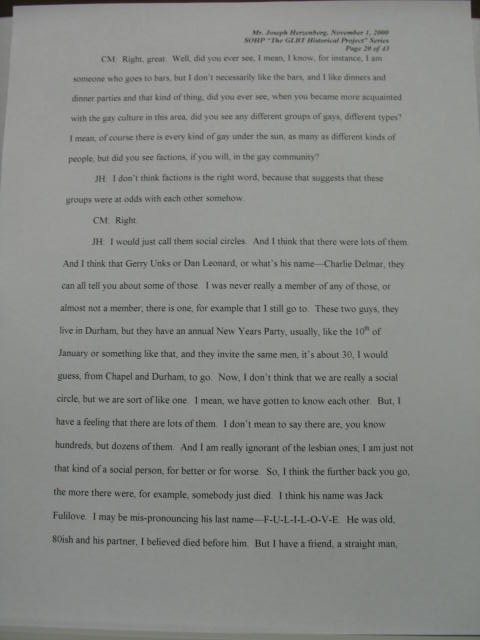
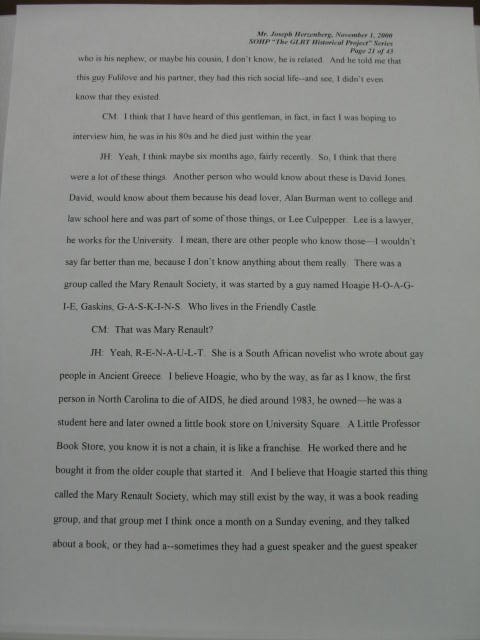
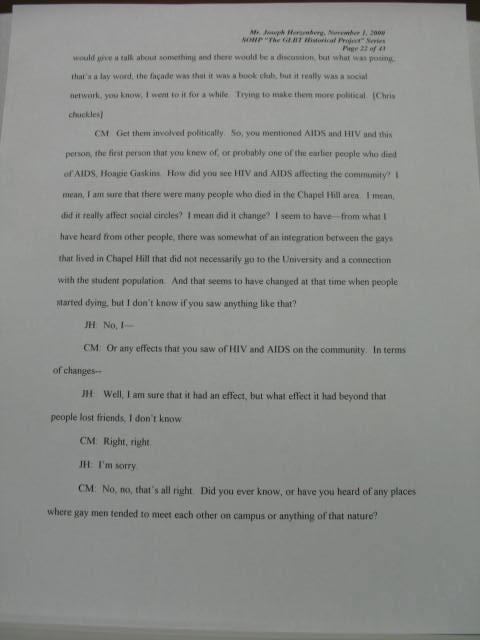
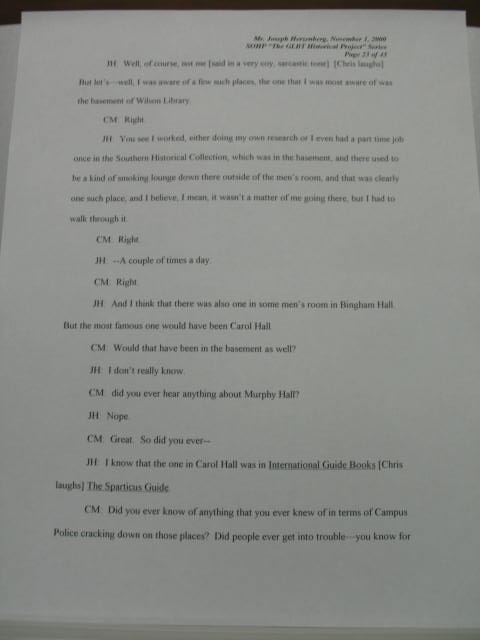
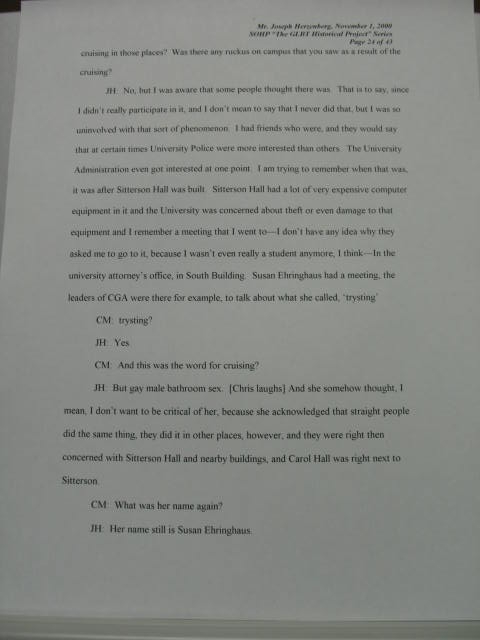
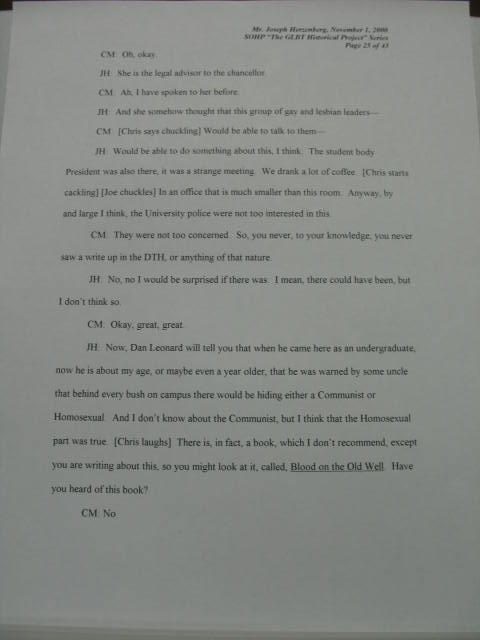
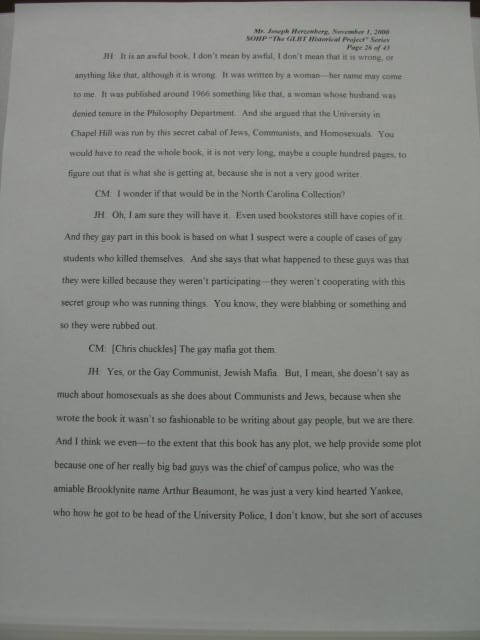
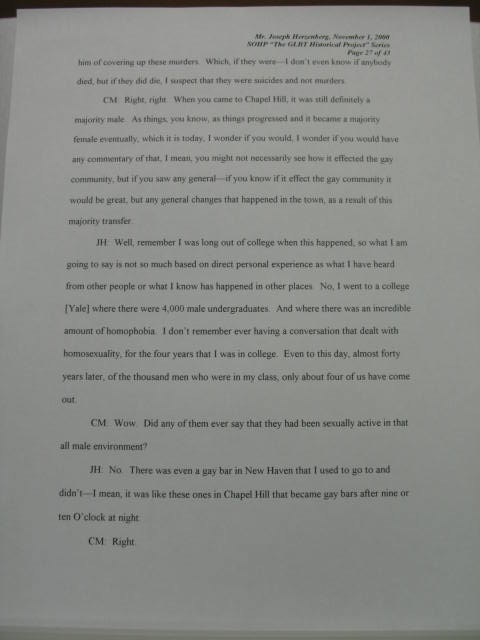
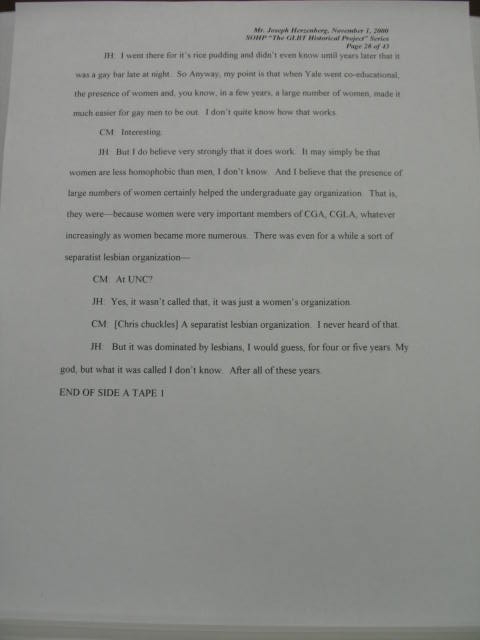
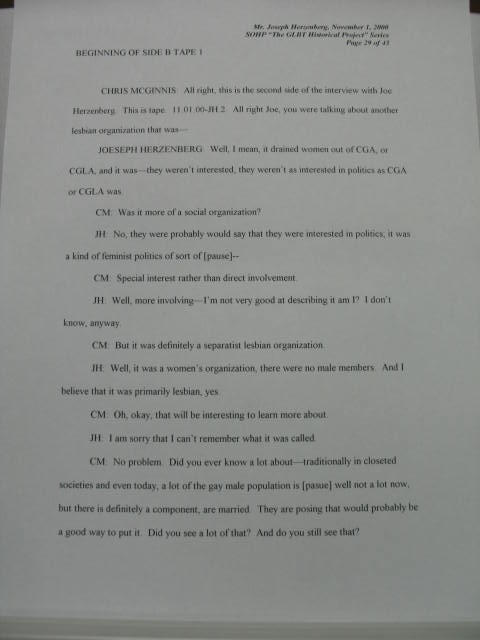
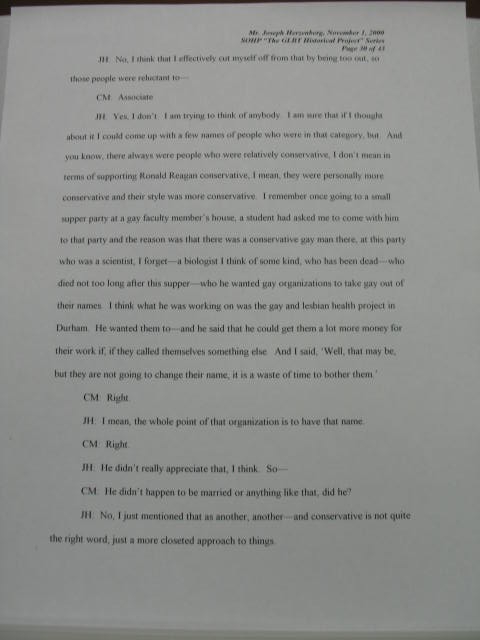
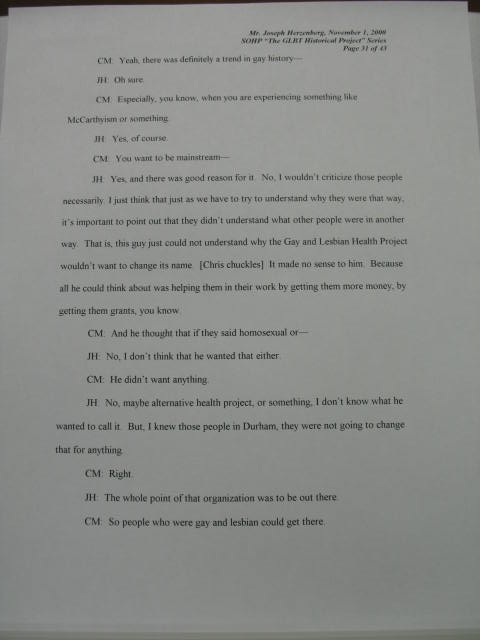
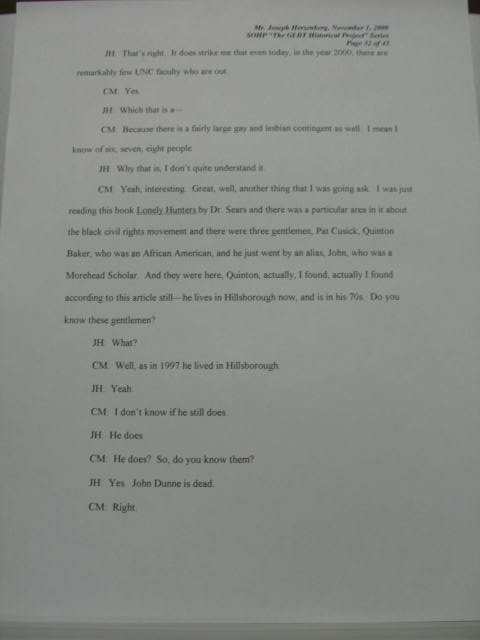
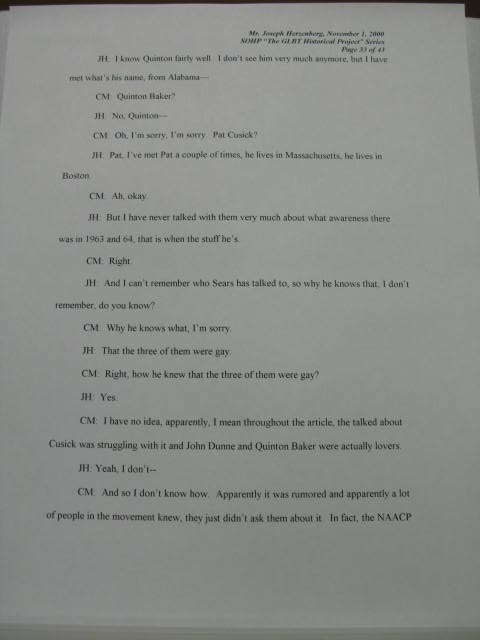
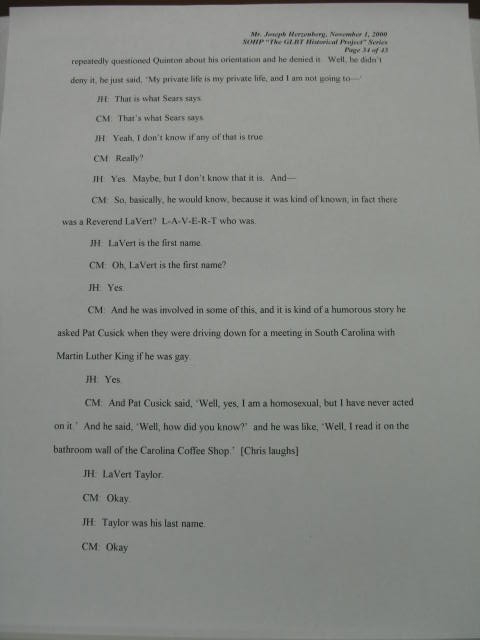
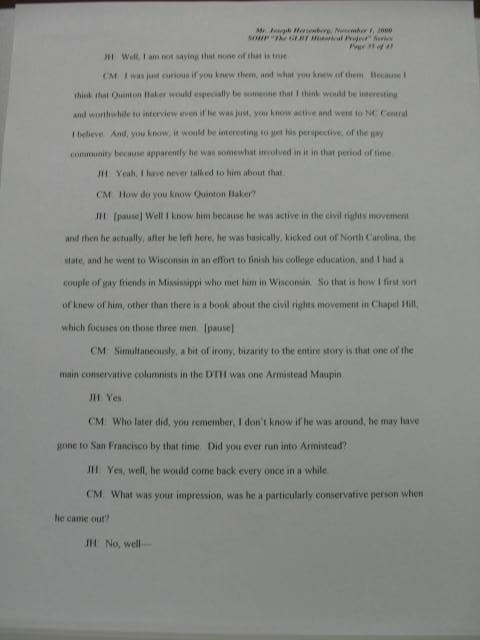
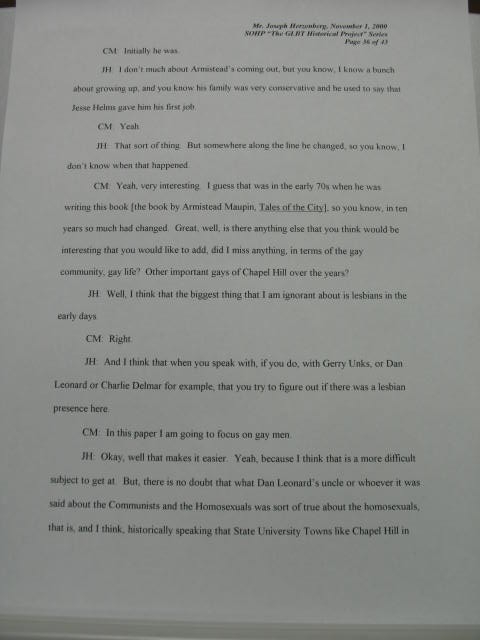
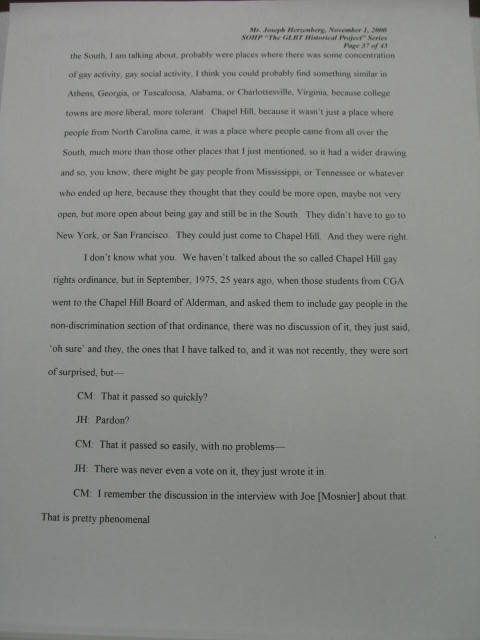
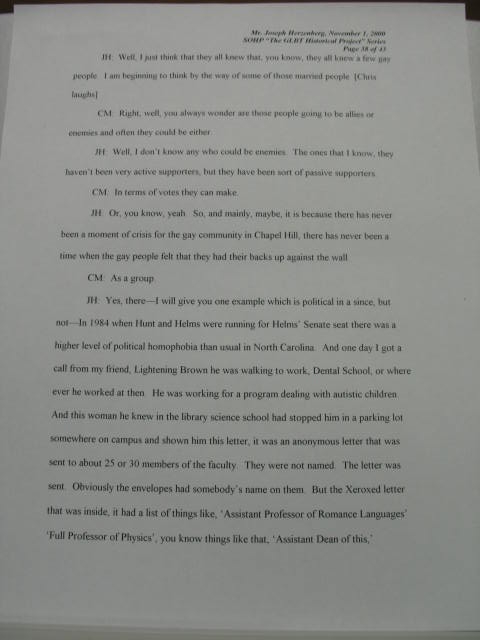
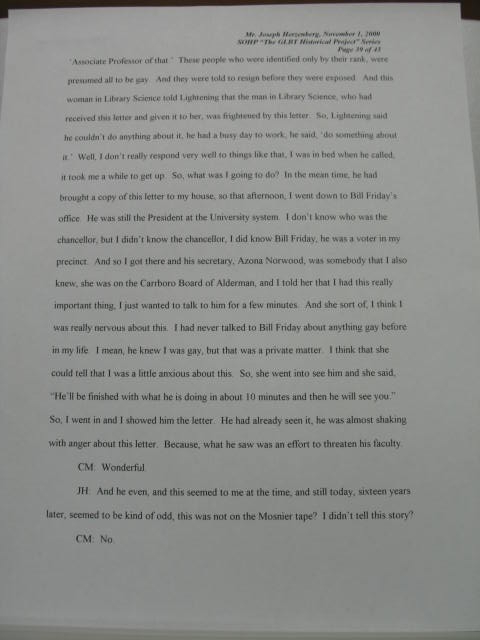
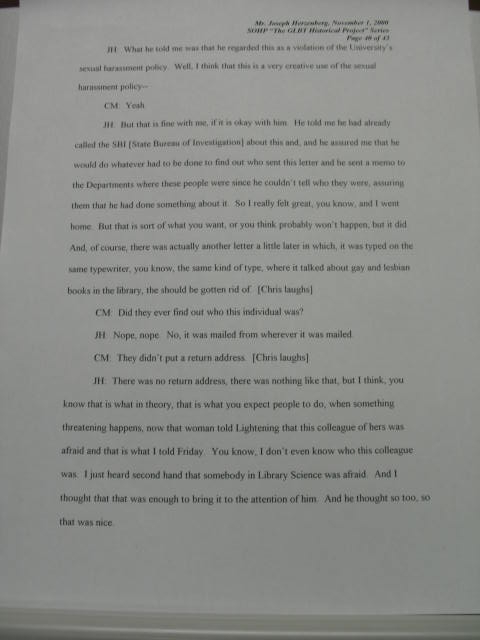
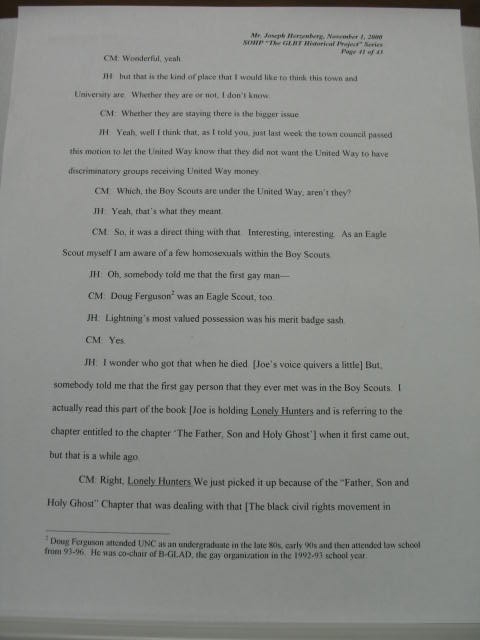
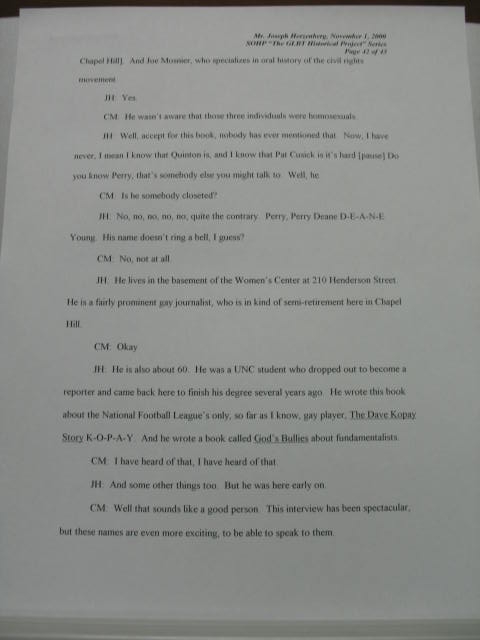
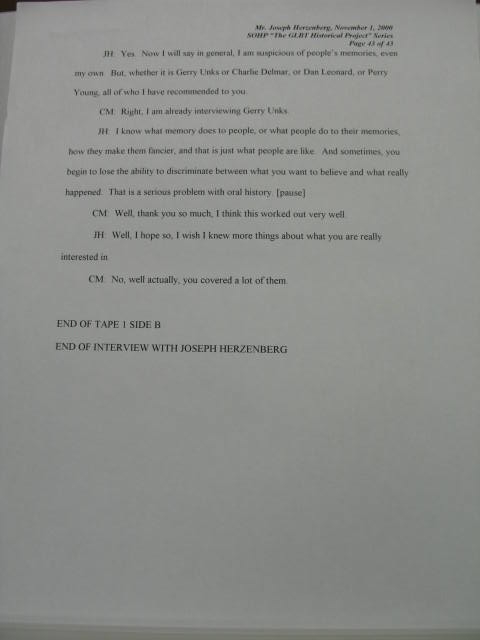
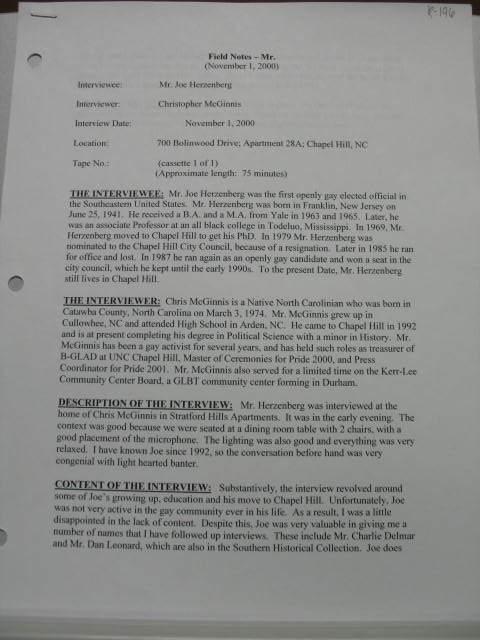
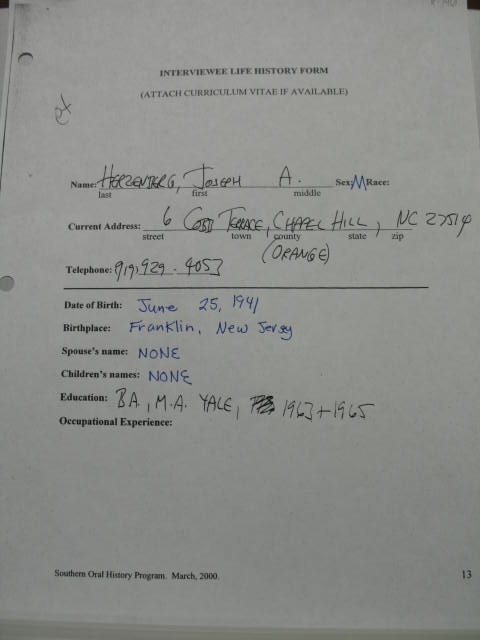
Listening for a Change: Interview with Joe Herzenberg, conducted by Chris McGinnis
Oral History Interview with Joe Herzenberg, conducted by Chris McGinnis, Nov. 1, 2000.
Interview Number: K-0196. Archived for listening as part of the Southern Oral History Program at the Southern Historical Collection Manuscripts Department in Wilson Libary, UNC-Chapel Hill. The complete transcript is reproduced below.
Interview Number: K-0196. Archived for listening as part of the Southern Oral History Program at the Southern Historical Collection Manuscripts Department in Wilson Libary, UNC-Chapel Hill. The complete transcript is reproduced below.
Listening for a Change: History of Gay Men and Transgender People in the South
These interviews by Chris McGinnis, an undergraduate at the University of North Carolina at Chapel Hill, were conducted for an independent study in the fall semester of 2000 and for the Southern Oral History Program in 2001-2002.
They give a perspective of gay life in the South, with particular emphasis on North Carolina in the 1960s through the 1980s. The interviews chronicle the development of the gay community in the South and explore early gay bars, social events and festivals of the gay community, gay organizations and activism, and places where gay men met and engaged in public sex, among other topics.
Included are interviews with Chapel Hill, N.C., town council member Joseph A. Herzenberg and writer Perry Deane Young. Interviews with Angela Brightfeather and Lily Rose DeVee offer perspectives of transgender individuals.
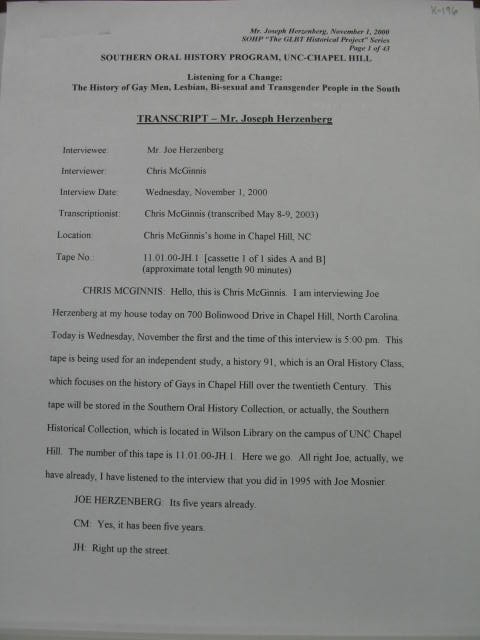
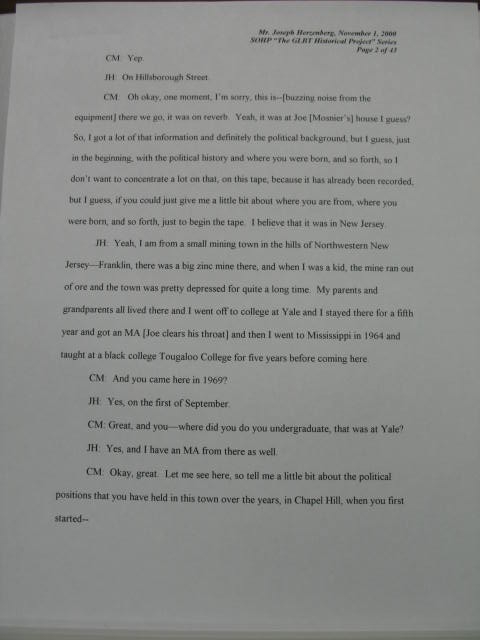
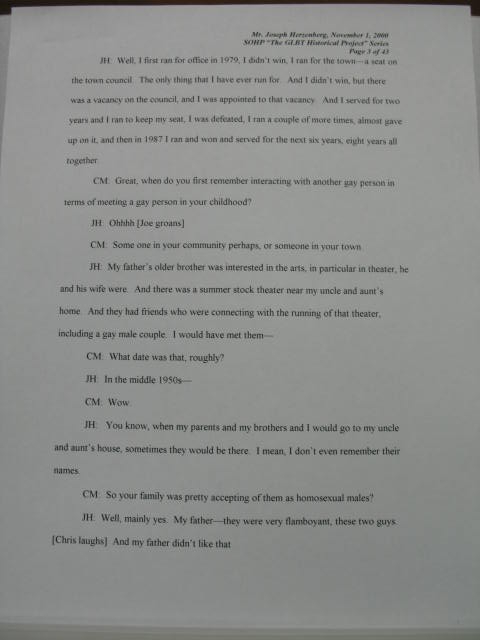


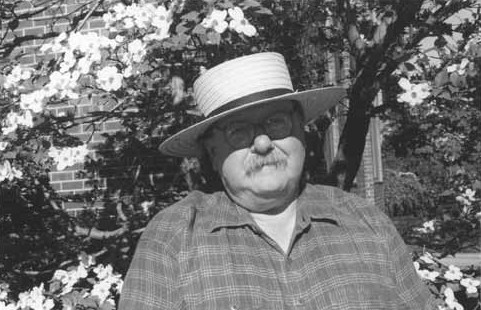
Joe in 2000, as featured in Out and Elected in the U.S.A. photo exhibit
Wednesday, September 13, 2000
Town milestone in gay rights
Chapel Hill News, Sept. 13, 2000 - Letter to the Editor
Twenty-five years ago, on Sept. 13, 1975, the Chapel Hill Board of Aldermen, as the Town Council was then called, passed the first gay rights law in the southern states. (In 1975 fewer than a dozen towns and cities in the United States had such laws.)
The aldermen at the time were considering a new personnel ordinance for the town employees. In response to a request from the recently formed Carolina Gay Association, a UNC student organization, the aldermen included gay people among the list of groups against whom the town should not discriminate in matters of hiring and compensation, training and promotion. The vote was unanimous.
After all these years, it may be appropriate to thank once again those who took a stand in 1975: Mayor Howard Lee and Alderman Gerry Cohen, Tommy Gardner, Shirley Marshall, Sid Rancer, R.D. Smith and Alice Welsh.
Joe Herzenberg
Chapel Hill
Twenty-five years ago, on Sept. 13, 1975, the Chapel Hill Board of Aldermen, as the Town Council was then called, passed the first gay rights law in the southern states. (In 1975 fewer than a dozen towns and cities in the United States had such laws.)
The aldermen at the time were considering a new personnel ordinance for the town employees. In response to a request from the recently formed Carolina Gay Association, a UNC student organization, the aldermen included gay people among the list of groups against whom the town should not discriminate in matters of hiring and compensation, training and promotion. The vote was unanimous.
After all these years, it may be appropriate to thank once again those who took a stand in 1975: Mayor Howard Lee and Alderman Gerry Cohen, Tommy Gardner, Shirley Marshall, Sid Rancer, R.D. Smith and Alice Welsh.
Joe Herzenberg
Chapel Hill
Sunday, June 11, 2000
Gay Rights: Where Are We Now?
NC Society for Ethical Culture Sunday Platform Talk, June 11, 2000
Featured Speaker:
Joe Herzenberg, retired historian, Founding Board Member of Equality NC PAC
Presentation:
Gay Rights: Where Are We Now?
Our platform speakers are selected based on their knowledge and expertise on a given subject, not necessarily on the degree to which they agree with the basic values and principles of Ethical Culture. We may invite speakers with dramatically opposing views in order to challenge the existing "politically correct" views.
Presentations are on Sundays at 11AM at the Arts Center, 300 E. Main St. in Carrboro, NC.
Featured Speaker:
Joe Herzenberg, retired historian, Founding Board Member of Equality NC PAC
Presentation:
Gay Rights: Where Are We Now?
Our platform speakers are selected based on their knowledge and expertise on a given subject, not necessarily on the degree to which they agree with the basic values and principles of Ethical Culture. We may invite speakers with dramatically opposing views in order to challenge the existing "politically correct" views.
Presentations are on Sundays at 11AM at the Arts Center, 300 E. Main St. in Carrboro, NC.
Thursday, April 20, 2000
Wilson would help protect environment
Chapel Hill Herald, April 20, 2000 - Letter to the Editor
It seems we've had one environmental disaster after another this year. We need strong leadership in North Carolina to protect our environment for the people of our state. Ed Wilson, candidate for lieutenant governor, will provide such leadership.
For instance, Ed Wilson wants to eliminate hog lagoons. Meanwhile his opponent, Beverly Perdue, not only voted to prohibit local communities from regulating hog lagoons, she also sponsored a bill that would have barred the state's main environmental police from inspecting livestock operations.
Vote for Ed Wilson to represent the environmental concerns of the people of North Carolina over special interests of corporate hog farms.
Joe Herzenberg
Chapel Hill
It seems we've had one environmental disaster after another this year. We need strong leadership in North Carolina to protect our environment for the people of our state. Ed Wilson, candidate for lieutenant governor, will provide such leadership.
For instance, Ed Wilson wants to eliminate hog lagoons. Meanwhile his opponent, Beverly Perdue, not only voted to prohibit local communities from regulating hog lagoons, she also sponsored a bill that would have barred the state's main environmental police from inspecting livestock operations.
Vote for Ed Wilson to represent the environmental concerns of the people of North Carolina over special interests of corporate hog farms.
Joe Herzenberg
Chapel Hill
Sunday, January 30, 2000
Readers know about their pizza
Chapel Hill Herald, Jan. 30, 2000
Last week's Challenge readers know their pizza joints, including Courtney Morris who knew the answer to the following:
Where on Franklin Street can you get a slice of Luau pizza?
The hint was that compared to a slice of Luau, the regular Hawaiian pizza, ham and pineapple, is like looking at slides of someone else's vacation.
The answer is Pepper's Pizza on East Franklin Street. Pepper's opened its doors in the mid-1980s and has become a favorite hangout since for those looking to rub shoulders with an eclectic mix of customers and staff.
...
On the wall opposite the front counter are several profiles of Pepper's customers, including Joe Herzenberg whose profile describes his occupation as "small town politician" and his latest accomplishment as "an out-of-town trip to Carrboro."
There's also an ever-changing display of artwork for sale above the booths.
Last week's Challenge readers know their pizza joints, including Courtney Morris who knew the answer to the following:
Where on Franklin Street can you get a slice of Luau pizza?
The hint was that compared to a slice of Luau, the regular Hawaiian pizza, ham and pineapple, is like looking at slides of someone else's vacation.
The answer is Pepper's Pizza on East Franklin Street. Pepper's opened its doors in the mid-1980s and has become a favorite hangout since for those looking to rub shoulders with an eclectic mix of customers and staff.
...
On the wall opposite the front counter are several profiles of Pepper's customers, including Joe Herzenberg whose profile describes his occupation as "small town politician" and his latest accomplishment as "an out-of-town trip to Carrboro."
There's also an ever-changing display of artwork for sale above the booths.
Friday, June 11, 1999
Gays see the glass half full
Ruth Sheehan, The News & Observer, Raleigh, June 11, 1999
Starting this evening, thousands of gay men and women will gather in Greensboro for seminars and speeches, a big campy parade - and lots of parties. They call it PRIDE weekend. And this year, gay activists say they have much to celebrate. Much to be proud of.
"This was a good year," says my friend Joe Herzenberg, a former Chapel Hill Town Council member and the state's first openly gay elected official. "A very good year."
A key reason, according to Herzenberg, is that in April, for the first time ever, not one but two bills aimed at protecting gay citizens received a hearing on the floor of the state House.
One of the bills would have allowed Orange County commissioners to bar discrimination based on sexual orientation in employment, housing and public accommodations. The second - named for Matthew Shepard, the former Triangle resident who was pistol-whipped, tied to a fence and left to die in Wyoming because he was gay - would have expanded the definition of hate crimes to include victims targeted because of their sexual orientation, sex, disability or age.
Both bills were killed on the House floor. But to Herzenberg, in some ways, that's a small detail.
"Gay rights were discussed by the full House," Herzenberg tells me. "That is a big step. There are people who want to make radical change in a hurry. That's not always the best approach."
Herzenberg knows all too well that gay rights in a Bible Belt state such as North Carolina, where anti-gay sentiment remains so entrenched, is a two-steps-forward, one-step-back proposition at best: Superior Court Judge Ray Warren comes out of the closet, only to be run out of the Republican Party. The Rev. Jimmy Creech officiates at a gay union, only to face the possibility of expulsion from the pulpit. Chapel Hill and Carrboro offer benefits to the domestic partners of town employees, including two gay workers, only to find the policies challenged in court by disapproving conservatives.
The progress is incremental. Painstakingly so, it seems to me.
Because in the end, you can still be fired, or evicted, or denied a job because you're gay.
You can be beaten simply because of whom you love - and it won't be considered a hate crime.
You can actually be arrested for the way you and your partner engage in fully consensual sex, even though many straight people routinely engage in similarly illegal activity.
It all amounts to legal discrimination against one final unprotected group of people. So to me, the fact that the state House heard, and promptly quashed, two mostly symbolic bills to protect gay civil rights is more an outrage than a cause for optimism.
But Herzenberg is far more patient. He points out that the landscape has changed dramatically since 1987, when he was first elected. Gay couples are out-virtually everywhere, without so much as an eyebrow raised, Herzenberg notes.
Getting the laws to acknowledge this social reality is the next step. And getting gay-rights legislation heard on the House floor is obviously a crucial part of that process.
Perhaps, as Herzenberg says, it has been a "good" year. But I believe we could have done better.
Starting this evening, thousands of gay men and women will gather in Greensboro for seminars and speeches, a big campy parade - and lots of parties. They call it PRIDE weekend. And this year, gay activists say they have much to celebrate. Much to be proud of.
"This was a good year," says my friend Joe Herzenberg, a former Chapel Hill Town Council member and the state's first openly gay elected official. "A very good year."
A key reason, according to Herzenberg, is that in April, for the first time ever, not one but two bills aimed at protecting gay citizens received a hearing on the floor of the state House.
One of the bills would have allowed Orange County commissioners to bar discrimination based on sexual orientation in employment, housing and public accommodations. The second - named for Matthew Shepard, the former Triangle resident who was pistol-whipped, tied to a fence and left to die in Wyoming because he was gay - would have expanded the definition of hate crimes to include victims targeted because of their sexual orientation, sex, disability or age.
Both bills were killed on the House floor. But to Herzenberg, in some ways, that's a small detail.
"Gay rights were discussed by the full House," Herzenberg tells me. "That is a big step. There are people who want to make radical change in a hurry. That's not always the best approach."
Herzenberg knows all too well that gay rights in a Bible Belt state such as North Carolina, where anti-gay sentiment remains so entrenched, is a two-steps-forward, one-step-back proposition at best: Superior Court Judge Ray Warren comes out of the closet, only to be run out of the Republican Party. The Rev. Jimmy Creech officiates at a gay union, only to face the possibility of expulsion from the pulpit. Chapel Hill and Carrboro offer benefits to the domestic partners of town employees, including two gay workers, only to find the policies challenged in court by disapproving conservatives.
The progress is incremental. Painstakingly so, it seems to me.
Because in the end, you can still be fired, or evicted, or denied a job because you're gay.
You can be beaten simply because of whom you love - and it won't be considered a hate crime.
You can actually be arrested for the way you and your partner engage in fully consensual sex, even though many straight people routinely engage in similarly illegal activity.
It all amounts to legal discrimination against one final unprotected group of people. So to me, the fact that the state House heard, and promptly quashed, two mostly symbolic bills to protect gay civil rights is more an outrage than a cause for optimism.
But Herzenberg is far more patient. He points out that the landscape has changed dramatically since 1987, when he was first elected. Gay couples are out-virtually everywhere, without so much as an eyebrow raised, Herzenberg notes.
Getting the laws to acknowledge this social reality is the next step. And getting gay-rights legislation heard on the House floor is obviously a crucial part of that process.
Perhaps, as Herzenberg says, it has been a "good" year. But I believe we could have done better.
Sunday, May 16, 1999
Tradition could wilt with retirement of `flower ladies'
Chapel Hill Herald, May 16, 1999
By Ray Gronberg
CHAPEL HILL -- Franklin Street regulars are starting to wonder where all the flower ladies have gone. And the answer, unfortunately, seems to be that age is catching up with them.
Some worry another Chapel Hill tradition is about to fade away, a gnawing fear that has grown in inverse proportion to the number of active flower ladies. For now, only one still plies her wares on a regular basis.
"It looks like it's a dying breed," sighed Manning Outen, manager of NationsBank Plaza. "We need somebody to pick up the tradition."
Outen's building -- soon to be renamed the Bank of America Center -- served as the daytime base of operations for two of the last flower ladies, Mary Farrington and Betty Jones.
Neither is active.
Outen and hotdog vendor Ed "Squeaky" Morgan believe Jones is out of the flower business entirely after an early evening auto accident about a month ago.
Until then, Jones "was here any day it wasn't raining," said Morgan, also a Franklin Street fixture. "She didn't get hurt, but she was shaken up. Her son came and took her back to Texas. I don't think she'll be coming back."
Farrington seemingly hasn't set up shop in the lobby of NationsBank Plaza even once this year. Health is believed an issue, though she has told patrons she'll "be coming back now and then," Morgan said.
One other woman, Moselle Pratt, is holding up the flower lady tradition by night. She prefers working outdoors, and Police Department Sgt. Steve Riddle said people can find her near the Sephora perfume store most any time the weather is nice.
Morgan and Outen are not alone in suspecting that the curtain is about to close on Chapel Hill's flower ladies.
"It is probably not a profession that anybody's looking to go into," said Robert Humphreys, executive director of the Chapel Hill Downtown Commission. "Once our existing flower ladies are gone, it may be something that falls by the wayside."
If that's the case, time will have done something the town bureaucracy couldn't.
The flower ladies -- and Morgan -- are the last vestiges of a sidewalk vending trade that Chapel Hill essentially outlawed during the 1970s.
The ban targeted a small group of peddlers "whom one might call hippies," said Joe Herzenberg, a local historian and former town councilman.
"It wasn't exactly an effort to get rid of the flower ladies, quite the contrary," he said. "It was an effort to get rid of other people, and the flower ladies were gotten rid of in the process."
The hippies sparked complaints, he said, from people offended by their views and their appearance. Town officials tried briefly to exempt the flower ladies from the ban, but they soon fretted that the attempt would draw a court challenge.
In any case, the exemption gave the town's real targets a way to evade the ban.
"Vendors would sell you a daisy for $30 and give you a pair of sandals for free," Planning Director Roger Waldon said.
Several of the flower ladies eventually found a home in the NationsBank Plaza lobby -- safe on private property -- as did Morgan, who briefly defied the vending ban in 1993.
The final flower lady may fall victim to simple economics. "I don't think business is great, to tell you the truth," Herzenberg said. "She doesn't sell that many, but she likes coming and talking to people."
By Ray Gronberg
CHAPEL HILL -- Franklin Street regulars are starting to wonder where all the flower ladies have gone. And the answer, unfortunately, seems to be that age is catching up with them.
Some worry another Chapel Hill tradition is about to fade away, a gnawing fear that has grown in inverse proportion to the number of active flower ladies. For now, only one still plies her wares on a regular basis.
"It looks like it's a dying breed," sighed Manning Outen, manager of NationsBank Plaza. "We need somebody to pick up the tradition."
Outen's building -- soon to be renamed the Bank of America Center -- served as the daytime base of operations for two of the last flower ladies, Mary Farrington and Betty Jones.
Neither is active.
Outen and hotdog vendor Ed "Squeaky" Morgan believe Jones is out of the flower business entirely after an early evening auto accident about a month ago.
Until then, Jones "was here any day it wasn't raining," said Morgan, also a Franklin Street fixture. "She didn't get hurt, but she was shaken up. Her son came and took her back to Texas. I don't think she'll be coming back."
Farrington seemingly hasn't set up shop in the lobby of NationsBank Plaza even once this year. Health is believed an issue, though she has told patrons she'll "be coming back now and then," Morgan said.
One other woman, Moselle Pratt, is holding up the flower lady tradition by night. She prefers working outdoors, and Police Department Sgt. Steve Riddle said people can find her near the Sephora perfume store most any time the weather is nice.
Morgan and Outen are not alone in suspecting that the curtain is about to close on Chapel Hill's flower ladies.
"It is probably not a profession that anybody's looking to go into," said Robert Humphreys, executive director of the Chapel Hill Downtown Commission. "Once our existing flower ladies are gone, it may be something that falls by the wayside."
If that's the case, time will have done something the town bureaucracy couldn't.
The flower ladies -- and Morgan -- are the last vestiges of a sidewalk vending trade that Chapel Hill essentially outlawed during the 1970s.
The ban targeted a small group of peddlers "whom one might call hippies," said Joe Herzenberg, a local historian and former town councilman.
"It wasn't exactly an effort to get rid of the flower ladies, quite the contrary," he said. "It was an effort to get rid of other people, and the flower ladies were gotten rid of in the process."
The hippies sparked complaints, he said, from people offended by their views and their appearance. Town officials tried briefly to exempt the flower ladies from the ban, but they soon fretted that the attempt would draw a court challenge.
In any case, the exemption gave the town's real targets a way to evade the ban.
"Vendors would sell you a daisy for $30 and give you a pair of sandals for free," Planning Director Roger Waldon said.
Several of the flower ladies eventually found a home in the NationsBank Plaza lobby -- safe on private property -- as did Morgan, who briefly defied the vending ban in 1993.
The final flower lady may fall victim to simple economics. "I don't think business is great, to tell you the truth," Herzenberg said. "She doesn't sell that many, but she likes coming and talking to people."
Sunday, August 16, 1998
ACLU seeks nominees for top award
Chapel Hill Herald, Aug. 16, 1998 - Letter to the Editor
The Chapel Hill-Carrboro chapter of the American Civil Liberties Union is seeking nominations for our 1998 Charles and Dorcas Jones Award.
This award, initiated in 1993, recognizes a person or group who has made outstanding contributions to civil liberties and civil rights in Orange and Chatham counties, the area served by the local ACLU chapter.
Previous recipients of the Jones award include: Joe and Lucy Straley, 1993; Rebecca Clark, 1994; Robert Seymour, 1995; Dan Pollitt, 1996; and the UNC housekeepers, 1997.
The deadline for submitting nominations is Aug. 31.
To make a nomination, call 929-4052 and leave a brief message, or drop a note to ACLU, P.O. Box 1285, Chapel Hill, 27514.
Joe Herzenberg
Chapel Hill
The Chapel Hill-Carrboro chapter of the American Civil Liberties Union is seeking nominations for our 1998 Charles and Dorcas Jones Award.
This award, initiated in 1993, recognizes a person or group who has made outstanding contributions to civil liberties and civil rights in Orange and Chatham counties, the area served by the local ACLU chapter.
Previous recipients of the Jones award include: Joe and Lucy Straley, 1993; Rebecca Clark, 1994; Robert Seymour, 1995; Dan Pollitt, 1996; and the UNC housekeepers, 1997.
The deadline for submitting nominations is Aug. 31.
To make a nomination, call 929-4052 and leave a brief message, or drop a note to ACLU, P.O. Box 1285, Chapel Hill, 27514.
Joe Herzenberg
Chapel Hill
Saturday, June 27, 1998
Joe's 57th Birthday Dinner, 1998
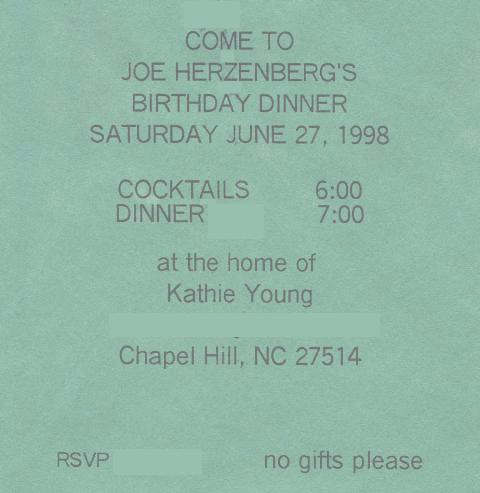
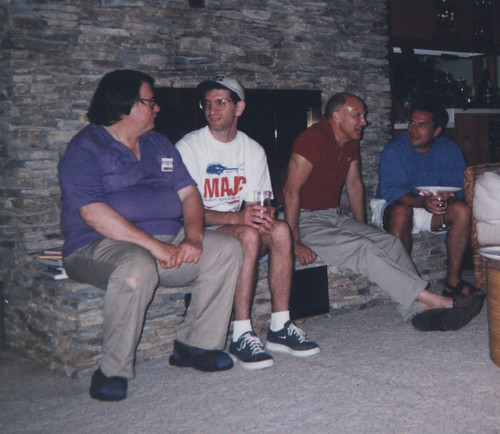
Joe at his 57th birthday dinner, June 27, 1998. Photo and invite courtesy of Mark Donahue.
Sunday, June 7, 1998
The Henderson Street shootings
Chapel Hill Herald, June 7, 1998
CHAPEL HILL -- During the past several weeks, readers have voted, by mail and via the Internet, on what they see as the 10 most important stories published in The Chapel Hill Herald during the past decade.
3. The Henderson Street shootings.
Joe Herzenberg's first thought was about gun control. Seeing a man walk down your street with a high-powered weapon will do that.
"He was carrying this rifle, and I was thinking, `Is it illegal to carry a rifle on the street?' " said Herzenberg, a Cobb Terrace resident and former town councilman. "And while I was thinking, he turned to the house next door and started firing on it. He was actually killing somebody."
Herzenberg could only watch as a deranged UNC law student, Wendell Williamson, gunned down the first of two men he would kill during his Jan. 26, 1995, shooting rampage.
Ralph Walker Jr., a restaurant worker, died on the steps of his Cobb Terrace rooming house. Williamson's other victim, UNC lacrosse player Kevin Reichardt, fell between two parked cars. He had been riding up Henderson Street on his bike.
Dozens of people witnessed the shootings, and many were lucky not to lose their own lives. Williamson, who was diagnosed with paranoid schizophrenia, set out that day to kill as many people as possible. He thought himself to have telepathic powers, and was angry that no one believed him.
A jury later acquitted Williamson of his crimes, judging that his insanity freed him of responsibility for his actions. He remains hospitalized in a state mental institution in Morganton.
CHAPEL HILL -- During the past several weeks, readers have voted, by mail and via the Internet, on what they see as the 10 most important stories published in The Chapel Hill Herald during the past decade.
3. The Henderson Street shootings.
Joe Herzenberg's first thought was about gun control. Seeing a man walk down your street with a high-powered weapon will do that.
"He was carrying this rifle, and I was thinking, `Is it illegal to carry a rifle on the street?' " said Herzenberg, a Cobb Terrace resident and former town councilman. "And while I was thinking, he turned to the house next door and started firing on it. He was actually killing somebody."
Herzenberg could only watch as a deranged UNC law student, Wendell Williamson, gunned down the first of two men he would kill during his Jan. 26, 1995, shooting rampage.
Ralph Walker Jr., a restaurant worker, died on the steps of his Cobb Terrace rooming house. Williamson's other victim, UNC lacrosse player Kevin Reichardt, fell between two parked cars. He had been riding up Henderson Street on his bike.
Dozens of people witnessed the shootings, and many were lucky not to lose their own lives. Williamson, who was diagnosed with paranoid schizophrenia, set out that day to kill as many people as possible. He thought himself to have telepathic powers, and was angry that no one believed him.
A jury later acquitted Williamson of his crimes, judging that his insanity freed him of responsibility for his actions. He remains hospitalized in a state mental institution in Morganton.
Saturday, May 2, 1998
Jacobs has all the tools for commissioner
Chapel Hill Herald, May 2, 1998
Just writing to encourage support for Barry Jacobs for Orange County Commissioner in the Democratic primary on Tuesday (the polls are open from 6:30 a.m. until 7:30 p.m.)
Barry has a distinguished record of public service, including terms on the Orange County Planning Board and the Orange Water and Sewer Authority board, both of which he chaired. He has progressive positions on various issues, including the environment, civil rights for all, social service, affordable housing and public schools. He is open to new ideas. He works well with elected officials in Chapel Hill, Carrboro and Hillsborough. And, perhaps most importantly, Barry will listen to the voices of all citizens and help provide civil leadership for our county. We can do better.
I urge your vote for Barry Jacobs for county commissioner on Tuesday.
Joe Herzenberg
Chapel Hill
Just writing to encourage support for Barry Jacobs for Orange County Commissioner in the Democratic primary on Tuesday (the polls are open from 6:30 a.m. until 7:30 p.m.)
Barry has a distinguished record of public service, including terms on the Orange County Planning Board and the Orange Water and Sewer Authority board, both of which he chaired. He has progressive positions on various issues, including the environment, civil rights for all, social service, affordable housing and public schools. He is open to new ideas. He works well with elected officials in Chapel Hill, Carrboro and Hillsborough. And, perhaps most importantly, Barry will listen to the voices of all citizens and help provide civil leadership for our county. We can do better.
I urge your vote for Barry Jacobs for county commissioner on Tuesday.
Joe Herzenberg
Chapel Hill
Thursday, January 1, 1998
Reminiscences of Running Water Farm and RFD Journal
www.coolcatdaddy.com
By Stuart Norman
Greensboro, NC 1998
I first began visiting Running Water Farm in 1982. Located on a mountainside outside the picturesque town of Bakersville, NC, Run Hua, as it was sometimes affectionately called by the Faeries, was a faerie sanctuary and home of RFD Journal, presided over by its editor, Ron Lambe. Ron was a member of a collective, Gay Community Social Services, based in Seattle, that owned Running Water and was also responsible for RFD. It was a primitive place - just one small old house, an outbuilding-cum barn, and an outhouse. At least there was electricity and a phone.
From early spring through the fall various faerie gatherings were held there, the most important were on the summer equinox and the solstices, others might be spontaneous. Attendance might be from a handful to over 50. Anything magical might happen, and did. But RW was also a year around home for Ron and faeries were welcome to visit at anytime. Usually there were three or four temporary residents, staying from a few days to several months. The winters there were harsh and the long gravel road up the mountainside was treacherous and the residents might be snowed in for a couple of weeks, so there were few visitors in those short, cold days. I can only remember it as a warm place, full of love and happiness. I’m sure many others share that memory.
Running Water is no longer a faerie sanctuary, although still owned by the collective, it was shut down by the county in 1989 for lack of proper sanitary facilities. The homophobia of a bible-thumping area must also be held accountable. After ten years as editor and needing a change in life, Ron moved on to nearby Asheville and a growing political-environmental activism. RFD moved to Short Mountain Sanctuary in Tennessee, where it is alive and well.
Faeries associated with RFD, Running Water and of influence in the gay movement I have known:
Carl Wittman (d), activist, author of “The Gay Manifesto", 1970?
Alan Troxler, activist, Durham, NC
Allan Berube, activist, author “Coming Out Under Fire", 1993; SF, CA
Fred Brungard, aka Sister Missionary Position (Sisters of Perpetual Indulgence, SF), Short Mountain, TN
Gary Kaupman, editor, Southern Voice, Atlanta, GA
Barry Yeoman, editor, The Independent, Durham, NC
Don King, activist, Charlotte, NC
Fegele Ben Miriam, activist, Chapel Hill, NC; now Seattle, WA
Lee Mullis (d), activist, Chapel Hill, NC
Ron Lambe, warden of Running Water Farm, editor of RFD, 1978-88; Asheville, NC
Charles Hall, aka Crazy Owl, Chinese Herbalist; Atlanta, GA
Lightning Brown (d), activist; Chapel Hill, NC
James Broughton, poet, filmmaker; Port Townsend, WA
Joe Herzenberg, activist, politician; Chapel Hill, NC
Lou Harrison, composer; Aptos, CA
Franklin Abbott, psychologist; Atlanta, GA
By Stuart Norman
Greensboro, NC 1998
I first began visiting Running Water Farm in 1982. Located on a mountainside outside the picturesque town of Bakersville, NC, Run Hua, as it was sometimes affectionately called by the Faeries, was a faerie sanctuary and home of RFD Journal, presided over by its editor, Ron Lambe. Ron was a member of a collective, Gay Community Social Services, based in Seattle, that owned Running Water and was also responsible for RFD. It was a primitive place - just one small old house, an outbuilding-cum barn, and an outhouse. At least there was electricity and a phone.
(RFD's) move from Oregon to North Carolina coincided with the move of (Carl) Wittman and (Alan) Troxler to nearby Durham, but their involvement with RFD was essentially over. In the summer of 1980, RFD moved to Bakersville in the mountains of western North Carolina where it was produced by a four-man gay collective on the Running Water Farm. Eventually, in 1993, it was moved to Liberty, Tennessee, where it recently produced its 132nd issue (Winter 2008; see www.rfdmag.org). The themes that RFD continues to explore were in large measure defined by Wittman and are a testament to his enduring influence. These include community, diverse sexuality, caring for the environment, supporting gays in prison, poetry, prose, drawing, photography, Radical Faerie consciousness, nature-centered spirituality, and sharing experiences.
- from "A spirit of the 60's," by D.E. Mungello, Gay & Lesbian Review Worldwide, May-June, 2008
From early spring through the fall various faerie gatherings were held there, the most important were on the summer equinox and the solstices, others might be spontaneous. Attendance might be from a handful to over 50. Anything magical might happen, and did. But RW was also a year around home for Ron and faeries were welcome to visit at anytime. Usually there were three or four temporary residents, staying from a few days to several months. The winters there were harsh and the long gravel road up the mountainside was treacherous and the residents might be snowed in for a couple of weeks, so there were few visitors in those short, cold days. I can only remember it as a warm place, full of love and happiness. I’m sure many others share that memory.
Running Water is no longer a faerie sanctuary, although still owned by the collective, it was shut down by the county in 1989 for lack of proper sanitary facilities. The homophobia of a bible-thumping area must also be held accountable. After ten years as editor and needing a change in life, Ron moved on to nearby Asheville and a growing political-environmental activism. RFD moved to Short Mountain Sanctuary in Tennessee, where it is alive and well.
Faeries associated with RFD, Running Water and of influence in the gay movement I have known:
Carl Wittman (d), activist, author of “The Gay Manifesto", 1970?
Alan Troxler, activist, Durham, NC
Allan Berube, activist, author “Coming Out Under Fire", 1993; SF, CA
Fred Brungard, aka Sister Missionary Position (Sisters of Perpetual Indulgence, SF), Short Mountain, TN
Gary Kaupman, editor, Southern Voice, Atlanta, GA
Barry Yeoman, editor, The Independent, Durham, NC
Don King, activist, Charlotte, NC
Fegele Ben Miriam, activist, Chapel Hill, NC; now Seattle, WA
Lee Mullis (d), activist, Chapel Hill, NC
Ron Lambe, warden of Running Water Farm, editor of RFD, 1978-88; Asheville, NC
Charles Hall, aka Crazy Owl, Chinese Herbalist; Atlanta, GA
Lightning Brown (d), activist; Chapel Hill, NC
James Broughton, poet, filmmaker; Port Townsend, WA
Joe Herzenberg, activist, politician; Chapel Hill, NC
Lou Harrison, composer; Aptos, CA
Franklin Abbott, psychologist; Atlanta, GA
Wednesday, October 15, 1997
3 reasons for Franck
Chapel Hill Herald, Oct. 15, 1997
Here are three reasons why I am voting to keep Richard Franck on the Town Council.
As a user of town and Triangle Transit Authority buses, I believe that no one now on the Council has a greater and more effective commitment to public transit than Richard.
As a member of the Chapel Hill Greenways Commission, I know that Richard is a big supporter of greenways, parks and open space.
And as someone who has struggled with Chapel Hill's garbage, I believe that Richard is providing important leadership on solid-waste issues on the Council and on the Landfill Owners Group, which he chairs.
Please help keep Richard Franck on the Council for another term.
Joe Herzenberg
Chapel Hill
Here are three reasons why I am voting to keep Richard Franck on the Town Council.
As a user of town and Triangle Transit Authority buses, I believe that no one now on the Council has a greater and more effective commitment to public transit than Richard.
As a member of the Chapel Hill Greenways Commission, I know that Richard is a big supporter of greenways, parks and open space.
And as someone who has struggled with Chapel Hill's garbage, I believe that Richard is providing important leadership on solid-waste issues on the Council and on the Landfill Owners Group, which he chairs.
Please help keep Richard Franck on the Council for another term.
Joe Herzenberg
Chapel Hill
Friday, July 25, 1997
ACLU seeks nominations for Jones Award
Chapel Hill Herald, July 25, 1997
The Chapel Hill-Carrboro Chapter of the American Civil Liberties Union is seeking nominations for our 1997 Charles and Dorcas Jones Award.
The award, initiated in 1993, recognizes a person who has made outstanding contributions to the cause of civil liberty in Orange and Chatham counties, the area served by the local ACLU chapter.
Previous recipients of the Jones Award include Joe and Lucy Straley, 1993; Rebecca Clark, 1994; Robert Seymour, 1995; and Dan Pollitt, 1996.
The deadline for submitting nominations is Aug. 5. To make a nomination for this year's award, call 929-4053 or drop a note to ACLU, P.O. Box 1285, Chapel Hill, NC 27514.
Joe Herzenberg
Chapel Hill
The Chapel Hill-Carrboro Chapter of the American Civil Liberties Union is seeking nominations for our 1997 Charles and Dorcas Jones Award.
The award, initiated in 1993, recognizes a person who has made outstanding contributions to the cause of civil liberty in Orange and Chatham counties, the area served by the local ACLU chapter.
Previous recipients of the Jones Award include Joe and Lucy Straley, 1993; Rebecca Clark, 1994; Robert Seymour, 1995; and Dan Pollitt, 1996.
The deadline for submitting nominations is Aug. 5. To make a nomination for this year's award, call 929-4053 or drop a note to ACLU, P.O. Box 1285, Chapel Hill, NC 27514.
Joe Herzenberg
Chapel Hill
Tuesday, April 8, 1997
History is not always rosy
Fine lines and firing lines
The News & Observer, April 8, 1997
By ANDREW GUY JR.
The News & Observer, April 8, 1997
By ANDREW GUY JR.
CHAPEL HILL -- He was summoned to town to help them create their first piece of public art. He told them to remember the violence. They told him to take his ideas and go home. Thomas Sayre of Raleigh, one of the state's most respected conceptual artists, didn't ask to help Chapel Hill create a public sculpture. But Sayre finds himself caught up in the struggle of a town coming to grips with the idea that bad things - violent things - can happen in their peaceful little village.
Two years ago, Sayre offered the idea of constructing five benches at the sites of the town's most shocking shootings. The benches would be constructed of dismantled firearms collected in a gun buyback program. "In order to deal with evil," he says, "you must own up to it."
...
When Sayre introduced his first vision for the Chapel Hill project, people were struggling with the reality that their town was no longer the tiny Village on the Hill. The town was still in shock over a tragedy that had rocked the state.
On Jan. 26, 1995, UNC law student Wendell Williamson, wearing military-style fatigues, went on a methodical - and still unexplained - shooting spree down Franklin Street, killing two people at random.
"After that happened, I felt that the town was in the exact state as I was in," says Ruby Sinreich, who from a window saw Williamson kill UNC undergraduate Kevin Reichardt. "We were all shocked." Ten months after the shootings, Williamson was found not guilty by reason of insanity. He is being treated at a
mental hospital.
Joe Herzenberg lives on Cobb Terrace, where Williamson began his deadly rampage. He thinks some kind of memorial is necessary to commemorate the tragedies that have occurred in this town.
"I thought it was important not only to have a memorial, but to have it downtown," says Herzenberg, whose 27-year residency in Chapel Hill included an eight-year stint on the town council. "I think it's really good to have a Holocaust museum or Vietnam wall and other things to remind people that history is not always rosy."
...
Monday, December 30, 1996
Peek at town's new year promises
Chapel Hill Herald, Dec. 30, 1996
By BETH VELLIQUETTE
CHAPEL HILL -- The new year is just around the corner, and if you haven't made a new year's resolution, now is the time to start thinking about them. Here's a sampling of resolutions from Orange County residents.
...
Newly elected state Sen. Eleanor Kinnaird doesn't make resolutions. "I don't believe in New Year's resolutions," she said. "If you can't do it the rest of the year, what makes you think you can do it now?"
...
Manju Rajendran, a 16-year-old activist, has a simple resolution. "I'm going to save the world," she said. "I've been trying for a long time, but it isn't happening."
...
Chapel Hill citizen Joe Herzenberg, who can be seen regularly walking in Chapel Hill and Carrboro, has three resolutions. "Walk more. Two is write more, and three is improve my Hebrew," he said.
Herzenberg already has started on the Hebrew resolution. "Well, I went to the library today, and I got some books," he said.
And he vows to write more than just a few notes and cards next year. "It's incredible how little I write," he said. "There's a couple of books I've started and not finished. I could go on and on."
By BETH VELLIQUETTE
CHAPEL HILL -- The new year is just around the corner, and if you haven't made a new year's resolution, now is the time to start thinking about them. Here's a sampling of resolutions from Orange County residents.
...
Newly elected state Sen. Eleanor Kinnaird doesn't make resolutions. "I don't believe in New Year's resolutions," she said. "If you can't do it the rest of the year, what makes you think you can do it now?"
...
Manju Rajendran, a 16-year-old activist, has a simple resolution. "I'm going to save the world," she said. "I've been trying for a long time, but it isn't happening."
...
Chapel Hill citizen Joe Herzenberg, who can be seen regularly walking in Chapel Hill and Carrboro, has three resolutions. "Walk more. Two is write more, and three is improve my Hebrew," he said.
Herzenberg already has started on the Hebrew resolution. "Well, I went to the library today, and I got some books," he said.
And he vows to write more than just a few notes and cards next year. "It's incredible how little I write," he said. "There's a couple of books I've started and not finished. I could go on and on."
Subscribe to:
Posts (Atom)